


Why patent inventions drive 33% more tech innovation revenue

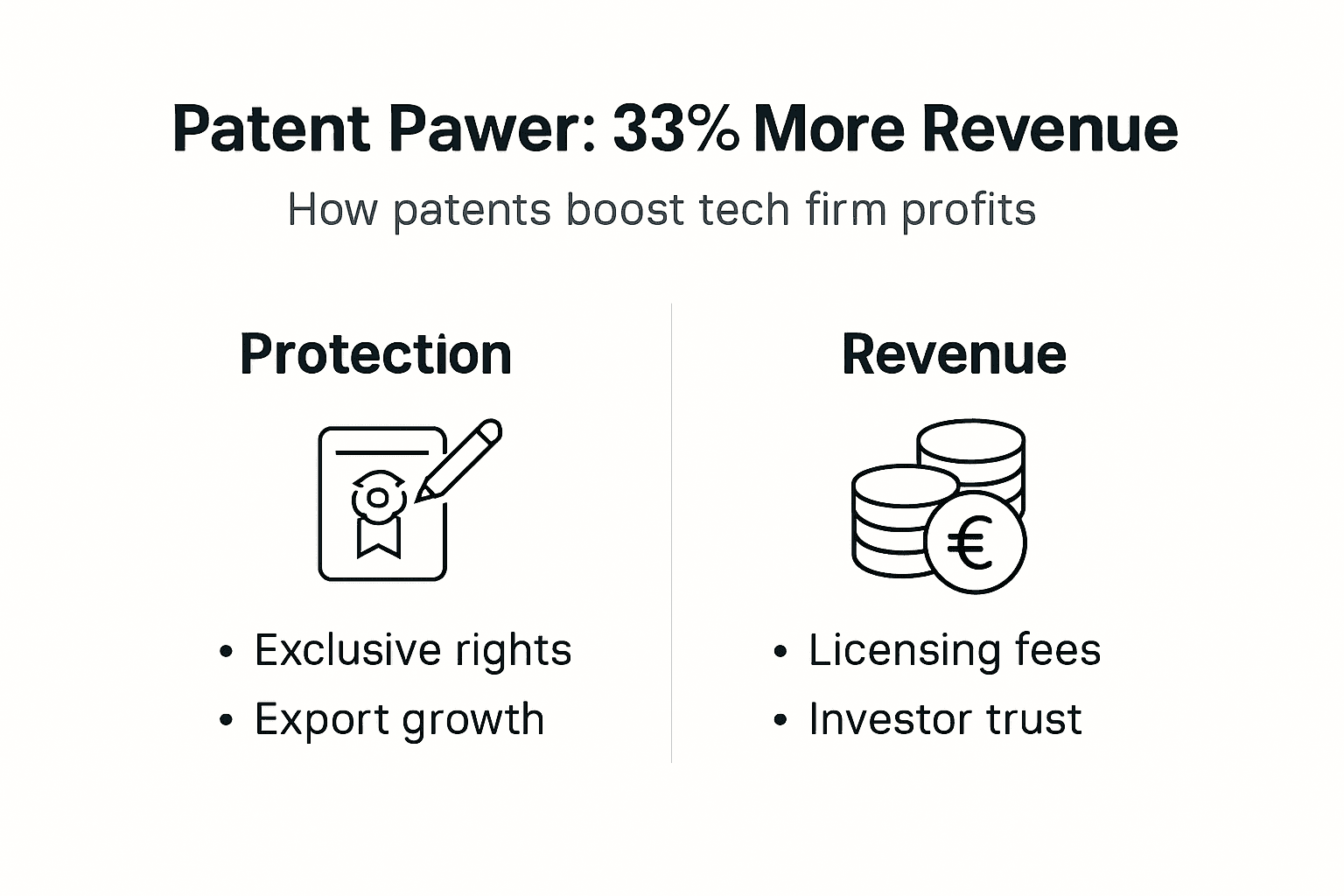
Patents protect business innovations by granting exclusive rights to inventions for up to 20 years, preventing competitors from copying groundbreaking technology. In rapidly evolving sectors like artificial intelligence, patent applications have surged 33% since 2018, proving that businesses recognize patents as essential tools for securing market position and revenue. This guide explains how patents boost competitive advantage, attract investors, and create licensing income streams for technology companies in Italy and internationally.
Table of Contents
Key takeaways
Point | Details |
Exclusive market control | Patents prevent competitors from copying technology innovations for up to two decades, creating barriers to entry. |
Investor attraction | Strong patent portfolios signal innovation leadership and increase venture capital interest by demonstrating protected assets. |
Revenue diversification | Licensing patented inventions generates ongoing royalty income without requiring production or market expansion. |
Italian competitive edge | Italy shows high patent efficiency per R&D investment, driving export specialization in medium-high tech sectors. |
Strategic timing matters | Filing before public disclosure is critical, as premature revelation can permanently void patent rights and protection. |
Introduction to patent protection for businesses
Patents are legal instruments granting inventors exclusive rights to make, use, sell, or import their inventions, typically for 20 years from filing date. This protection prevents unauthorized commercial exploitation by competitors and establishes a legal monopoly over the innovation. Patent protection lasts 20 years, after which inventions enter public domain and become freely available.
Geographic scope presents a critical consideration. Patents granted in Italy protect inventions only within Italian borders, requiring separate filings in other jurisdictions for international coverage. Businesses must develop comprehensive filing strategies across target markets to ensure global protection.
Three essential criteria determine patentability. First, the invention must be novel, meaning it differs from everything previously known or published. Second, it must involve an inventive step that would not be obvious to someone skilled in the field. Third, industrial applicability requires the invention to have practical use in manufacturing or other industries.
Technology innovations qualify for patent protection when they meet these standards. Software inventions, biotechnology developments, mechanical devices, and manufacturing processes all receive patent coverage if they satisfy novelty and non-obviousness requirements. Understanding patent protection basics helps businesses identify which innovations warrant filing.
Key eligibility factors include:
Novel solutions not disclosed in prior art or existing publications
Non-obvious improvements that skilled professionals would not naturally develop
Industrial applicability demonstrating practical commercial or manufacturing use
Sufficient technical disclosure enabling others to recreate the invention
Excludes abstract ideas, natural phenomena, and purely theoretical concepts
The business case for patenting inventions
Exclusive patent rights create formidable competitive barriers by legally blocking rivals from manufacturing, selling, or importing protected technologies. This monopoly position enables premium pricing strategies and higher profit margins, as competitors cannot offer identical alternatives. Businesses with protected innovations capture greater market share and customer loyalty.
Patent portfolios enhance business growth, attract investors, and create licensing revenue streams that increase overall commercial value. Venture capitalists and strategic partners view robust patent holdings as indicators of innovation leadership and reduced competitive risk. Companies with strong intellectual property assets command higher valuations during funding rounds and acquisition negotiations.
Licensing patented technologies generates ongoing royalty income without requiring manufacturing infrastructure or distribution networks. Businesses monetize innovations by granting usage rights to third parties while maintaining ownership and control. This revenue diversification supports sustainable research and development investment.
Integrating patents into business strategy drives growth across multiple dimensions. Protected innovations differentiate products in crowded markets, justify price premiums, and support brand positioning as technology leaders. The benefits of patent protection extend beyond legal rights to encompass strategic market advantages.
Core business advantages include:
Market exclusivity preventing competitor entry for two decades
Enhanced valuation through documented intellectual property assets
Licensing revenue creating passive income streams
Negotiating leverage in partnerships and joint ventures
Customer confidence in protected, non-replicable solutions
Pro Tip: Build your patent portfolio systematically by protecting core technologies first, then expanding to cover improvements and related innovations. Sequential filing creates defensive barriers while maximizing commercial options.
Patent protection for emerging and high-tech innovations
Artificial intelligence represents the fastest-growing patent category, with applications rising 33% since 2018 as businesses rush to protect machine learning algorithms, neural networks, and automated decision systems. This surge reflects recognition that AI innovations require legal safeguards against rapid imitation in fast-moving technology markets.
Biotechnology, clean energy, and advanced materials sectors similarly rely on patents for competitive positioning. Companies investing millions in research and development demand protection ensuring they can recoup costs and profit from breakthroughs. Patent filings help secure market position in rapidly changing industries where first-movers gain substantial advantages.

Emerging challenges complicate high-tech patenting. Software inventions face scrutiny over whether code constitutes abstract ideas or practical applications. Biotechnology patents must navigate ethical considerations and regulatory requirements. Artificial intelligence raises questions about inventorship when algorithms generate novel solutions autonomously.
Technology Sector | Patent Growth Rate | Key Protection Challenges |
Artificial Intelligence | 33% increase since 2018 | Distinguishing algorithms from abstract ideas |
Biotechnology | 18% annual growth | Ethical constraints and regulatory approval |
Clean Energy | 22% increase | Prior art from academic research |
Quantum Computing | 45% increase | Defining novelty in theoretical advances |
Strategic patent mapping optimizes portfolio value by identifying white spaces where competitors lack protection and avoiding infringement risks. Businesses analyze existing patents in their fields to spot gaps representing patenting opportunities and crowded areas requiring design-arounds. This intelligence informs research priorities and filing strategies.
Integrating intellectual property in innovation strategy ensures protection aligns with commercial goals. Companies coordinate R&D, legal, and business teams to identify high-value innovations early, file before public disclosure, and build portfolios supporting market expansion.
Pro Tip: In emerging technology fields, file provisional applications quickly to secure priority dates while continuing development. This approach protects against competitor filings while allowing refinement before committing to full patent costs.
Commercial benefits of patenting: licensing and strategic alliances
Patents provide the legal foundation for licensing inventions to third parties who pay royalties for usage rights. Businesses monetize innovations without manufacturing obligations by granting licenses to companies operating in different markets or possessing complementary capabilities. This arrangement multiplies revenue potential across geographic regions and industry sectors.
Cross-licensing allows companies to share access to complementary technologies, enabling both parties to offer enhanced products without infringement concerns. Technology firms frequently exchange patent rights to reduce litigation risks and accelerate product development. These arrangements work particularly well when companies operate in overlapping fields but target different customer segments.
Licensing generates royalty income supporting sustainable innovation by funding ongoing research and development. Businesses reinvest licensing fees into next-generation technologies, creating a virtuous cycle where protected innovations finance future breakthroughs. This revenue stream proves especially valuable for smaller companies lacking manufacturing scale.
Strategic alliances leverage combined patent portfolios for competitive advantage against larger rivals. Joint ventures and partnerships pool intellectual property assets, enabling participants to offer solutions neither could deliver independently. Patent licensing agreements structure these relationships by defining usage rights, royalty rates, and exclusivity terms.
Successful licensing models include:
Exclusive licenses granting single licensees sole rights in defined territories
Non-exclusive licenses allowing multiple parties to use inventions simultaneously
Cross-licensing exchanges where companies trade patent access mutually
Technology transfer agreements combining patents with know-how and training
Royalty structures based on sales percentages, unit counts, or upfront fees
Technology companies leverage patents to enter markets requiring substantial capital investment. Licensing to established manufacturers with distribution networks provides market access without building infrastructure. This strategy proves particularly effective for startups and research institutions commercializing innovations.
Impact of patents on Italian business competitiveness
Italy demonstrates high patent efficiency relative to research and development inputs, generating more patents per euro invested than many European counterparts. This efficiency reflects focused innovation in specialized sectors where Italian companies command technical leadership. Patent efficiency relative to R&D inputs in Italy shows evidence of patents driving export specialization in medium-high technology industries.
Patents drive export-oriented innovation by enabling Italian businesses to compete in global technology markets with protected offerings. Companies in machinery, automation, fashion technology, and food processing leverage patents to differentiate products and command premium pricing internationally. Protection against imitation proves essential when exporting to markets with aggressive reverse engineering.
Comparative analysis with Germany highlights Italian strength in niche fields such as luxury goods technology, food processing innovation, and design-intensive manufacturing. While Germany leads in automotive and chemical patents, Italy excels in sectors combining technical sophistication with artisanal tradition. Patent activity supports distinctive competitive positioning.
Country | Patents per Billion EUR R&D | Export Specialization Index | Primary Patent Sectors |
Italy | 142 patents | 1.34 in medium-high tech | Machinery, automation, food tech |
Germany | 156 patents | 1.52 in high tech | Automotive, chemicals, electronics |
France | 128 patents | 1.28 in aerospace | Aerospace, pharmaceuticals, telecom |
Patent activity correlates with long-term business sustainability by protecting innovations that generate recurring revenue. Italian companies with robust patent portfolios show greater resilience during economic downturns and higher growth rates during expansions. Intellectual property assets provide collateral for financing and signal creditworthiness to lenders.
Strategic patent use improves intellectual property evaluation procedures by establishing measurable innovation output. Businesses quantify intellectual property value through patent counts, citation frequency, and licensing revenue. These metrics support investment decisions and merger negotiations.
Patent impact on Italian businesses extends to employment growth, as protected innovations enable companies to expand production and hire skilled workers. Technology sectors with strong patent activity show higher wages and better working conditions, creating positive economic spillovers.
Common misconceptions about patents and their corrections
Many businesses believe patenting delays market entry by adding bureaucratic hurdles to product launches. Reality contradicts this assumption, as delays actually risk loss of rights when competitors file first. The first-to-file system rewards businesses acting quickly, making speed essential. Patent applications can proceed while products undergo development, protecting innovations before commercialization.
Another misconception suggests patents automatically ensure commercial success regardless of market strategy. Patents provide legal protection but do not guarantee customer demand or effective marketing. Businesses must combine intellectual property rights with sound business plans, distribution channels, and customer engagement. Protection enables success but does not replace commercial execution.
Some entrepreneurs assume all inventions qualify for patents when many fail eligibility requirements. Inventions must be novel, involve non-obvious improvements, and demonstrate industrial applicability. Abstract ideas, mathematical formulas, and natural phenomena cannot receive patents. Understanding criteria prevents wasted filing costs on ineligible innovations.
Public disclosure before filing represents a critical mistake that can void patent rights permanently. Presenting inventions at conferences, publishing research papers, or demonstrating prototypes publicly creates prior art defeating novelty requirements. Most jurisdictions offer no grace period, making confidentiality essential until applications are filed.
Failing to patent leads to higher risks of imitation and loss of intellectual property rights, negatively impacting business value. Competitors can freely copy unprotected innovations, eliminating competitive advantages. The patent registration checklist helps businesses avoid common filing errors.
Key misconceptions corrected:
Myth: Patents are only for large corporations. Fact: Small businesses and startups benefit equally from protection against better-resourced competitors.
Myth: Patent searches are optional formalities. Fact: Comprehensive searches prevent infringement liability and identify prior art blocking applications.
Myth: One patent provides global protection. Fact: Patents are territorial, requiring filings in each target jurisdiction.
Myth: Patent costs outweigh benefits for most businesses. Fact: Protection costs far less than losing market share to imitators.
Understanding patent misconceptions corrected enables smarter strategic decisions about when and how to protect innovations. Businesses balance filing costs against competitive risks and revenue potential.
Practical steps and strategic considerations for businesses
Assessing invention patentability begins with evaluating novelty by searching existing patents, scientific publications, and commercial products. Conduct comprehensive prior art searches using patent databases, technical journals, and industry publications. This research identifies whether similar inventions already exist and helps refine claims to emphasize unique aspects.
Determine non-obviousness by considering whether skilled professionals in your field would view the invention as a natural next step. Innovations combining known elements in unexpected ways or producing surprising results typically satisfy this requirement. Document the problem your invention solves and why existing solutions proved inadequate.
Industrial applicability requires demonstrating practical use in manufacturing, agriculture, or other industries. Purely theoretical concepts or aesthetic designs without functional utility fail this test. Describe specific applications and technical advantages your invention provides.
Document invention details including technical specifications, development timeline, and inventor contributions before filing.
Conduct patentability searches using databases like Google Patents, Espacenet, and USPTO records to identify prior art.
Evaluate commercial potential by analyzing market size, competitive landscape, and licensing opportunities.
File patent applications promptly to secure priority dates before competitors or public disclosure.
Develop patent portfolio strategy aligned with business expansion plans and product roadmaps.
Plan international filings using Patent Cooperation Treaty routes for cost-effective multi-jurisdiction protection.
Monitor competitor patents and industry developments to identify infringement risks and portfolio gaps.
File patent applications before any public disclosure, presentations, or sales activities. Most jurisdictions provide no grace period, making timing critical. Even confidential discussions with potential partners risk disclosure if non-disclosure agreements are inadequate. The international patent filing guide explains procedures for securing global protection.
Develop patent portfolios aligned with strategic business areas by protecting core technologies first, then covering improvements and adjacent innovations. Portfolio breadth creates defensive barriers while providing licensing flexibility. Focus resources on inventions supporting key revenue streams and competitive differentiation.
Plan international patent filings early using the Patent Cooperation Treaty, which allows filing a single application designating multiple countries. This approach delays country-specific costs while maintaining priority dates. The step-by-step patent protection guide simplifies the filing process.
Leverage patents for licensing by identifying companies that could benefit from your technology but operate in non-competing markets. Licensing generates revenue while expanding the innovation’s reach. International patent protection strategies help businesses navigate cross-border enforcement.
Pro Tip: Maintain detailed invention records including lab notebooks, design documents, and meeting notes with dates and signatures. This documentation proves invention dates and inventorship if disputes arise, strengthening your legal position.
Conclusion: enhancing business value with intelligent patent strategies
Patents are essential for securing competitive advantage and market exclusivity in technology-driven industries. Businesses that strategically protect innovations create barriers preventing competitors from offering identical solutions, enabling premium pricing and customer loyalty. Legal monopolies lasting 20 years provide time to recoup research investments and build market leadership.
A strategic patent portfolio unlocks commercial and licensing opportunities by creating assets that generate revenue beyond direct product sales. Royalty income from licensing, cross-licensing arrangements reducing costs, and enhanced company valuations during fundraising all stem from robust intellectual property holdings. Patents transform innovations into measurable business assets.
Early and professional intellectual property advice maximizes value and mitigates risks by ensuring proper filing procedures, comprehensive claim drafting, and strategic portfolio development. Amateur applications often fail to capture full invention scope or contain errors enabling competitors to design around protection. Expert guidance optimizes outcomes.
Patent protection supports sustainable innovation and export growth by enabling Italian businesses to compete globally with protected offerings. Companies investing in research and development require assurance they can profit from breakthroughs without immediate imitation. Integrate IP into innovation strategy for maximum competitive impact.
Businesses should embed patent strategy into overall growth plans from inception. Coordinate research and development priorities with intellectual property protection to ensure innovations receive timely filings. Regular portfolio reviews identify gaps requiring additional protection and opportunities for licensing or monetization.
Protect your innovation with expert patent services
Your breakthrough technology deserves comprehensive protection that secures competitive advantage in Italy and international markets. Studio Legale Coviello provides specialized patent consultancy combining legal expertise with deep understanding of technology innovation and business strategy.

Our proven intellectual property evaluation procedure identifies high-value innovations and develops filing strategies aligned with your business goals. We guide clients through patentability assessments, prior art searches, and application drafting that maximizes protection scope.
Benefit from tailored international patent protection strategies that secure your innovations across target markets efficiently. Our experience with Patent Cooperation Treaty filings, European patents, and country-specific procedures ensures cost-effective global coverage. Contact us today to transform your innovations into protected business assets that drive growth and competitive advantage.
Frequently asked questions
How long does patent protection last for business inventions?
Patent protection typically lasts 20 years from the filing date, providing two decades of exclusive rights to make, use, and sell the invention. After expiration, the invention enters public domain and anyone can use it freely. Maintenance fees are required periodically to keep patents in force.
Can I patent software and artificial intelligence innovations?
Yes, software and AI innovations qualify for patents when they produce technical effects beyond abstract algorithms. The invention must solve a specific technical problem using novel methods. Pure mathematical formulas or business methods without technical implementation typically fail patentability requirements.
What happens if I disclose my invention before filing a patent?
Public disclosure before filing usually destroys patent rights permanently in most countries. Even confidential discussions can create prior art if non-disclosure agreements are inadequate. Some jurisdictions offer limited grace periods, but immediate filing after invention is the safest approach.
How much does it cost to patent an invention internationally?
International patent costs vary widely based on number of countries, translation requirements, and attorney fees. A Patent Cooperation Treaty application costs approximately 3,000 to 5,000 EUR initially, with country-specific fees of 2,000 to 8,000 EUR per jurisdiction during national phase entry. Budget accordingly based on target markets.
Do patents automatically protect my invention in all countries?
No, patents are territorial and protect inventions only in jurisdictions where granted. You must file separate applications in each target country or use regional systems like the European Patent Convention. Strategic international filing plans balance protection costs against market potential.
How can patents help attract investors to my business?
Investors view patent portfolios as indicators of innovation leadership and competitive barriers protecting their investment. Patents demonstrate that your technology is novel, defensible, and difficult for competitors to replicate. Strong intellectual property assets increase company valuation and reduce investment risk.
Recommended

Comments