


Role of AI in Copyright Management: Legal Impact and Solutions

Managing copyright in the era of Artificial Intelligence presents a challenge that even the most seasoned European and American legal professionals cannot ignore. As courts stress human creativity as the foundation of copyright eligibility, innovative AI tools bring new complexity to defining authorship, tracking infringement, and safeguarding intellectual property assets. This article offers practical insights into AI-driven copyright detection, cutting-edge legal frameworks, and proven strategies for protecting creative works across digital platforms.
Table of Contents
Key Takeaways
Point | Details |
AI Challenges Authorship | AI blurs traditional definitions of authorship, necessitating clear legal frameworks to assess human creativity in copyright eligibility. |
Emerging Legal Frameworks | Different regions, such as the EU and the U.S., are developing unique approaches to handle AI-generated content and copyright ownership. |
Automated Detection Technologies | AI-powered tools are transforming copyright enforcement by enabling real-time monitoring and infringement detection across platforms. |
Proactive Compliance Strategies | Organizations must implement robust pre-screening and documentation tactics to adapt to the evolving standards in AI copyright compliance. |
Defining AI in Copyright Management Today
Artificial Intelligence (AI) is fundamentally reshaping copyright management, introducing unprecedented complexities in legal frameworks worldwide. At its core, AI challenges traditional notions of authorship and creativity by blurring the lines between technological tool and potential creative agent. Legal interpretations of AI-generated content continue to evolve, emphasizing human creativity as the primary determinant of copyright eligibility.
The contemporary landscape of AI in copyright management presents several critical dimensions:
Machine Learning Algorithms: Capable of generating original content
Training Data Sources: Often comprising copyrighted materials
Creative Input Evaluation: Assessing human versus machine contributions
Legal Recognition: Determining copyright ownership
Courts and legal institutions are increasingly wrestling with fundamental questions about AI’s role in content creation. The key challenge lies in distinguishing between AI as a sophisticated tool and AI as a potential author. Current legal standards predominantly maintain that copyright protection requires substantive human creative input, with technological assistance serving as a supplementary mechanism.
Emerging Legal Frameworks are developing nuanced approaches to categorize AI-generated works. These frameworks typically consider several critical factors:
Degree of human intervention
Original creative decisions
Technological process transparency
Intentionality of content generation
Pro tip: Document every stage of AI-assisted content creation, explicitly highlighting human creative contributions to strengthen potential copyright claims.
Automated Detection and Enforcement Tools
The landscape of copyright protection is rapidly transforming through advanced AI-powered detection technologies that offer unprecedented capabilities for identifying and preventing intellectual property infringements. Algorithmic enforcement mechanisms are increasingly sophisticated, enabling real-time monitoring and proactive copyright management across digital platforms.
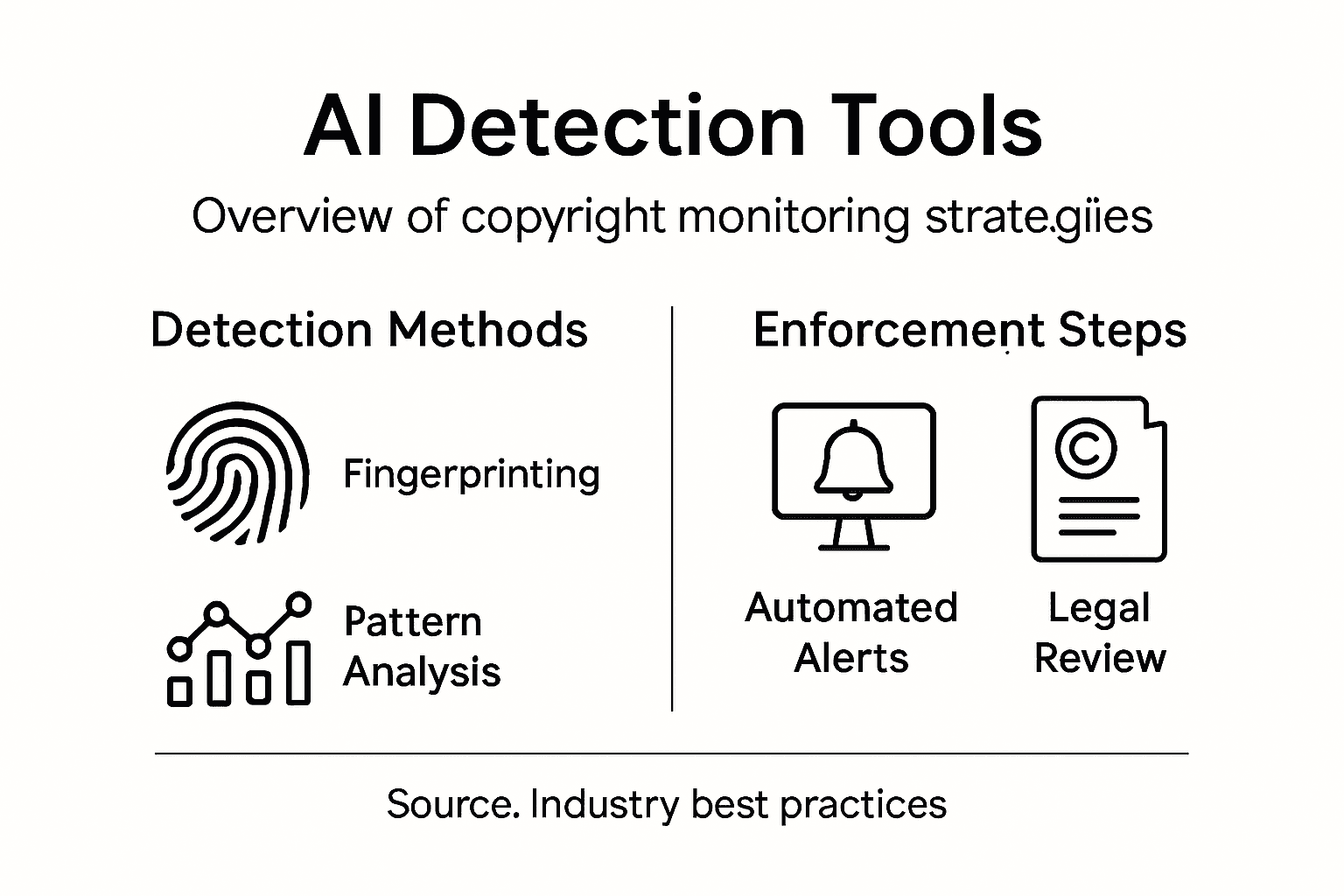
Key technological strategies for automated copyright detection include:
Content Fingerprinting: Creating unique digital signatures for original works
Machine Learning Algorithms: Analyzing complex patterns of potential infringement
Cross-Platform Scanning: Monitoring multiple digital environments simultaneously
Predictive Risk Assessment: Identifying potential copyright violations before publication
The European Union has been particularly progressive in implementing comprehensive upload filter technologies. These systems leverage artificial intelligence to detect and block potentially infringing content before it reaches public platforms, significantly reducing manual review processes and protecting intellectual property rights.
Advanced forensic tools are now emerging to address complex copyright challenges. Copyright Detective systems represent a new generation of AI-powered enforcement mechanisms that can:
Analyze large language model outputs
Detect potential copyright risks
Provide detailed infringement assessments
Support responsible AI content generation
Pro tip: Implement multi-layered AI detection strategies and regularly update your copyright monitoring technologies to stay ahead of evolving digital infringement techniques.
Legal Framework Shaping AI Copyright Use
Artificial Intelligence is fundamentally challenging existing legal frameworks for intellectual property protection across global jurisdictions. Comparative legal analysis reveals significant variations in how different regions approach AI-generated content, creating a complex landscape of copyright regulation that demands sophisticated legal interpretation.
Key differences in regional AI copyright approaches include:
European Union: Developing sui generis rights for AI-generated works
United States: Applying broad fair use principles
China: Emerging adaptive legal frameworks
Global Trend: Seeking balanced innovation and creator protection
The European Parliament has been particularly proactive in addressing these technological challenges. Generative AI legal studies774095_EN.pdf) highlight critical gaps in current copyright law, emphasizing the need for comprehensive regulatory mechanisms that can effectively govern AI-generated intellectual property.

Here’s a quick comparison of global legal approaches to AI copyright regulation:
Region | Approach Taken | Notable Features | Regulatory Challenge |
European Union | Sui generis rights emerging | Pre-publication upload filters | Defining AI authorship |
United States | Broad fair use applications | Dynamic case law development | Ownership of AI creations |
China | Adaptive frameworks evolving | State-driven regulation | Licensing complexity |
Global Trend | Balance innovation, protection | Cross-jurisdiction compliance | Harmonizing legal standards |
Critical legal considerations for AI copyright frameworks involve:
Defining authorship in AI-generated content
Establishing ownership rights
Creating transparent licensing mechanisms
Protecting original creators’ interests
Pro tip: Develop flexible legal strategies that can adapt to rapidly evolving AI technologies while maintaining clear principles of intellectual property protection.
AI-Driven Risk Assessment and Compliance Issues
The emergence of artificial intelligence has created unprecedented challenges in copyright risk management, fundamentally disrupting traditional legal compliance frameworks. Legal and economic implications reveal complex regulatory landscapes that demand sophisticated approaches to intellectual property protection.
Key risk assessment dimensions for AI copyright compliance include:
Training Data Verification: Ensuring legal source materials
Derivative Work Analysis: Identifying potential copyright infringements
Licensing Complexity: Navigating multi-jurisdictional legal requirements
Algorithmic Transparency: Documenting AI content generation processes
Generative AI systems present particularly nuanced challenges in copyright risk management. Copyright challenges in generative systems highlight the critical need for comprehensive regulatory frameworks that balance innovation with intellectual property protection.
Critical compliance strategies for organizations involve:
Implementing robust pre-screening mechanisms
Developing clear AI usage policies
Creating documentation trails for AI-generated content
Establishing ongoing legal risk monitoring systems
Pro tip: Develop a proactive legal compliance framework that treats AI-generated content as a dynamic intellectual property ecosystem requiring continuous assessment and adaptation.
For reference, here’s a summary of practical AI copyright risk management strategies organizations are adopting:
Strategy | Purpose | Common Implementation |
Robust pre-screening mechanisms | Prevent legal disputes | Automated content analysis tools |
Clear AI usage policies | Clarify permissible practices | Internal policy training |
Documentation trails for AI outputs | Provide regulatory transparency | Dedicated tracking software |
Ongoing legal risk monitoring | Identify and address new copyright risks | Continuous system audits |
Practical Use Cases for Rights Holders
Artificial Intelligence is revolutionizing how creators and rights holders protect and monetize their intellectual property across digital landscapes. Practical implications for creators reveal sophisticated strategies for maintaining control in an increasingly complex technological environment.
Key use cases for rights holders include:
Automated Licensing Tracking: Monitoring and enforcing digital rights
AI-Powered Infringement Detection: Identifying unauthorized content usage
Dynamic Revenue Stream Management: Creating new monetization pathways
Transparent Rights Management: Documenting content provenance and usage
The European intellectual property landscape is particularly dynamic, with emerging regulatory frameworks providing robust mechanisms for rights protection. Generative AI copyright solutions offer rights holders multiple strategies for maintaining control over their creative assets.
Practical implementation strategies involve:
Developing comprehensive opt-out mechanisms
Creating granular licensing agreements
Implementing advanced digital rights management technologies
Establishing clear transparency protocols for AI interactions
Pro tip: Continuously update your AI rights management strategy, treating intellectual property as a dynamic ecosystem that requires proactive, technology-enabled protection.
Unlock the Full Potential of AI in Copyright Management with Expert Legal Solutions
Navigating the complex legal challenges posed by AI-generated content requires more than just awareness. The article highlights critical issues like defining authorship, managing copyright risks, and enforcing protection through cutting-edge AI-powered tools. If you are struggling to safeguard your intellectual property in an era where AI rapidly reshapes creativity and rights, professional guidance is essential. Understanding nuances such as training data verification and licensing complexities can feel overwhelming but are vital to maintaining control over your creative assets.

Take action today to protect your intellectual property with tailored legal strategies that integrate AI innovations. At Studio Legale Coviello, we specialize in intellectual property law and leverage advanced technology to enhance enforcement and compliance. Discover how our expert team supports rights holders by implementing automated infringement detection, secure licensing frameworks, and transparent rights management. Visit our landing page and start securing your creative future with trusted legal expertise that keeps pace with the evolving AI landscape.
Frequently Asked Questions
What is the impact of AI on copyright management?
Artificial Intelligence is changing copyright management by introducing complexities in legal frameworks, challenging traditional notions of authorship and creativity, and necessitating new approaches to copyright ownership and protection.
How does AI help in detecting copyright infringement?
AI uses advanced detection technologies, such as content fingerprinting and machine learning algorithms, to identify and prevent intellectual property infringements in real-time across various digital platforms.
What are the key legal challenges posed by AI-generated content?
The primary legal challenges include defining authorship for AI-generated works, establishing ownership rights, ensuring transparency in the licensing process, and balancing innovation with the interests of original creators.
What strategies can organizations implement to manage copyright risks associated with AI?
Organizations can adopt strategies such as robust pre-screening mechanisms, clear AI usage policies, documentation trails for AI-generated content, and continuous legal risk monitoring to effectively manage copyright risks.
Recommended

Comments