


What is trademark protection: 2026 guide for businesses
Updated: 6 days ago

Many entrepreneurs wrongly believe slapping a logo on their products equals legal brand protection. Reality check: using a mark doesn’t guarantee exclusive rights or legal safeguards. Trademark registration transforms your brand identity into a defensible legal asset with enforceable protections. This guide clarifies what trademark protection actually means, how it works globally, and practical steps to safeguard your business identity in 2026.
Table of Contents
Key takeaways
| Point | Details | |-------|---------|| | Trademark definition | Distinctive signs identifying goods or services, granting exclusive legal rights to prevent consumer confusion. | | Registration benefits | 10-year renewable protection with stronger enforcement capabilities compared to unregistered marks. | | Global frameworks | Madrid Protocol enables single-application protection across 120+ countries, streamlining international filings. | | Common misconceptions | Registration alone doesn’t guarantee protection without active monitoring and enforcement efforts. | | Strategic management | Combine registration, monitoring, enforcement, and timely renewal for sustained brand exclusivity. |
Introduction to trademark protection
A trademark is a distinctive sign that identifies goods or services from a particular source, differentiating your business from competitors in the marketplace. Think words, logos, slogans, colors, sounds, or even specific product shapes. The primary purpose centers on protecting brand identity while preventing consumer confusion about product origins.
Trademark protection grants exclusive rights to use distinctive signs under national laws and international treaties. This legal exclusivity stops others from using confusingly similar marks that could mislead customers or dilute your brand reputation. Without these protections, competitors could legally copy your brand elements and capture your hard-earned market position.
Trademarks work differently from patents or copyrights. While patents protect inventions and copyrights safeguard creative works, trademarks specifically defend brand identifiers that signal quality and origin to consumers. Coca-Cola’s script logo, Nike’s swoosh, and McDonald’s golden arches exemplify powerful trademarks that drive instant brand recognition.
Key trademark categories include:
Word marks: brand names, slogans, taglines
Design marks: logos, graphical elements, stylized text
Composite marks: combined words and design elements
Three-dimensional marks: product shapes, packaging designs
Non-traditional marks: sounds, colors, motions
Business recognition hinges on strong trademark protection. When customers see your mark, they associate specific quality expectations and brand values. This recognition builds trust, loyalty, and ultimately drives revenue growth through repeat purchases and referrals.
How trademark protection works
Legal rights typically arise from formal registration with governmental authorities, though some jurisdictions recognize limited common law rights through commercial use. Registered trademarks grant owners exclusive authority to use specific marks for designated goods or services, enabling legal action against parties using confusingly similar identifiers.

Trademark protection generally lasts 10 years from registration date, renewable indefinitely as long as you maintain proper use in commerce and file renewal applications. This differs sharply from patents with fixed terms or copyrights that eventually enter public domain. Your trademark can literally last forever with proper maintenance.
Unregistered trademarks receive variable protection depending on jurisdiction and proof of established use. Some countries recognize common law trademark rights after demonstrating substantial market presence and consumer recognition. However, these protections remain weaker and harder to enforce compared to registered marks. You’ll face steeper evidence burdens proving prior use and market confusion.
Trademark rights don’t prevent others from manufacturing similar products, only from using confusingly similar marks in commerce. This critical distinction confuses many business owners. If you trademark “BlueSky” for software services, competitors can still create software, they just can’t market it under names likely to confuse customers about the source.
Enforcement responsibilities fall on trademark owners. Registration doesn’t create automatic governmental policing of infringement. You must actively monitor marketplaces, identify unauthorized uses, and pursue legal remedies through cease-and-desist letters, opposition proceedings, or infringement lawsuits. Passive ownership without enforcement can weaken your rights or lead to abandonment claims.
Pro Tip: Document every instance of trademark use with dated evidence like product photos, marketing materials, and sales records. This proof becomes crucial during enforcement actions or renewal applications, especially when demonstrating continuous commercial use.
For comprehensive guidance on navigating the application process, consult our detailed trademark registration guide covering step-by-step filing procedures.
Global trademark protection frameworks
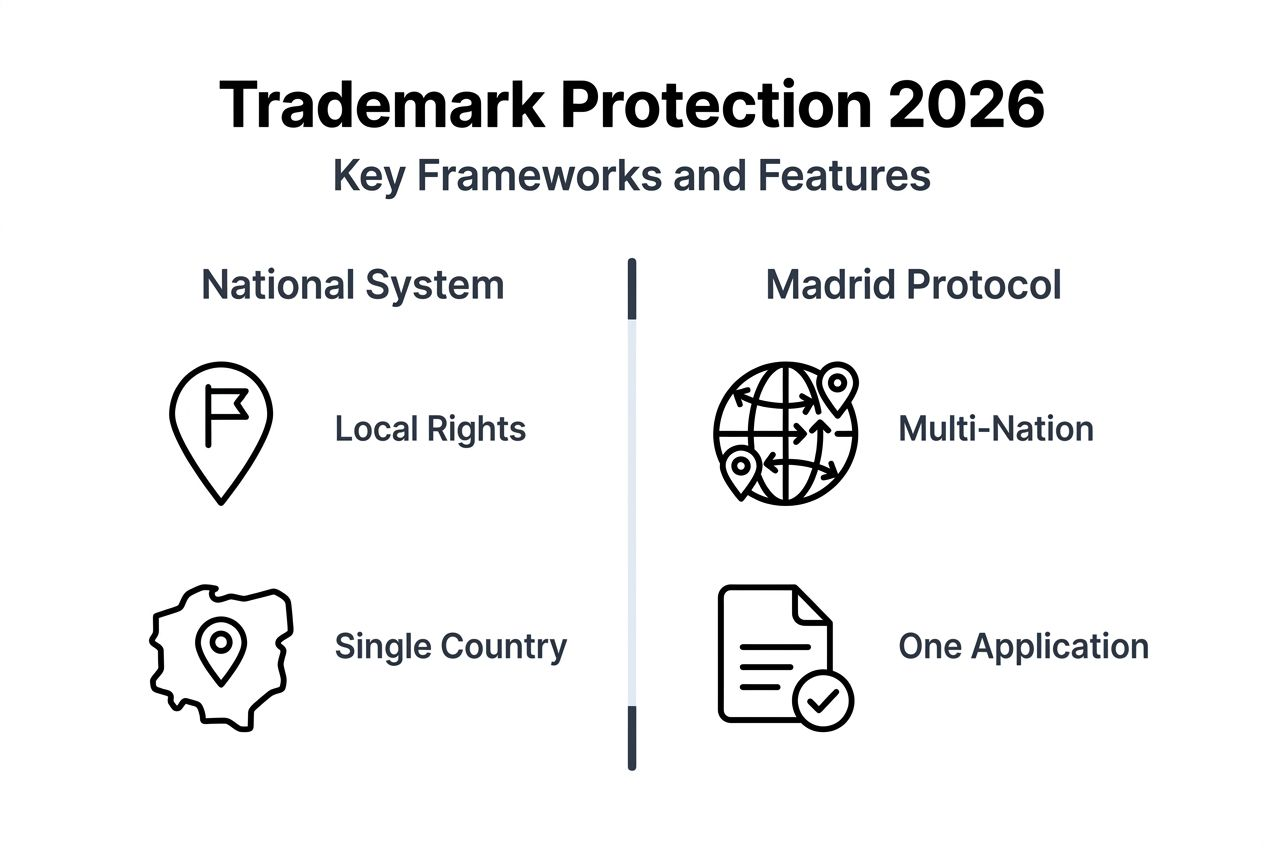
The Madrid Protocol streamlines international registration by allowing trademark owners to file one application designating protection across 120+ member countries. This system dramatically reduces costs, paperwork, and administrative complexity compared to filing separate national applications in each target jurisdiction. You manage everything through a single application in your home country’s language.
Trademark laws and enforcement mechanisms vary significantly by country. Some jurisdictions operate on first-to-file principles where registration rights trump prior use, while others recognize common law rights from commercial activity. Legal remedies, damages calculations, and infringement standards differ across borders, requiring localized legal expertise for effective enforcement.
Businesses face several challenges when expanding trademark protection globally:
Translation complexities: marks may carry unintended meanings in foreign languages
Prior conflicting registrations: existing marks in target markets block your application
Examination standards: countries apply different distinctiveness and descriptiveness criteria
Costs and timelines: international filings require significant financial investment and patience
Enforcement difficulties: pursuing infringers across jurisdictions demands substantial resources
Feature | National Registration | Madrid System |
Geographic coverage | Single country only | 120+ countries via one application |
Application complexity | Moderate, country-specific forms | Simplified, unified application process |
Cost efficiency | Higher cumulative costs for multiple countries | Lower overall costs for multi-country protection |
Management centralization | Separate renewals per country | Centralized renewal and management |
Initial filing requirements | Direct with national office | Through home country office first |
Strategic jurisdiction choices matter enormously. Focus trademark protection on markets where you currently operate, plan expansion, or face significant counterfeiting risks. Consider manufacturing hubs where infringers produce knockoffs and major consumer markets driving revenue. Don’t waste resources filing in countries with minimal business relevance.
Our international trademark protection guide provides detailed strategies for global brand protection. Learn specific tactics for protecting trademarks abroad across different legal systems and cultural contexts.
Common misconceptions about trademark protection
Many business owners mistakenly believe trademark registration covers patents and product designs. Wrong. Trademarks protect brand identifiers, patents protect inventions and technical innovations, while design patents or registrations protect ornamental product appearances. These represent separate intellectual property categories requiring distinct applications and legal strategies.
Another dangerous assumption: unregistered trademarks confer strong legal rights everywhere. Reality varies dramatically by jurisdiction. While some countries recognize common law trademark rights after proving substantial market presence, enforcement remains difficult and expensive. You’ll bear heavy evidence burdens proving prior use, market reputation, and likelihood of confusion without registration certificates.
Some entrepreneurs expect registration guarantees absolute protection without active enforcement. Registration creates legal presumptions and remedies, but doesn’t automatically stop infringers. You must monitor marketplaces, identify unauthorized uses, and pursue legal action. Courts won’t protect marks you’ve abandoned through non-use or failure to enforce against known infringers.
Trademark scope frequently gets confused with broader intellectual property rights. Your trademark on “TechFlow” for software doesn’t prevent competitors from using that term in unrelated industries like plumbing services. Protection extends only to goods/services specified in your registration and closely related categories where confusion might arise.
Pro Tip: Budget for ongoing trademark protection costs beyond initial registration fees. Effective brand protection requires monitoring services, periodic renewals, and potential enforcement actions. These recurring investments protect the brand equity you’ve built through marketing and customer relationships.
Successful trademark management demands strategic thinking beyond paperwork submission. Consider how your mark fits within competitive landscapes, potential expansion categories, and long-term brand evolution. Strong protection combines legal registration with business strategy and active market monitoring.
The practical steps to register and manage a trademark
Building a trademark protection strategy requires systematic execution across registration, monitoring, enforcement, and renewal phases. Follow these concrete steps to establish defensible brand protection:
Conduct comprehensive trademark searches before filing to identify potential conflicts with existing registrations or common law rights. Use governmental databases, commercial search services, and internet searches covering domain names, social media handles, and business registries. Missing conflicts wastes filing fees and delays market entry.
File applications with appropriate national or international authorities specifying your mark, goods/services categories, and claiming proper filing bases. Work with experienced trademark attorneys to navigate complex classification systems, draft strong descriptions, and respond to examiner objections. Small errors trigger costly office actions or outright rejections.
Monitor marketplaces and unauthorized use regularly through watch services, internet surveillance, and marketplace audits. Early detection of infringement enables faster, cheaper resolution before infringers establish market presence or claim prior use defenses. Set up Google Alerts and monitor e-commerce platforms where counterfeits appear.
Enforce rights via legal means against infringements through cease-and-desist letters, administrative opposition proceedings, or federal lawsuits seeking injunctions and damages. Document infringement thoroughly with screenshots, purchase evidence, and consumer confusion proof. Swift action prevents brand dilution and market confusion.
Renew registrations timely to maintain protection, typically every 10 years with some jurisdictions requiring interim maintenance filings. Calendar critical deadlines and budget renewal fees years in advance. Missing renewal deadlines can forfeit trademark rights permanently, requiring expensive re-filing processes.
AI and online tools dramatically improve trademark search and monitoring efficiency. Advanced algorithms identify phonetic similarities, visual resemblances, and translation equivalents that manual searches miss. These technologies reduce search costs while improving accuracy, letting you focus resources on strategic decisions rather than administrative tasks.
Our detailed trademark registration guide walks through filing procedures step by step. Explore specialized trademark search tools for comprehensive conflict checking before investing in applications.
Pro Tip: Create a trademark management calendar tracking filing dates, renewal deadlines, and monitoring review schedules. Centralized deadline tracking prevents costly missed renewals and ensures consistent enforcement efforts. Many businesses lose trademark rights simply through administrative oversights.
Why trademark protection matters for business success
Trademark protection directly impacts brand equity and consumer recognition, transforming legal rights into measurable business value. Strong trademarks become company assets worth millions, driving premium pricing power and customer loyalty impossible for generic competitors to replicate.
Active enforcement reduces infringement while protecting revenue streams from counterfeiters and brand diluters. Every unauthorized use potentially confuses customers, degrades brand perception, and diverts sales to competitors. Vigorous enforcement signals market strength, deterring future infringers and maintaining brand exclusivity.
Registered marks provide competitive advantages through:
Legal presumptions of ownership and validity in court proceedings
Nationwide protection from federal registration versus limited geographic common law rights
Customs recordation enabling border seizure of counterfeit imports
Licensing and franchising opportunities generating additional revenue
Enhanced company valuations during acquisitions or investment rounds
Effective trademark strategies accelerate business growth by building recognizable brand identities that attract customers and command premium prices. Companies with strong trademark portfolios typically achieve faster market penetration, higher customer retention rates, and superior profit margins compared to competitors with weak brand protection.
“Trademark protection isn’t just legal compliance, it’s a growth strategy. Companies with actively managed trademark portfolios report 23% higher revenue growth and 31% stronger brand equity compared to businesses treating trademarks as mere registration formalities.”
Brand value compounds over time through consistent trademark use and protection. Think about iconic brands like Apple, Amazon, or Google. Their trademarks represent billions in intangible asset value built through decades of protection, enforcement, and strategic brand management. Your trademark protection investments today create lasting competitive moats protecting future business success.
Explore expert trademark legal services at Studio Legale Coviello
Protecting your brand requires specialized legal expertise navigating complex national and international trademark systems. Studio Legale Coviello delivers comprehensive trademark legal services combining traditional legal excellence with cutting-edge AI technology for efficient brand protection across global markets.

Our team assists with registration strategies, conflict searches, opposition proceedings, and infringement enforcement across 120+ countries. We handle everything from initial branding and trademark naming consultation through renewal management and portfolio optimization. Whether you need single-country protection or global trademark strategies, we develop customized solutions matching your business objectives and budget constraints. Contact Studio Legale Coviello today to safeguard your brand identity with proven international trademark protection strategies designed for 2026’s complex legal landscape.
Frequently asked questions
What types of marks can be trademarked?
Words, logos, slogans, colors, sounds, product shapes, and even scents qualify as trademarks if they distinctively identify goods or services. The mark must be non-generic and non-descriptive, meaning it can’t simply describe the product’s features or common category. Arbitrary or fanciful marks like Apple for computers receive strongest protection.
How long does trademark protection last?
Registered trademarks typically last 10 years from registration date with unlimited renewal potential as long as you maintain commercial use and file timely renewals. Unlike patents with fixed terms, trademarks can protect your brand indefinitely. Some jurisdictions require proof of continued use at renewal, so document your trademark’s ongoing commercial activity.
Do I need to register my trademark internationally?
International registration makes sense if you operate, plan expansion, or face counterfeiting risks in foreign markets. The Madrid Protocol simplifies multi-country protection through one application. However, if your business remains purely domestic, national registration may suffice initially. Evaluate international filing based on your actual business footprint and growth strategy.
What happens if someone infringes my trademark?
You can pursue enforcement through cease-and-desist letters demanding they stop using your mark, administrative opposition proceedings, or federal lawsuits seeking injunctions preventing further use plus monetary damages for lost profits and legal fees. Document infringement thoroughly with evidence of use, consumer confusion, and damages. Swift action prevents infringers from establishing market presence or prior use defenses.
Can trademarks protect product designs?
No, trademarks protect brand identifiers like names and logos, not product designs themselves. Ornamental product appearances require design patents or design registrations providing separate protection. However, if a product shape becomes distinctive enough to identify source like Coca-Cola’s bottle shape, it may qualify for trademark protection as trade dress after proving acquired distinctiveness.
Recommended

Comments