


International copyright protection guide for businesses

Misunderstanding international copyright protection puts your creative assets at serious risk in global markets. Many business owners assume copyright protections automatically apply worldwide, but this misconception can lead to costly infringement and lost opportunities. This guide provides clear, actionable steps to secure your intellectual property internationally, leveraging treaties, registration strategies, and enforcement mechanisms that protect your business innovations across borders.
Table of Contents
Key takeaways
Point | Details |
Treaties provide baseline protection | International copyright treaties set minimum protections but don’t eliminate registration needs in key markets. |
Registration strengthens enforcement | Formal registration in strategic jurisdictions provides stronger legal remedies and damages recovery options. |
Enforcement requires tailored strategies | Effective protection demands diverse legal approaches customized to specific jurisdictions and digital platforms. |
AI content faces eligibility challenges | Pure AI-generated works typically lack copyright protection because human authorship remains a legal requirement. |
Monitoring prevents rights loss | Active surveillance and prompt enforcement action protect against common pitfalls and preserve legal standing. |
Introduction to international copyright protection
Copyright protects original creative works like software, marketing content, product designs, and written materials that drive business value. Without proper protection, competitors can copy your innovations freely, eroding market position and revenue. Enforcing copyright across borders becomes complicated because each country maintains its own legal system and enforcement procedures. Major treaties like the Berne Convention create a foundational international framework, but business owners must understand how these treaties interact with national laws to build comprehensive protection strategies.
Key elements of international copyright include:
Original works of authorship automatically receive protection in most countries
Protection duration typically extends for the author’s life plus 50 to 70 years
Exclusive rights cover reproduction, distribution, public performance, and derivative works
Treaties establish minimum standards but national laws may provide additional protections
Navigating this landscape requires managing international IP rights strategically and understanding how international patent strategies complement copyright protections. The complexity of international copyright enforcement demands careful planning and expert guidance.
Prerequisites: what you need before starting
Before pursuing international copyright protection, establish clear ownership and documentation of your creative works. Gather evidence showing creation dates, authorship, and the original expression embodied in your materials. This foundation becomes critical when disputes arise or enforcement actions become necessary.
Essential prerequisites include:
Confirmed authorship and ownership documentation for all creative works
Understanding of your home country’s copyright registration procedures and timelines
Familiarity with key international treaties relevant to your target markets
Access to qualified legal counsel experienced in international IP matters
Monitoring tools and processes to detect unauthorized use across jurisdictions
Your preparation should mirror approaches used in international trademark protection, where systematic documentation and strategic planning prevent costly mistakes. Learning from common errors in avoiding IP management mistakes helps streamline your protection efforts.
Pro Tip: Maintain detailed creation logs with timestamps, drafts, and communications showing your creative process. These records become invaluable evidence in infringement disputes and ownership challenges.
Understanding international copyright law
The Berne Convention ensures automatic copyright protection across all member countries without requiring separate registration in each jurisdiction. This treaty establishes minimum protection standards that member states must provide to foreign creators. Currently, over 180 countries participate in the Berne Convention, making it the cornerstone of international copyright protection.

The TRIPS Agreement requires member states to implement minimum copyright standards and provides enforcement and dispute resolution mechanisms under the World Trade Organization framework. TRIPS strengthens Berne protections by adding enforcement requirements and trade-related intellectual property standards. The WIPO Copyright Treaty specifically addresses protections for digital works and technological protection measures in the internet age.
Treaty | Key Protection | Enforcement Mechanism |
Berne Convention | Automatic minimum copyright protection | National court systems |
TRIPS Agreement | WTO-enforced copyright standards | WTO dispute resolution |
WIPO Copyright Treaty | Digital rights and anti-circumvention | National implementation |
National laws implement and often expand on treaty obligations, creating variation in protection levels, registration requirements, and enforcement options. Understanding these differences helps you prioritize registration in jurisdictions critical to your business. Avoiding international IP errors requires recognizing how international treaty protections work alongside national requirements. The U.S. copyright international guidance provides detailed examples of how treaty obligations translate into domestic law.
Formal registration and its importance
Registration is not mandatory under Berne protections but proves highly advantageous for enforcing rights and recovering damages. Countries like Italy, the United States, and many others provide clear legal advantages to registered copyright holders. In the U.S., registration before infringement or within three months of publication allows statutory damages and attorney fees, making enforcement economically viable.
Registration benefits include:
Public record of your copyright claim establishing ownership
Legal presumption of validity in infringement litigation
Enhanced remedies including statutory damages and attorney fees
Eligibility to pursue customs enforcement against imports
Stronger negotiating position in licensing and disputes
Registration timelines vary by jurisdiction but typically process within weeks to a few months. Costs remain modest compared to litigation expenses and potential losses from unprotected works. Maintaining organized registration records across jurisdictions simplifies enforcement and proves ownership when disputes arise.
Pro Tip: Register copyrights before publishing or distributing works internationally to maximize legal protections and remedies. Early registration costs far less than attempting to prove ownership and damages after infringement occurs.
Apply the same strategic thinking used in international trademark registration to prioritize copyright registration in your most valuable markets.
Step-by-step process for international copyright registration
Begin by documenting your original work thoroughly with creation dates, author information, and evidence of the creative process. Secure this documentation in multiple formats and storage locations to ensure availability during enforcement actions.
Follow this systematic approach:
Create comprehensive documentation proving authorship, originality, and creation timeline
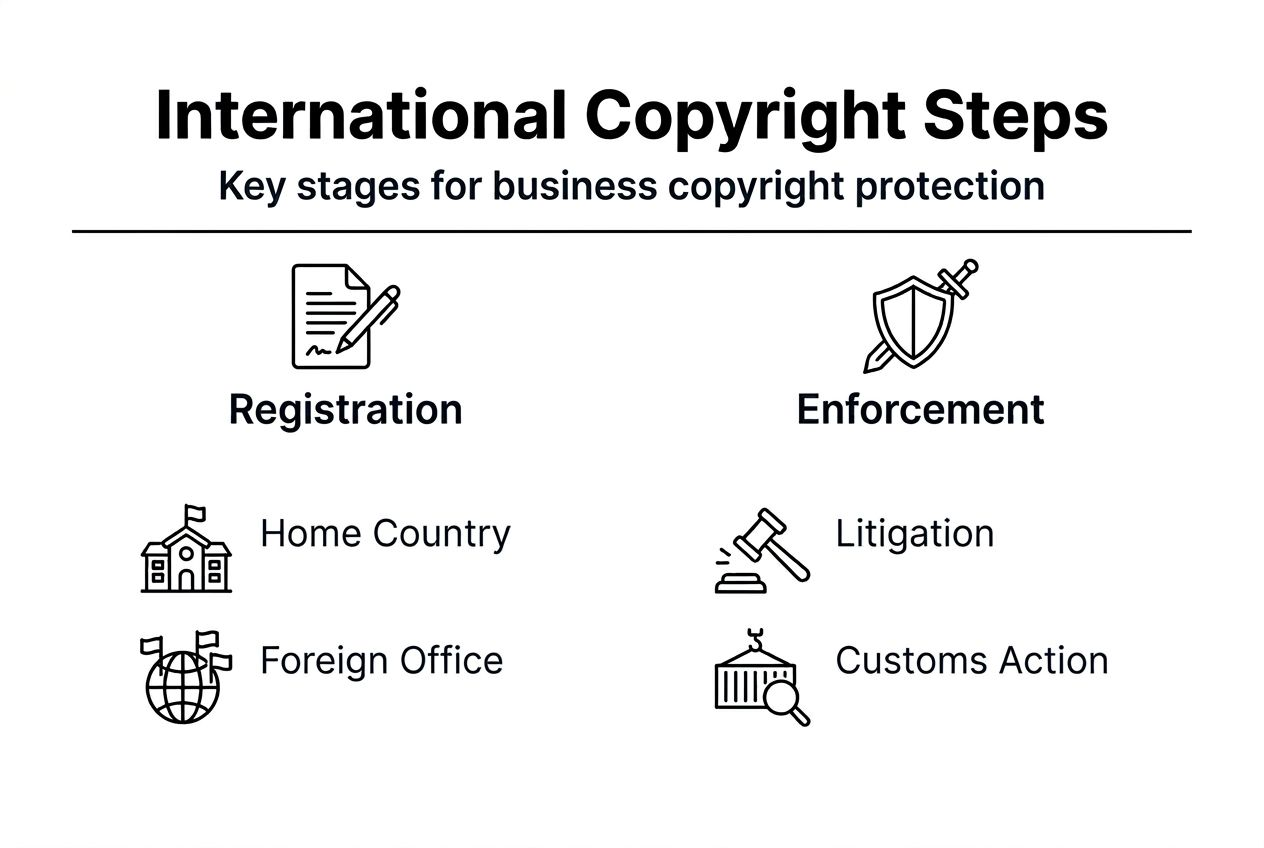
File registration in your home country where formal systems exist
Rely on Berne Convention automatic protections for initial coverage in member countries
Identify key foreign markets where formal registration provides strategic advantages
File registrations in priority jurisdictions using local counsel or international services
Maintain detailed records of registration dates, certificates, and renewal requirements
Implement monitoring systems to detect unauthorized use across jurisdictions
Update registrations and documentation as works are modified or expanded
Registration Stage | Timeline | Key Documentation |
Home country filing | 2-8 weeks | Application, deposit copies, proof of authorship |
Foreign market registration | 1-6 months | Translated materials, local agent details, fee payment |
Monitoring setup | Ongoing | Search parameters, alert systems, enforcement contacts |
Utilize digital registration platforms and copyright offices’ online systems for efficiency and faster processing. Many jurisdictions now offer expedited processing for additional fees when urgent protection is needed. The systematic approach mirrors step-by-step trademark protection strategies that ensure comprehensive coverage.
Enforcement mechanisms across jurisdictions
Enforcement mechanisms vary by country but often include cease and desist letters, civil litigation, customs seizures, and digital takedown procedures. Each approach serves different purposes and suits particular types of infringement.
Cease and desist letters provide the fastest, lowest-cost first response to unauthorized use. These formal notices demand infringement cessation and often resolve disputes without litigation. When violations continue, civil litigation in the infringer’s jurisdiction becomes necessary to obtain court orders and damages.
Available enforcement tools:
Cease and desist letters for immediate infringement notification
Civil lawsuits to obtain injunctions and monetary damages
Customs recordation to block infringing imports at borders
Digital Millennium Copyright Act takedown notices for online content
Criminal prosecution in jurisdictions where copyright theft constitutes a crime
Alternative dispute resolution including mediation and arbitration
Customs and border controls can seize infringing physical goods before they enter markets, preventing distribution and sale. Digital takedown requests through platform notification systems address online infringement effectively on websites, social media, and e-commerce platforms. Combining multiple enforcement methods simultaneously maximizes chances of successful protection.
Implement online copyright defense strategies alongside traditional enforcement to protect works across physical and digital channels. Understanding copyright enforcement methods helps you select appropriate responses for each violation.
Special considerations for digital and AI-generated content
Human authorship must be significant for copyright eligibility because purely AI-generated works lack protection in most jurisdictions. Current legal frameworks require human creative input, judgment, and expression as essential elements of copyrightable works. As artificial intelligence tools become common in content creation, distinguishing human contributions from machine outputs determines protection eligibility.
Critical factors for AI-assisted works:
Human creative decisions, selections, and arrangements establish copyrightability
Pure AI outputs without human creative input typically receive no protection
Documentation of human involvement becomes essential for ownership claims
Legal standards continue evolving as courts address new AI capabilities
International variations create uncertainty in cross-border AI content protection
Maintaining detailed records showing how humans directed, selected, edited, and refined AI-generated materials strengthens copyright claims. These records should demonstrate creative choices and original expression contributed by human authors. Consulting specialized legal counsel experienced in AI copyright risks and opportunities improves handling of these emerging issues.
The intersection of AI technology and copyright law continues developing rapidly, requiring businesses to stay informed about global IP protection strategies that adapt to technological change. Understanding AI copyright legal trends helps you structure creative processes to maintain protection.
Common pitfalls and troubleshooting
Common mistakes include assuming copyright protection is automatic and indefinite worldwide, neglecting registration, and delays in enforcement. These errors can result in lost rights, weakened legal positions, and inability to recover damages from infringement.
Never assume Berne Convention protections eliminate the need for strategic registration in key markets. While automatic protections exist, registration substantially strengthens enforcement capabilities and available remedies. Delaying enforcement and monitoring often leads to loss of rights and evidence as infringement becomes widespread.
Frequent errors to avoid:
Assuming automatic worldwide protection eliminates registration benefits
Failing to register before publication or first commercial use
Neglecting to monitor for unauthorized use across jurisdictions
Delaying enforcement actions allowing infringement to spread
Ignoring jurisdictional differences in protection standards and procedures
Overlooking digital content and AI-generated work special requirements
Implement systematic monitoring using automated tools, manual searches, and professional services to detect infringement early. Respond promptly when violations occur, preserving evidence and initiating appropriate enforcement actions. Learning from avoiding international IP pitfalls helps you prevent these costly mistakes.
Understanding international copyright common errors allows you to build processes that maintain strong protection and enforcement capabilities.
Costs, timelines, and expected results
Registration timelines typically range from weeks to a few months depending on jurisdictions and processing backlogs. U.S. Copyright Office standard processing takes approximately three to seven months, while expedited service reduces timelines to weeks. Many countries offer similar variations in processing speed tied to fee levels.
Activity | Typical Timeline | Cost Range |
Home country registration | 2-8 weeks | $50-$500 per work |
Foreign registration | 1-6 months | $200-$2,000 per jurisdiction |
Cease and desist letter | 1-2 weeks | $500-$2,500 |
Civil litigation | 12-36 months | $10,000-$100,000+ |
Digital takedown | 1-7 days | $0-$500 |
Costs vary widely based on jurisdiction complexity, legal fees, translation requirements, and enforcement needs. Registration fees remain modest while litigation expenses can escalate substantially. The investment in proactive registration and monitoring typically proves cost-effective compared to lost revenue and enforcement difficulties from unprotected works.
Successful enforcement can lead to cessation of unauthorized use, monetary damages, destruction of infringing materials, and attorney fee recovery in jurisdictions that permit such awards. Proactive monitoring reduces infringement occurrences by enabling early detection and intervention before violations become widespread.
Measure success through documented registrations across priority markets, enforcement actions that stop infringement, recovery of damages and lost profits, compliance with international treaty obligations, and reduced unauthorized use over time. These benchmarks demonstrate effective protection strategies.
Protect your intellectual assets with expert legal support
Navigating international copyright protection requires specialized expertise in multiple legal systems, treaties, and enforcement mechanisms. Professional guidance reduces risks, streamlines registration processes, and maximizes enforcement effectiveness across jurisdictions.
Studio Legale Coviello offers comprehensive support for AI and patent legal services, license agreement services, and strategic intellectual property protection. Our experience with international copyright, trademark registration, and patent law helps businesses secure and enforce their creative assets globally.

Engage legal counsel for IP protection to assess your copyright portfolio, develop registration strategies, implement monitoring systems, and handle enforcement actions. Expert support transforms complex international requirements into manageable protection strategies that safeguard your business innovations.
Frequently asked questions
What is the Berne Convention and why does it matter?
The Berne Convention ensures automatic copyright protection without requiring registration among member countries. It establishes minimum protection standards that over 180 countries must provide to foreign creators. This treaty forms the foundation for most national copyright laws worldwide and enables businesses to rely on baseline protections across major markets.
Do I need to register my copyright in every country I want protection?
Registration is not mandatory under the Berne Convention but is often required or advantageous in some countries to enforce rights. Automatic protection exists in member countries, but formal registration strengthens enforcement possibilities substantially. Strategic registration in key markets where you face significant infringement risks or conduct major business proves highly beneficial.
Are works created solely by AI protected under copyright?
Most jurisdictions require significant human authorship because purely AI-generated works are not eligible for copyright protection. Documenting human involvement in directing, selecting, editing, and refining AI outputs becomes vital for establishing valid copyright claims. Without substantial human creative input, works lack the originality requirement for protection.
What enforcement actions can I take if my copyright is infringed internationally?
Enforcement mechanisms include cease and desist letters, civil litigation, customs seizures, and digital takedown procedures. Start with formal notices to halt infringement quickly and cost-effectively. Consider litigation where necessary and supported by local laws for injunctions and damages. Utilize customs controls for physical goods and platform takedown systems for online content.
How long does international copyright protection last?
Protection duration typically extends for the author’s life plus 50 to 70 years depending on the jurisdiction. The Berne Convention establishes a minimum of life plus 50 years, but many countries including the U.S. and European Union provide life plus 70 years. Corporate authorship and works for hire follow different duration rules specified by national laws.
Recommended

Comments