


AI in Intellectual Property Management: Efficiency Unlocked

More than 60 percent of technology startups struggle to keep pace with evolving global patent and trademark regulations, especially as American innovation sets new standards for intellectual property protection. For Italian and international SMEs aiming to expand their reach, mastering efficient intellectual property management is no longer a choice but a necessity. This article sheds light on how Artificial Intelligence can empower ambitious businesses to safeguard and maximize their creative assets amid intense global competition.
Table of Contents
Key Takeaways
Point | Details |
AI Transforms IP Management | Artificial Intelligence enhances processes such as patent searching and copyright protection, enabling faster and more accurate analysis of intellectual property. |
Essential AI Technologies | Key technologies include machine learning, neural networks, and natural language processing, which together streamline the assessment of IP assets. |
Legal Compliance Challenges | The rise of AI-generated content poses significant compliance issues regarding ownership and authorship that require updated legal frameworks. |
Strategic Risk Management | Organizations must implement a holistic risk management approach that combines legal insight, ethical considerations, and continuous monitoring to address the complexities of AI in IP. |
Defining AI in Intellectual Property Management
Artificial Intelligence is rapidly transforming intellectual property management, introducing sophisticated computational methods for analyzing, protecting, and strategically leveraging creative and technological assets. At its core, AI represents a suite of advanced algorithms and machine learning techniques designed to replicate complex human cognitive processes within specialized legal and technological domains.
In the context of intellectual property, AI enables unprecedented capabilities for patent searching, trademark monitoring, copyright protection, and rights management. Researchers have demonstrated that AI-driven content analysis techniques can swiftly evaluate complex documentation, identifying potential intellectual property conflicts with remarkable speed and accuracy.
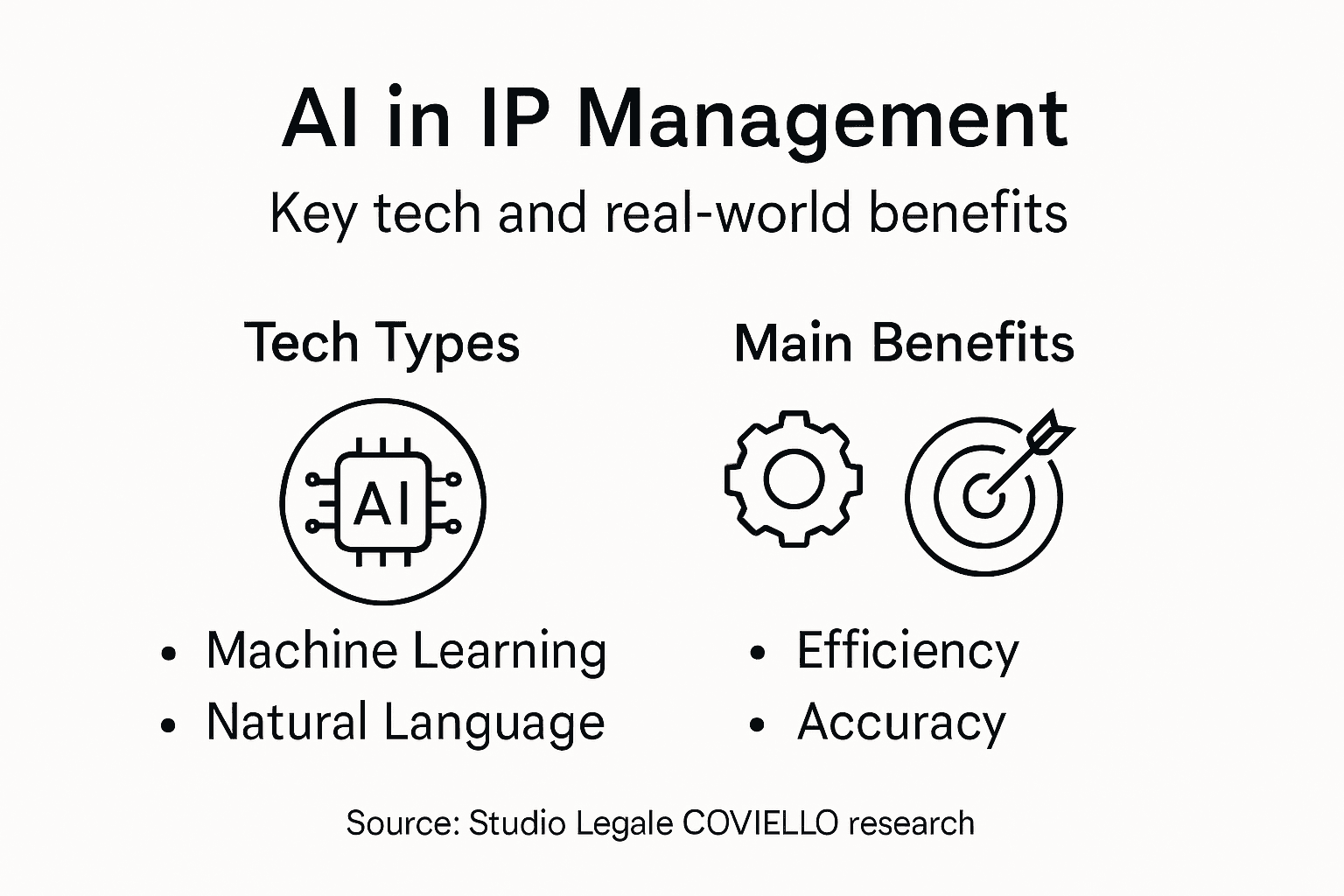
The fundamental components of AI in intellectual property management include machine learning algorithms, natural language processing, and predictive analytics. These technologies work synergistically to streamline traditionally labor-intensive processes like patent landscape analysis, prior art searches, and infringement detection. By automating complex analytical tasks, AI empowers legal professionals and innovators to make more informed strategic decisions about intellectual asset protection and commercialization.
Pro Tip: When implementing AI in intellectual property workflows, always maintain human oversight to validate algorithmic findings and preserve nuanced legal interpretations.
Core Applications: Patents, Trademarks, Copyrights
Artificial Intelligence is dramatically reshaping intellectual property management across three critical domains: patents, trademarks, and copyrights. By leveraging advanced machine learning and natural language processing technologies, AI enables legal professionals to conduct more sophisticated and efficient analyses of intellectual property landscapes.
In patent management, AI demonstrates remarkable capabilities in accelerating intellectual property research through automated prior art searches and complex technological similarity assessments. These algorithms can rapidly scan millions of global patent documents, identifying potential infringement risks and emerging technological trends with unprecedented speed and accuracy. Advanced AI systems now provide nuanced insights that would traditionally require weeks of manual expert review, dramatically compressing timelines for patent prosecution and portfolio management.
For trademark protection, AI technologies offer sophisticated monitoring and risk assessment tools. Machine learning algorithms can comprehensively scan global trademark databases, detecting potential visual and phonetic similarities that might escape human detection. These systems analyze complex design elements, linguistic variations, and market context to provide comprehensive trademark conflict assessments. Copyright management similarly benefits from AI’s ability to track and identify potential unauthorized reproductions across digital platforms, enabling more proactive and comprehensive intellectual property enforcement strategies.
The integration of AI into intellectual property workflows represents a fundamental transformation in how creative and technological assets are discovered, protected, and monetized. By automating complex analytical processes, AI empowers legal professionals to focus on high-value strategic decision-making, ultimately creating more robust and adaptive intellectual property management approaches.
Pro Tip: Implement AI-powered intellectual property tools with a hybrid approach that combines algorithmic insights with human expertise to maximize accuracy and strategic interpretation.
Key Technologies and How They Work
Artificial Intelligence in intellectual property management relies on a sophisticated array of computational technologies that simulate and augment human cognitive processes. Advanced machine learning architectures enable these systems to process vast amounts of complex data, identifying patterns and generating insights far beyond traditional manual analysis methods.

The core technological foundations include machine learning algorithms, neural networks, and natural language processing systems. Machine learning algorithms systematically analyze historical patent, trademark, and copyright data to develop predictive models that can anticipate potential intellectual property conflicts or emerging technological trends. Neural networks, particularly deep learning models, excel at recognizing intricate visual and textual patterns across massive document repositories, enabling unprecedented accuracy in similarity assessments and infringement detection.
Natural language processing technologies play a crucial role in intellectual property management by enabling AI systems to comprehend, interpret, and analyze complex legal and technical documentation. These advanced computational linguistics techniques can extract nuanced semantic meanings, compare technical descriptions, and generate comprehensive reports that would traditionally require extensive human expert review. Innovative data analytics approaches developed by research institutions have further refined these technologies, creating increasingly sophisticated tools for intellectual property professionals.
Here’s how AI technologies differ in intellectual property management:
Technology Type | Main Function | Unique Benefit |
Machine Learning | Pattern recognition, prediction | Forecasts IP trends |
Neural Networks | Image and text similarity assessment | Detects infringement faster |
Natural Language Processing | Legal document analysis | Identifies semantic conflicts |
The transformative power of these AI technologies lies in their ability to integrate multiple computational approaches simultaneously. By combining machine learning, statistical analysis, and semantic processing, these systems can provide holistic insights that transcend traditional siloed research methodologies. This integrated approach allows legal professionals to make more informed, data-driven decisions about intellectual property strategy, risk management, and portfolio development.
Pro Tip: Regularly update and retrain AI models with recent intellectual property data to maintain their predictive accuracy and contextual relevance.
Legal Frameworks and Compliance Challenges
The integration of Artificial Intelligence into intellectual property management presents complex legal challenges that require sophisticated and adaptive regulatory approaches. Intellectual property legal frameworks are struggling to keep pace with the rapid technological advancements introduced by AI-driven innovation, creating significant uncertainty around ownership, authorship, and protection mechanisms.
Key compliance challenges emerge from fundamental questions about AI-generated intellectual assets. Traditional legal structures typically require human inventorship or authorship, but AI systems blur these established boundaries by generating potentially patentable innovations autonomously. Machine learning algorithms can now produce technical designs, creative works, and novel solutions that challenge conventional definitions of originality and inventive step. This technological evolution necessitates reimagining legal concepts of intellectual property rights, requiring nuanced interpretations that balance technological innovation with established legal principles.
The European Union and other global jurisdictions are actively developing regulatory frameworks to address these emerging challenges. Generative AI compliance strategies must now navigate intricate legal landscapes that consider multiple dimensions of technological output, including algorithmic transparency, data provenance, potential biases, and the complex attribution of intellectual property rights. Legal professionals must develop sophisticated approaches that can effectively assess AI-generated content, distinguishing between truly novel innovations and derivative works that might infringe existing intellectual property protections.
Navigating these legal complexities requires a multidisciplinary approach that combines technological expertise, legal acumen, and adaptive regulatory thinking. Organizations must develop robust internal policies that proactively address potential intellectual property challenges, implementing comprehensive documentation, ethical guidelines, and clear attribution protocols for AI-generated intellectual assets.
The table below contrasts major compliance challenges and solutions with AI-generated IP:
Compliance Challenge | Cause | Strategic Solution |
Unclear inventorship | Autonomous AI creations | Update legal definitions |
Data attribution issues | Algorithmic data mixing | Enforce provenance tracking |
Regulatory lag | Rapid tech advancement | Develop adaptive frameworks |
Pro Tip: Consult interdisciplinary legal experts who specialize in both intellectual property law and emerging AI technologies to develop comprehensive compliance strategies.
Managing Risks, Costs, and Ethical Issues
Managing the complex landscape of AI in intellectual property requires a strategic approach that balances technological innovation with comprehensive risk mitigation. AI risk management frameworks provide critical guidance for organizations seeking to navigate the intricate ethical and financial challenges presented by emerging artificial intelligence technologies.
Critical risk dimensions include potential algorithmic biases, data privacy concerns, and the evolving legal uncertainties surrounding AI-generated intellectual property. Organizations must develop robust governance structures that systematically identify and mitigate potential risks across multiple dimensions. These risks range from technical vulnerabilities that could compromise intellectual property security to ethical challenges related to AI decision-making transparency and potential discriminatory outcomes in algorithmic processing.
Financial considerations play a significant role in AI intellectual property risk management. Ethical AI implementation strategies require substantial investment in governance frameworks, ongoing monitoring systems, and continuous training programs. Companies must budget for comprehensive risk assessment tools, legal consultations, and potential litigation expenses associated with emerging AI-related intellectual property challenges. The cost of proactive risk management is increasingly viewed as a critical investment in technological resilience and organizational reputation.
Effective risk management demands a holistic approach that integrates technological expertise, legal insight, and ethical considerations. Organizations must develop adaptive strategies that can quickly respond to changing regulatory landscapes, technological advancements, and emerging intellectual property challenges. This requires building cross-functional teams that can provide nuanced perspectives on the complex interplay between AI technologies and intellectual property management.
Pro Tip: Develop a dynamic risk assessment framework that includes regular external audits and continuous stakeholder feedback to maintain proactive risk management in AI intellectual property environments.
Unlock the Full Potential of AI in Intellectual Property Management
Artificial Intelligence offers groundbreaking opportunities to enhance the way intellectual property is managed but also brings complex challenges such as clarifying inventorship, ensuring compliance, and mitigating risks. Whether you’re navigating patent searching, trademark monitoring, or copyright protection AI can dramatically improve efficiency and accuracy yet requires expert legal oversight to ensure your assets remain secure and fully enforceable.
At Studio Legale COVIELLO, we specialize in leveraging cutting-edge AI technologies to empower your intellectual property strategy. Our tailored legal and technical consultancy guides you through the evolving landscape of AI-driven intellectual property management while mitigating compliance issues and ethical risks. Discover how our innovative digital tools, including a dedicated mobile app for IP rights management, can help you protect and maximize the value of your patents, trademarks, and copyrights.

Take control of your intellectual assets with trusted guidance that bridges advanced AI capabilities and expert legal insight. Visit Studio Legale COVIELLO now to explore our services and start unlocking new efficiencies in your intellectual property management today.
Frequently Asked Questions
What role does AI play in intellectual property management?
AI enhances intellectual property management by automating tasks such as patent searching, trademark monitoring, and copyright protection, leading to more efficient analysis and decision-making in these areas.
How does AI improve patent research and analysis?
AI accelerates patent research by conducting automated prior art searches, quickly scanning millions of global patent documents to identify potential infringement risks and emerging technological trends, significantly reducing the time required for expert reviews.
What are the key technologies used in AI for intellectual property?
Key technologies include machine learning algorithms for pattern recognition, neural networks for similarity assessments, and natural language processing for analyzing complex legal documents, all of which work together to provide comprehensive insights.
What legal challenges does AI introduce in intellectual property management?
AI poses challenges regarding inventorship and authorship of AI-generated innovations, as traditional legal frameworks typically require human involvement, creating uncertainties about ownership and protection of these intellectual assets.
Recommended

Comments