


Copyright Infringement: Risks for Global Startups

Building a tech startup means every original idea, line of code, and creative asset can become a target for unauthorized use. As your company grows beyond Italy or Europe, the risk of copyright infringement multiplies quickly. Founders often misunderstand what actually triggers legal exposure, confusing fair use myths with reality. This article uncovers what copyright infringement occurs when someone uses an original work without permission from the copyright holder means, highlights common misconceptions, and shows you how to protect your intellectual property through global expansion.
Table of Contents
Key Takeaways
Point | Details |
Understanding Copyright Infringement | Copyright infringement occurs when someone uses an original work without permission, regardless of its publication status or copyright notice. |
Myths About Fair Use | Many founders mistakenly believe that small uses qualify as fair use, or that purchasing a physical copy grants full usage rights, which is not true. |
Types of Infringement | Infringement scenarios include literal copying, unauthorized derivatives, and distribution without permission, each carrying distinct legal remedies. |
Global Compliance Strategy | Startups must understand international copyright differences to avoid legal risks; a tailored compliance strategy is essential before expanding into new markets. |
Defining Copyright Infringement and Key Myths
When you build a startup, your intellectual property becomes one of your most valuable assets. But understanding exactly what copyright infringement means is where many founders stumble. Simply put, copyright infringement occurs when someone uses an original work without permission from the copyright holder. This includes code you wrote, designs you created, written content, music, videos, or any other creative work that exists in a tangible form. The key distinction here: copyright protects original works fixed in a tangible medium, whether that’s a website, software repository, design file, or document. It doesn’t matter if your work is published, registered, or even marked with a copyright notice—the protection exists the moment you create it.
Now, let’s tackle the myths that get founders into real trouble. One dangerous misconception is that small use automatically falls under fair use. It doesn’t work that way. Another common mistake: assuming that because you bought a physical copy of something or downloaded a file, you own the rights to use it however you want. Wrong. Ownership of a physical copy is completely separate from ownership of the copyright. Some founders also believe that lack of a copyright notice means a work is free to use. Not true. Modern works are protected automatically without any marking required. Perhaps most risky is the belief that educational or nonprofit use automatically qualifies as fair use. Courts examine fair use case by case, considering factors like whether your use competes with the original or harms its commercial value. Ignorance of copyright law offers zero legal protection either. Your intent doesn’t matter if you violated someone’s rights.
Understanding valid copyright ownership, access to the original work, and whether copying falls outside legal exceptions forms the foundation of actual infringement claims. The consequences vary wildly depending on intent and circumstances. You could face damages payments, injunctions that shut down your product, or even criminal sanctions in egregious cases. There’s also confusion between plagiarism and infringement—plagiarism involves misattribution but is legally distinct from copyright infringement, which focuses on unauthorized use of protected material itself. For startups expanding globally, this complexity multiplies. Different jurisdictions recognize different fair use exceptions, different registration requirements exist across countries, and enforcement mechanisms vary dramatically. A use that’s technically permitted under American law might violate European protections.
Pro tip: Document your creation process for all original works your startup produces, and maintain clear records of where you sourced or licensed any third-party content used in your products—this documentation becomes invaluable if infringement claims ever arise.
Types of Copyright Infringement Explained
Copyright infringement takes many forms, and as a startup founder, you need to recognize them all. The most obvious type is literal copying, where someone reproduces your work directly without permission. But infringement goes far beyond exact duplication. Derivative works constitute infringement when someone creates new material based on your original work without authorization. This could mean adapting your software code, remixing your audio, translating your written content, or building sequels to your creative output. Then there’s distribution without permission, which happens when your work gets shared, sold, or transmitted to others without your consent. This applies whether it’s physical distribution (selling unauthorized copies) or digital distribution (hosting your code on an unauthorized repository or streaming your music without licensing). Public performance and display rights are also protected, meaning someone cannot publicly perform your work or display it to audiences without permission. Finally, importation of infringing copies into a country where your work is protected violates copyright law in that jurisdiction.
One type that trips up many startups involves user-generated content and fan creations. Fan fiction and derivative fan works exist in a legally gray area depending on your jurisdiction and how aggressively you protect your intellectual property. While some creators embrace fan works as marketing, others face unauthorized uses that directly compete with their own products. The legal status varies globally, with some countries providing stronger protections for copyright holders against fan content and others more permissive. For your startup, this matters when you’re either the creator (whose work gets fan-adapted without permission) or when your team might be inspired by existing franchises. Courts evaluate context carefully. A parody that comments on the original work might qualify as fair use. A fan story that simply retells existing characters in new scenarios without transforming the material typically does not. Understanding how courts evaluate fair use across different content types becomes critical when your startup operates in creative fields like gaming, music, publishing, or entertainment.
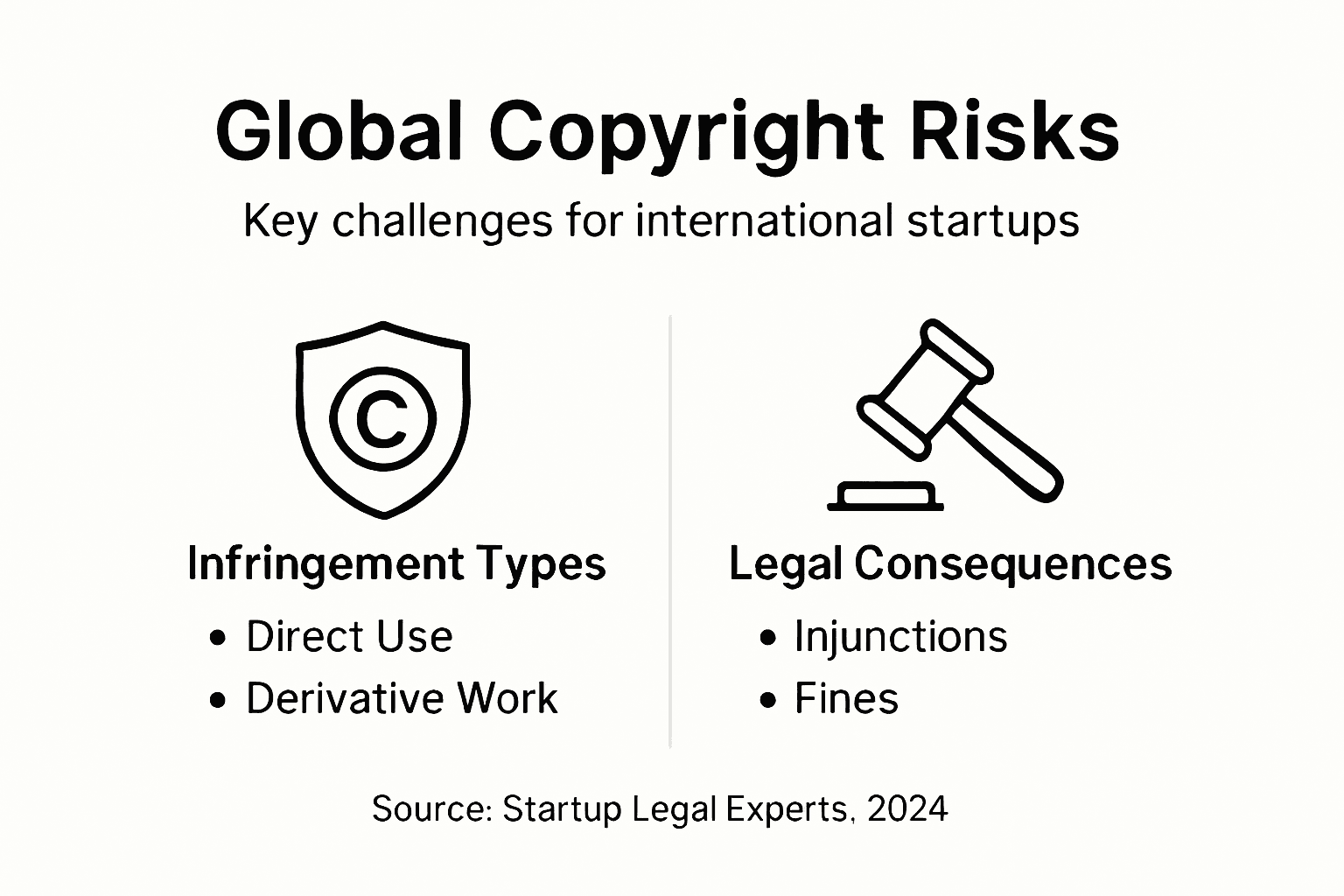
The distinction between infringement types matters legally because remedies differ. You might get injunctions stopping distribution, demands for damages, or in severe cases, criminal prosecution. For startups operating across borders, complexity multiplies because infringement types receive different legal treatment in different countries. European Union protections emphasize moral rights differently than American law. Some Asian jurisdictions prioritize different derivative work scenarios. One use might constitute clear infringement in Germany but face murky legal status in Southeast Asia. Your growth strategy should account for these variations, especially if your business model involves user-generated content, modifications, or adaptations of any kind.
This summary table outlines main types of copyright infringement and the typical remedies startups may face:
Infringement Type | Common Example | Typical Legal Remedy |
Literal Copying | Republishing code without permission | Damages, injunction |
Unauthorized Derivative | Translating a novel | Damages, possible destruction |
Unlicensed Distribution | Selling copied audio files | Removal, civil penalties |
Public Performance/Display | Streaming copyrighted video | Cease and desist orders |
Importation | Shipping pirated goods overseas | Customs seizure, penalties |
Pro tip: Create a content audit process that documents the origin and licensing status of every asset in your product before launching internationally—this prevents discovering infringement liability after you’ve invested in markets where local enforcement is particularly aggressive.
Legal Frameworks and International Differences
Here’s where global expansion gets complicated. Copyright law is not uniform worldwide, and that inconsistency creates real risks for startups scaling internationally. The foundation rests on international treaties like the Berne Convention, which establishes baseline protections across member countries. But here’s the catch: these treaties set minimum standards only. Each country interprets and implements copyright protection differently based on its own legal traditions and cultural values. Common law countries like the United States and the United Kingdom emphasize judicial precedents and creator rights, allowing courts to shape copyright doctrine through case decisions. Civil law countries, prevalent in Continental Europe and much of Latin America, take a different approach by codifying detailed copyright provisions into comprehensive statutory frameworks. This fundamental distinction affects how infringement gets prosecuted, how damages get calculated, and what defenses you can mount.
The variations go deeper than just legal philosophy. Copyright duration varies dramatically across jurisdictions. The United States protects works for the life of the author plus seventy years, but some countries offer different terms. Moral rights receive strong protection in European Union member states, allowing creators to object to modifications or misattribution even after selling their work, whereas American law treats moral rights much more narrowly. Registration requirements differ too. Some countries mandate registration for full copyright protection, while others grant protection automatically. Fair use interpretations diverge significantly. What constitutes acceptable fair use in American courts might constitute straightforward infringement under German law. The European Union uses a more restrictive concept called “fair dealing” with enumerated exceptions rather than the flexible American fair use standard. Meanwhile, international copyright protections and enforcement mechanisms remain inconsistent in implementation, creating gaps where infringement enforcement becomes challenging or nonexistent.
For your startup, these differences mean you cannot use a one-size-fits-all compliance strategy. A feature that relies on user-generated content might face serious legal exposure in Germany or France due to strict author protections, but operate with relative freedom in Southeast Asian markets with less aggressive enforcement. Your software licensing model might require different language and terms for European users versus American customers. If you license third-party content, you need separate agreements tailored to each major market where you operate. Companies operating in the gaming, music, or entertainment sectors face particularly complex scenarios because these industries trigger different copyright provisions across regions. An artificial intelligence training dataset that’s legally defensible in the United States might violate copyrights under strict European interpretations. The cost of non-compliance can range from takedown notices that disrupt your operations to damages that dwarf your annual revenue.
To better understand your global copyright risks, here’s a comparison of key legal differences across regions:
Legal Aspect | United States | European Union | Asia-Pacific (varies) |
Copyright Duration | Life + 70 years | Life + 70 years (minimum) | Typically life + 50 to 70 years |
Moral Rights | Limited; few protections | Strong; protects integrity/attribution | Varies; often weaker |
Registration Need | Not required for protection | Not required for protection | Some countries may require |
Fair Use/Dealing | Broad, flexible fair use doctrine | Narrower “fair dealing” exceptions | Varies by country |
Enforcement Strength | Consistent, strong infrastructure | Strict, active enforcement | Inconsistent between countries |
Pro tip: Before entering any new international market, conduct a copyright audit with local counsel who understands both your product and that country’s specific legal framework—this investment prevents costly legal surprises after you’ve built your market presence.
Risks, Penalties, and Liability Exposure
Copyright infringement carries financial and legal consequences that can cripple a startup. Let’s be direct: the penalties are severe, and intent doesn’t matter. You can violate someone’s copyright completely by accident and still face the full weight of legal liability. The financial exposure alone should grab your attention. Actual damages represent the copyright owner’s lost profit from your infringement, but courts often award statutory damages instead because actual damages are hard to prove. Statutory damages range from $200 to $150,000 per work infringed, and those numbers compound quickly if you’ve violated multiple copyrights. If a court determines your infringement was willful (meaning deliberate or reckless), the statutory damages jump to the maximum $150,000 per violation. For a startup using three unauthorized software libraries, three uncleared music tracks, and unlicensed design assets in your product, you’re potentially looking at millions in liability before trial even concludes. Beyond damages, courts order you to pay the copyright owner’s attorneys’ fees and court costs, which in complex intellectual property cases often reach six figures or more.
The legal restrictions go further than money. Courts issue injunctions that force you to stop the infringing activity immediately. This means pulling your product from app stores, removing content from your platform, or completely redesigning your service if the infringement is structural. Courts can also order impoundment and destruction of infringing materials in your possession. Criminal charges apply when infringement is willful and for commercial advantage. Criminal penalties include imprisonment up to five years and fines up to $250,000 per offense. While criminal prosecution typically targets major piracy operations, small startups have faced prosecution for intentional copyright violations. Beyond legal penalties, there are business consequences that may be worse. Copyright owners actively enforce their rights and can issue takedown notices that disrupt your operations through legal liability exposure, block your payment processing, remove you from app stores, or damage your reputation with investors and customers. A cease and desist letter arriving at your office freezes your capital raise, scares away partners, and signals to the market that your company operates recklessly.
The compounding nature of copyright liability makes this particularly dangerous for startups. Unlike some compliance violations where first offenses receive lenient treatment, copyright law offers no grace period. A single infringing work can trigger litigation that consumes months of management attention and hundreds of thousands in legal fees even if you ultimately win. More realistically, startups settle these cases for significant sums just to make the problem disappear and refocus on business. If you’re operating with venture funding, copyright litigation can trigger investor liability concerns and damage your ability to raise future rounds. International expansion amplifies the risk. An infringement that’s minor in one country becomes serious in another. A startup scaling to Europe suddenly faces the European Union’s stronger copyright protections and more aggressive enforcement. Courts in different jurisdictions calculate damages differently, and some countries impose additional penalties beyond monetary damages.
Pro tip: Conduct a complete intellectual property audit of your product before launch, specifically identifying every library, image, font, audio file, and design element, and document the license or permission status for each item—this creates a defensible record and prevents discovering liability after you’ve scaled.
Protecting Intellectual Assets Globally
Protection starts with understanding what you actually own. As a startup founder, you need a comprehensive strategy that works across multiple jurisdictions because your intellectual assets are only as strong as the weakest market where you operate. Begin with documentation and registration. While copyright protection exists automatically in most countries, registering your works with relevant authorities creates a legal record that strengthens your position in litigation. The United States Copyright Office registration, for example, enables you to sue for infringement and claim statutory damages. Many countries have similar registration systems. Beyond copyright, consider protecting your code through trade secret classification where appropriate. If your competitive advantage lies in undisclosed algorithms or business methods, keeping them confidential often provides better protection than copyright registration because trade secrets never expire. Document your creation process, maintain access controls, and require employees and contractors to sign confidentiality agreements.
Licensing is your second line of defense. When you use third-party content, software libraries, or services, understand the license terms completely before integration. Open source licenses like MIT, Apache, and GPL have different obligations. Some require you to open source your derivative work, while others permit commercial use without reciprocity. Many startups have learned this lesson the hard way after discovering their entire product is contractually required to be open source due to a GPL license buried in dependencies. Use licensing tools and software composition analysis platforms to identify all open source components automatically. For your own intellectual property, standardized Creative Commons licenses allow you to specify exactly how others can use your work while you retain attribution rights. If you’re releasing open source software, choosing the right license signals your intentions to the development community and protects your interests simultaneously.
Contracts and enforcement mechanisms form the foundation. Every agreement with third parties should explicitly address intellectual property ownership, permitted uses, and infringement liability. When scaling internationally, you need separate agreements tailored to local law in major markets. Work with local counsel to ensure your terms are enforceable where you operate. Global intellectual property frameworks require understanding national laws, international treaties, and enforcement mechanisms to protect assets effectively across borders. Additionally, implement technological safeguards. Watermarking, encryption, access controls, and digital rights management create friction for potential infringers. While no technology is infringement-proof, these measures demonstrate reasonable efforts to protect your assets, which strengthens your legal position if infringement occurs. For software, version control systems with clear commit histories, release notes, and change documentation prove ownership and creation timeline.
Regularly conduct intellectual property audits. Quarterly reviews of your codebase, design files, and content identify unlicensed third-party materials before they become costly problems. Maintain a comprehensive inventory of what your startup creates versus what you license. Understand the expiration dates of licenses and renewal requirements. Train your team on intellectual property policies. Many infringement violations happen because employees and contractors don’t understand what they can and cannot use. Create clear guidelines for using external resources, templates, and frameworks. Finally, establish relationships with intellectual property counsel before you need them. When disputes arise, having experienced counsel already familiar with your business accelerates your response and often prevents escalation into expensive litigation.
Pro tip: Implement a pre-launch intellectual property checklist that requires documentation of every external asset’s origin and license status, digital watermarking of your original creative content, and signed confidentiality agreements with all team members—this creates a defensible record if disputes arise during your international expansion.
Protect Your Startup from Global Copyright Risks Today
Navigating the complex landscape of copyright infringement is one of the toughest challenges startups face when expanding internationally. You understand the risks highlighted in the article from unauthorized derivative uses to strict enforcement of moral rights in different countries. Ignoring these issues can lead to costly damages, injunctions, and shattered reputations. Whether it is protecting your original works or licensing third-party content correctly, you need expert legal guidance that understands both international frameworks and technological innovation.
At Studio Legale Coviello, we specialize in helping startups like yours safeguard intellectual property across borders. Our tailored legal and technical consulting services focus on trademarks, patents, designs, and crucially, copyright protection that accommodates the diversity of global markets. We combine cutting-edge tools with deep legal expertise to provide proactive strategies, including thorough IP audits and customized licensing solutions. Do not wait for infringement issues to disrupt your growth. Visit our homepage, explore how our international consultancy can fortify your assets, and secure your startup’s future with confidence. Act now before facing costly consequences.
Frequently Asked Questions
What is copyright infringement?
Copyright infringement occurs when someone uses an original work without permission from the copyright holder. This includes various forms of creative works such as code, designs, written content, music, and videos.
How can startups protect their intellectual property from infringement?
Startups can protect their intellectual property by documenting their creation process, registering their works with relevant authorities, maintaining clear licensing terms, conducting regular intellectual property audits, and employing technological safeguards like encryption and digital rights management.
What are the consequences of copyright infringement for startups?
Consequences can include financial damages, injunctions that stop distribution, attorney fees, and even criminal penalties in severe cases. Additionally, reputational damage and operational disruptions can arise due to legal actions or cease and desist orders.
How does global expansion affect copyright risks for startups?
Global expansion complicates copyright risks due to varying copyright laws and enforcement mechanisms in different jurisdictions. A practice that might be legal in one country can lead to liability in another, making it essential for startups to understand local laws and tailor their compliance strategies accordingly.
Recommended

Comments