


Role of Copyrights in Business Success

Protecting an innovative idea can be the difference between global success and lost opportunity. In today’s competitive market, understanding how copyright law turns original software, designs, or creative content into legally protected business assets is more important than ever. For Italian and international technology leaders, mastering the rules of copyright offers a direct path to securing exclusive rights and commercial control—allowing you to build value, prevent infringement, and confidently scale in the global economy.
Table of Contents
Key Takeaways
Point | Details |
Copyright Protection is Automatic | Copyright protects original works as soon as they are fixed in a tangible medium, offering immediate legal safeguards. |
Strategic Asset for Businesses | Copyright transforms creative expressions into valuable business assets, enabling monetization through various strategies like licensing and royalties. |
Registration Enhances Legal Rights | Although copyright protection is automatic, formal registration provides additional legal benefits, including the ability to sue for infringement. |
Manage Risks Effectively | Developing a robust copyright management system is essential to safeguard against potential legal challenges and ensure compliance with international regulations. |
Copyright Basics and Business Relevance
Copyright represents a critical form of intellectual property protection that enables businesses and creators to safeguard their original works. Copyright protects original creative expressions across multiple domains, ranging from digital software to artistic compositions, providing legal mechanisms for ownership and commercial exploitation.
At its core, copyright establishes exclusive rights for creators, allowing them to control how their original works are used, reproduced, and monetized. These protections apply automatically when an original work is fixed in a tangible medium, which means creators do not need to complete formal registration to gain basic legal safeguards. The protections extend across various creative domains:
Literary works
Musical compositions
Artistic designs
Software code
Digital multimedia content
Architectural plans
For technology entrepreneurs and innovative businesses, copyright serves as a fundamental legal tool for protecting intellectual assets. Intellectual property laws support business innovation by creating frameworks that encourage investment in creative development and provide clear pathways for commercial exploitation of original works.
Copyright transforms creative expressions into valuable business assets that can be strategically leveraged for competitive advantage.
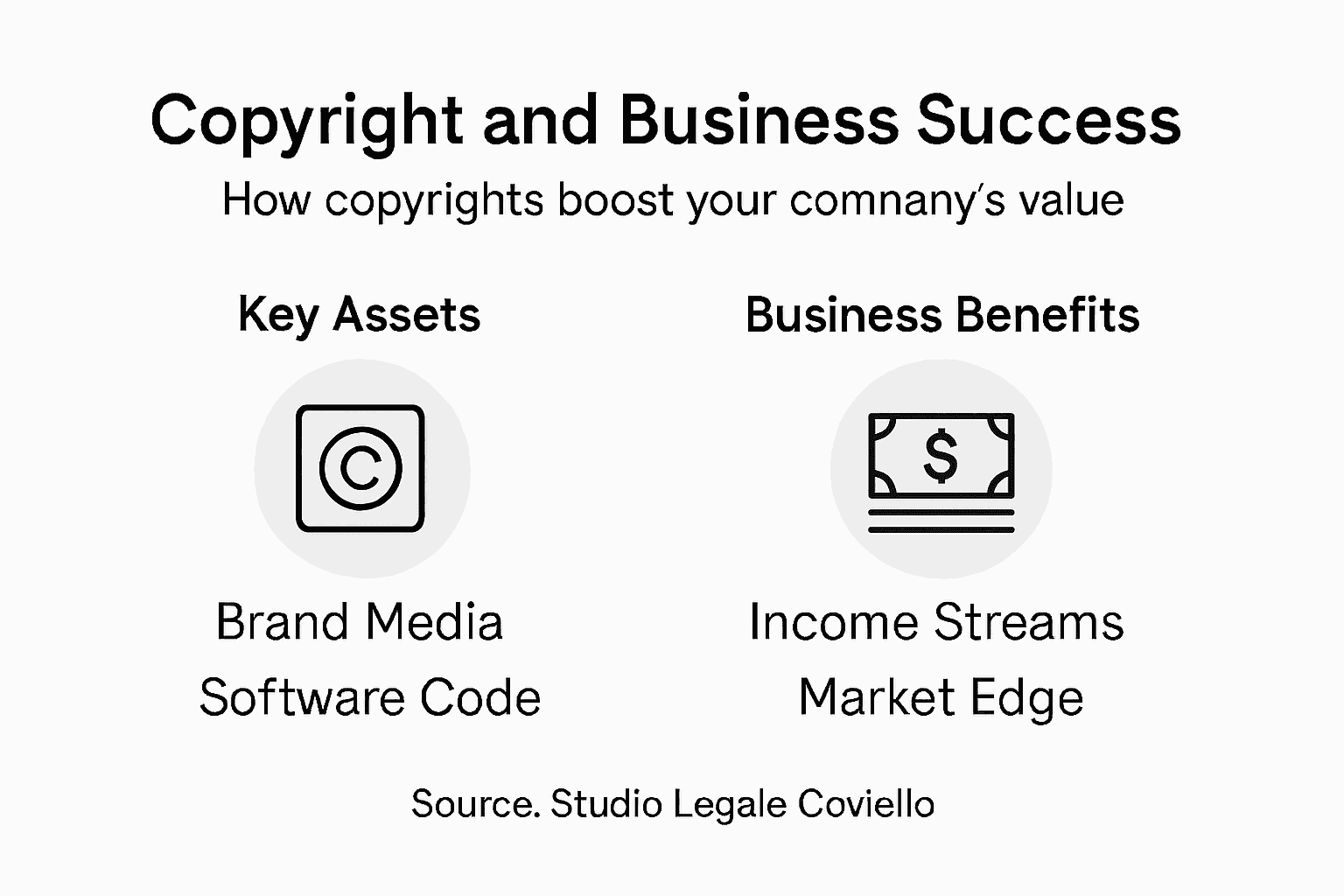
Businesses benefit from copyright protections in multiple strategic ways. They can prevent unauthorized reproduction of critical assets, generate revenue through licensing agreements, and establish clear ownership boundaries for their creative intellectual property. This legal mechanism not only protects current investments but also creates opportunities for future monetization and commercial expansion.
Pro tip: Develop a systematic approach to documenting and tracking your original creative works to maximize copyright protection and potential commercial value.
Types of Copyrightable Business Assets
Copyrightable business assets represent a diverse array of creative works that can be legally protected and monetized by organizations. Federal government materials include various copyrightable assets spanning multiple domains of intellectual property, providing businesses with critical mechanisms for safeguarding their innovative creations.
Businesses can protect several key types of intellectual assets through copyright, each representing a unique form of creative expression:
Software code and applications
Digital multimedia content
Architectural and design drawings
Marketing materials and advertising copy
Training manuals and instructional documents
Photographs and graphic designs
Musical compositions and audio recordings
Website content and blog posts
Trademarks and copyrights protect different intellectual property types that are crucial for comprehensive business asset protection. Each category of copyrightable asset offers specific legal safeguards that prevent unauthorized reproduction, distribution, or commercial exploitation of original creative works.
Copyright transforms intangible creative expressions into legally defendable business assets with measurable commercial value.
Technology entrepreneurs and creative professionals must understand the nuanced distinctions between different copyrightable assets. While some protections are automatic upon creation, others might require strategic documentation and registration to maximize legal defensibility. The breadth of protectable assets extends far beyond traditional artistic works, encompassing digital innovations, technical documentation, and strategic communication materials.
Here’s a quick comparison of copyright, trademark, and patent protection for business assets:
Aspect | Copyright | Trademark | Patent |
Protects | Creative expressions | Brand names, logos | Inventions, processes |
Automatic? | Yes, when created | No, requires registration | No, requires application |
Typical Duration | Life of creator + 70 yrs | Indefinite with renewal | 20 years from filing date |
Business Relevance | Content and IP defense | Brand identity protection | Innovation and technical edge |
Pro tip: Maintain a comprehensive inventory of your organization’s original creative works to streamline copyright registration and protect your intellectual assets.
Legal Protection and Registration Process
Copyright protection begins automatically upon the creation of an original work, providing businesses with immediate legal safeguards for their intellectual assets. This fundamental principle ensures that creative works are protected from the moment they are fixed in a tangible medium, giving entrepreneurs and creators significant legal advantages.
The copyright registration process involves several critical steps for businesses seeking comprehensive legal protection:
Documenting the original work’s creation date
Collecting all relevant creative materials
Preparing detailed registration documentation
Submitting application to the Copyright Office
Paying required registration fees
Maintaining comprehensive records of the submission
UK copyright law provides extensive protection that extends throughout the creator’s lifetime and an additional 70 years after their death. This extended protection allows businesses to maintain commercial control and potential monetization of their intellectual assets for generations.
Copyright registration transforms creative works from mere ideas into legally defensible business assets with measurable commercial value.
While automatic protection exists, formal registration offers significant additional benefits. Registered copyrights provide enhanced legal recourse, including the ability to sue for infringement, claim statutory damages, and recover potential attorney fees. Technology entrepreneurs and creative professionals should view copyright registration as a strategic investment in protecting their innovative intellectual property.

Pro tip: Consistently document and timestamp your original creative works to establish a clear chain of ownership and simplify potential future copyright registrations.
Commercial Applications and Monetization
Copyright enables sophisticated economic value creation778859_EN.pdf) through strategic monetization mechanisms that transform intellectual property into revenue-generating assets. Businesses can leverage their creative works across multiple commercial channels, developing comprehensive strategies that maximize financial potential.
Copyright holders can generate revenue through several key monetization strategies:
Licensing agreements
Exclusive licensing
Non-exclusive licensing
Territorial licensing
Royalty-based revenue models
Direct sales of creative works
Content syndication
Performance and reproduction rights
Digital distribution platforms
Intellectual Property Office highlights copyright monetization as a critical mechanism for businesses to generate sustainable income from their creative assets. By establishing clear ownership and controlling usage rights, organizations can create multiple revenue streams from a single intellectual property.
Copyright transforms creative expressions from artistic endeavors into strategic financial instruments with measurable economic potential.
Digital technologies have dramatically expanded copyright monetization opportunities, enabling creators to distribute and monetize their works across global platforms. Entrepreneurs can now leverage sophisticated licensing models, explore international markets, and implement dynamic pricing strategies that were previously impossible. The strategic management of copyright assets has become a sophisticated financial discipline requiring both legal expertise and creative business thinking.
Pro tip: Develop a comprehensive intellectual property portfolio strategy that includes multiple monetization pathways to maximize the economic potential of your creative assets.
Managing Risks and Compliance
Copyright protection requires comprehensive risk management strategies that safeguard businesses against potential legal challenges and intellectual property vulnerabilities. Proactive compliance approaches help organizations anticipate, prevent, and mitigate potential copyright-related risks across domestic and international markets.
Effective copyright risk management involves several critical components:
Monitoring potential infringements
Regular content tracking
Digital watermarking
Automated detection systems
Implementing robust documentation practices
Developing clear usage guidelines
Establishing international compliance protocols
Creating responsive legal intervention strategies
Training employees on intellectual property rights
Governance and risk management frameworks provide structured approaches for businesses to address complex copyright challenges. These integrated systems help organizations maintain legal accountability, protect creative assets, and reduce the potential for costly disputes.
Comprehensive copyright risk management transforms legal compliance from a reactive defense into a strategic competitive advantage.
Digital technologies have exponentially increased copyright complexity, requiring businesses to develop sophisticated, adaptive compliance strategies. Companies must now navigate intricate global regulations, cross-border intellectual property laws, and rapidly evolving technological landscapes that challenge traditional copyright protection models.
Below is a summary of major risks and compliance strategies in copyright management:
Risk Type | Potential Impact | Compliance Strategy |
Infringement | Lawsuits, financial loss | Regular monitoring and education |
Loss of ownership | Revenue and asset loss | Document creation and registration |
Global legal gaps | Cross-border disputes | Tailored international protocols |
Tech innovation risks | New regulatory challenges | Continuous legal review |
Pro tip: Develop a centralized copyright management system that combines technological monitoring, legal expertise, and proactive compliance protocols to minimize potential risks.
Copyright Challenges in Global Markets
Global markets create complex copyright landscapes that require sophisticated legal navigation by businesses seeking international intellectual property protection. Emerging technologies and divergent legal frameworks significantly complicate copyright management across different jurisdictions.
Key challenges in global copyright protection include:
Jurisdictional legal variations
Inconsistent copyright definitions
Differing registration requirements
Varying enforcement mechanisms
Cross-border intellectual property disputes
Technological innovation legal gaps
International treaty interpretation challenges
Digital content distribution complexities
Emerging artificial intelligence copyright questions
Artificial intelligence introduces unprecedented copyright complexities that challenge traditional legal frameworks worldwide. Many jurisdictions struggle to define authorship and ownership when creative works are generated through machine learning and algorithmic processes.
International copyright protection demands continuous adaptation to technological and legal transformations that transcend traditional regulatory boundaries.
Technology entrepreneurs must develop agile, proactive strategies that anticipate legal shifts and protect intellectual assets across multiple international markets. This requires comprehensive understanding of global copyright regulations, emerging technological challenges, and strategic legal positioning that can adapt to rapidly evolving digital landscapes.
Pro tip: Consult multinational intellectual property experts and develop flexible, jurisdiction-spanning copyright strategies that can quickly adapt to changing global legal environments.
Protect Your Business Success With Expert Copyright Guidance
The article highlights how copyright is essential to safeguarding your original creative works and turning them into valuable business assets. If you are a business owner or entrepreneur struggling with legal complexities around copyright registration, protection, or monetization, you are not alone. Key challenges include managing risk, navigating international laws, and leveraging intellectual property for revenue. Understanding these concepts like licensing agreements, automated copyright protection, and risk management strategies can make the difference between losing control of your assets and securing lasting competitive advantage.
At Studio Legale Coviello, we specialize in intellectual property law and commercial law with a strong focus on innovation and technology. Our expert legal and technical consulting services help businesses and individuals protect and maximize the value of trademarks, patents, designs, and copyrights. We employ cutting-edge solutions including artificial intelligence tools and a dedicated mobile app for intellectual property management to enhance your legal protection and strategic planning.

Don’t leave your valuable creative assets unprotected or exposed to costly risks. Take control now by partnering with professionals who understand the full scope of copyright challenges in today’s global and digital marketplace. Visit Studio Legale Coviello today to access tailored legal advice and innovative intellectual property strategies that secure your business success. Start safeguarding your intellectual property with confidence and unlock its full commercial potential.
Frequently Asked Questions
What is copyright and why is it important for businesses?
Copyright is a legal protection that safeguards original creative expressions. It is important for businesses as it gives creators exclusive rights to control the use, reproduction, and monetization of their works, preventing unauthorized use and allowing for revenue generation through licensing.
How can businesses monetize their copyrighted works?
Businesses can monetize their copyrighted works through various strategies, such as licensing agreements, direct sales, content syndication, and performance rights, allowing them to generate revenue and maximize the value of their creative assets.
What types of works can be protected by copyright in a business context?
Copyright can protect various creative works in a business context, including software code, digital multimedia content, marketing materials, training manuals, graphic designs, and website content among others.
Is copyright registration necessary for businesses to protect their works?
While copyright protection occurs automatically upon the creation of an original work, formal registration offers additional legal benefits such as the ability to sue for infringement and access statutory damages, making it a strategic investment for businesses.
Recommended

Comments