


What Is Design Registration and Why It Matters

Confusion between design registration, patents, and copyrights leaves many tech startups exposed to costly risks. As you develop an app, a hardware interface, or a new device, understanding what legally protects your visual innovation makes the difference between true ownership and open copying. This guide dispels common myths, clarifies how design registration protects ornamental features of your products, and reveals smarter ways to secure your intellectual property across European, American, and global markets.
Table of Contents
Key Takeaways
Point | Details |
Design Registration is Essential | It protects the ornamental features of a product, ensuring competitive advantage for tech startups. |
Myth of Automatic Protection | Registration is mandatory for legal protection; design ownership alone does not guarantee rights. |
Comprehensive IP Strategy Needed | Combining design registration with utility patents and trademarks enhances protection. |
Global Variations in Registration | Understanding national, regional, and international systems is crucial for protecting designs effectively. |
Design registration explained and common myths
Design registration protects the visual appearance of a product—how it looks, not how it works. For tech startups, this distinction matters enormously because your UI design, product shape, or distinctive visual elements deserve legal protection. But many founders confuse this with patents, copyrights, and trademarks, which leads to costly protection gaps.
What Design Registration Actually Covers
Design registration protects ornamental features applied to manufactured articles. The way an article looks—including shape, configuration, or surface ornamentation—receives protection when properly registered. Your app interface’s visual layout, a smartphone’s distinctive curved edges, or gaming hardware’s ergonomic form all qualify.
The key requirement: the design must be ornamental and inseparable from the product itself. Functional features that serve a purpose beyond aesthetics don’t qualify. This is critical for hardware startups blending form and function.
Here is a summary of what design registration covers versus other types of intellectual property protection:
Aspect Protected | Design Registration | Utility Patent | Trademark | Copyright |
Visual appearance | Yes, ornamental aspects | No, focuses on function | Only logos/branding | Sometimes, in artwork |
Functional features | No, not protected | Yes, if new/useful | No, not protected | No, not protected |
Duration of protection | 15-25 years, renewable | 20 years, no renewal | Unlimited with renewal | Life of author + years |
Registration required | Yes, formal application | Yes, rigorous review | Yes, formal application | Automatic (in the U.S.) |
Common Myths That Hurt Startups
Myth 1: Registration Happens Automatically
Your design is not protected simply because you created it. Protection requires formal registration with the appropriate authority—the European Union Intellectual Property Office (EUIPO) in Europe, the United States Patent and Trademark Office (USPTO) in America, or national offices elsewhere.
Without registration, you lack legal standing to sue infringers. Enforcement becomes nearly impossible.
Myth 2: Design Patents Protect the Entire Product
Design registration protects only the ornamental aspects, not the product itself or how it functions. Copyright protects original works of authorship fixed in a tangible medium and does not cover functional aspects or methods. If competitors create a functionally identical product with different aesthetics, they may not infringe your design registration.
For complete protection, combine design registration with utility patents and trademark registration.
Myth 3: Design Registration Lasts Forever
Design registrations expire. European designs last 5 years from filing and can be renewed up to 25 years total. United States design patents protect for 15 years (for applications filed after May 13, 2015). Plan renewals into your IP strategy.
Myth 4: All Visual Elements Are Protected
Design registration protects ornamental characteristics only. Text, logos, and brand identity fall under trademark and copyright, not design registration. Functional components—even if visually distinctive—receive no protection from design registration.
Myth 5: You Can Copy as Long as You Change One Feature
Infringement occurs when a design is substantially similar overall, not when a single element differs. Competitors making minor tweaks while copying your core visual concept still infringe.
Why This Matters for Your Startup
Competitive advantage: Registered designs deter copying and strengthen your market position
Licensing revenue: Lease your design to manufacturers in other markets
Valuation: Intellectual property assets increase company worth
International sales: Design registration in key markets protects you before competitors launch copycat products
Litigation strength: Registration creates a presumption of validity in court proceedings
Design registration is not automatic, doesn’t protect function, and requires active renewal management—but it’s your most accessible legal tool for protecting visual innovation.
Pro tip: File design registrations before public product launch or presentation at trade shows, as many jurisdictions treat public disclosure as a bar to registration; work with specialists in your target markets (Europe, North America, Asia) to prioritize filings where your customers exist.
Types of design registration and global variations
Design registration systems vary dramatically across regions. What works in Europe differs from the United States, which differs from Asia-Pacific. For tech startups expanding internationally, understanding these variations prevents costly mistakes and ensures your visual assets receive proper protection where your customers actually are.
National vs. Regional vs. International Registration
You have three primary pathways: register in individual countries, use regional systems, or leverage international agreements. Each offers different coverage, costs, and administrative burdens.
National Registration protects your design in a single country under that nation’s laws. This is the most basic option but requires separate filings in each market. A design registered in Italy receives no protection in Germany or France without additional applications.
Regional Registration covers multiple countries through unified systems. The European Union offers Community Design protection valid across all EU member states with a single application. This dramatically simplifies management for European expansion.
International Registration through the Hague System allows filing a single application covering up to 100 designs in over 90 countries simultaneously. This reduces costs and consolidates management of design rights across major markets.
Key Registration Systems by Region
European Union
The European Community Design (unregistered and registered) provides protection across the entire EU for up to 25 years. Registered Community Designs last 5 years from filing and renew every 5 years thereafter. No examination required—protection is automatic upon registration.
Benelux designs (Belgium, Netherlands, Luxembourg) offer similar 25-year protection with identical renewal cycles.
United States
Design patents protect U.S. rights for 15 years from filing (for applications filed after May 13, 2015). Unlike Europe, the U.S. requires substantive examination and approval before protection begins. Filing costs more and takes longer, but examination provides greater certainty.
International via Hague Agreement
The Hague System simplifies multi-country protection through a single application managed by the World Intellectual Property Organization (WIPO). You designate specific countries or regions. Protection duration and renewal requirements follow each designated country’s laws.
Comparison Table: Protection Duration and Renewal
System | Initial Protection | Maximum Duration | Renewal Period | Cost Efficiency |
EU Registered Design | 5 years | 25 years | Every 5 years | High |
U.S. Design Patent | 15 years | 15 years | None | Moderate |
Hague System | Varies by country | Varies | Varies | High for multi-country |
National Registration | Varies | Varies | Varies | Low |
International registration through the Hague System costs significantly less per country than filing separately, but you’re bound by the national laws of each designated territory.
Why Your Startup Needs Multiple Systems
If your tech product targets Europe, North America, and Asia, relying on one registration system leaves gaps. Your design protected in the EU receives zero protection in the United States. Competitors can legally copy your aesthetics in unprotected markets.
Start with your primary market, then expand systematically:
Phase 1: Secure protection in your home market
Phase 2: Register in major markets where you generate revenue
Phase 3: Use the Hague System to extend coverage cost-effectively to secondary markets
Pro tip: File your international design applications within 6 months of first disclosure in any country to maintain priority dates; many jurisdictions treat public launch as a bar to registration, so early filing protects your filing date retroactively across the entire international system.
Key legal requirements and registration process
Registering a design involves meeting specific legal requirements and following procedural steps that vary by jurisdiction. Understanding these requirements upfront prevents rejections, delays, and costly rework. The process differs significantly depending on whether you’re filing nationally, regionally, or internationally.

Legal Requirements Before Filing
Your design must meet fundamental criteria to qualify for registration protection. These requirements exist across all major jurisdictions, though specifics vary.
Novelty is the first requirement. Your design must be new—not previously disclosed in any form. Public presentations, trade show displays, social media posts, or product launches can destroy novelty in many jurisdictions. File before any public disclosure.
Individual character (or “non-obviousness” in some systems) means the design creates a different overall impression compared to existing designs. Minor variations from competitor products may not qualify.
Ornamental character requires that the design primarily serves aesthetic purposes. Purely functional features receive no protection—only the visual, non-functional elements qualify.
Reproducibility means the design must be capable of being applied to multiple articles of the same type. One-of-a-kind creations generally don’t qualify.
Step-by-Step Registration Process
Step 1: Prepare Design Documentation
Create clear representations of your design showing all angles and details. Requirements include:
High-quality photographs or digital renderings
Multiple views (front, back, sides, top, bottom)
Color documentation if color is essential to protection
Clarity sufficient for reproduction
Step 2: Conduct Prior Art Search
Search existing designs to confirm novelty and individual character. Check national registries, international databases, and market products. This prevents filing fees on designs already protected elsewhere.
Step 3: File Your Application
Filing through the Hague System requires submitting a single international application with WIPO, designating member countries where protection is sought. National filing requires submitting directly to each country’s intellectual property office.
Applications typically include:
Design representations
Description of the design
Claim statement
Filing fees
Applicant information
Step 4: Pay Filing and Designation Fees
Costs vary significantly. International Hague System registration bundles national registrations into one filing, lowering costs and simplifying management compared to separate national applications.
Step 5: Examination and Approval
Examination procedures differ by jurisdiction. EU systems require no substantive examination—protection is automatic. U.S. design patents require detailed examination and approval. International designations follow each country’s examination rules.
Step 6: Publication and Protection
Once approved, your design is published and protection begins. You can now enforce against infringers in designated territories.
Priority Rights and Six-Month Window
If you file subsequent applications within six months, you can claim priority from your first filing. This protects your filing date retroactively, even if you haven’t launched products in every market yet.
Meeting novelty requirements means filing before any public disclosure—one trade show presentation or social media post can eliminate protection in most jurisdictions.
Pro tip: File your design application before any public launch, product announcement, or investor presentation; if unavoidable disclosure occurs, file within the applicable grace period (typically 6-12 months depending on jurisdiction) to preserve priority rights.
Rights, protections, and commercial benefits
Registered design ownership grants you exclusive rights—the legal power to control how your visual innovation enters the market. For tech startups, these rights translate directly into competitive advantages, licensing revenue, and company valuation. Understanding what you actually own prevents costly disputes and unlocks commercial opportunities.
Exclusive Rights You Gain
Registration gives you the legal foundation to prevent competitors from copying your design. These rights vary by jurisdiction but share common elements.
Manufacturing Control means you alone can decide who manufactures products embodying your registered design. Competitors cannot legally produce identical or substantially similar articles without your permission.
Sales and Distribution Rights prevent others from selling or distributing products with your design. You control market access—competitors must redesign their products or license from you.
Import and Export Control restricts competitors from importing counterfeit products into your protected markets. This prevents offshore manufacturers from circumventing domestic manufacturing restrictions.
Licensing Authority allows you to grant others permission to use your design in exchange for royalties or licensing fees. This generates revenue without manufacturing products yourself.
Design registration provides exclusive rights to use, manufacture, sell, import, or export products featuring your registered design, creating substantial commercial value.
Commercial Benefits Beyond Legal Protection
Design rights generate tangible business value across multiple channels.
Brand Differentiation makes your product instantly recognizable in crowded markets. Customers identify your hardware by distinctive visual appearance before reading your branding.
Market Exclusivity prevents competitor copycats for years—sometimes decades. Without design registration, competitors reverse-engineer your aesthetics and launch knockoffs within weeks.
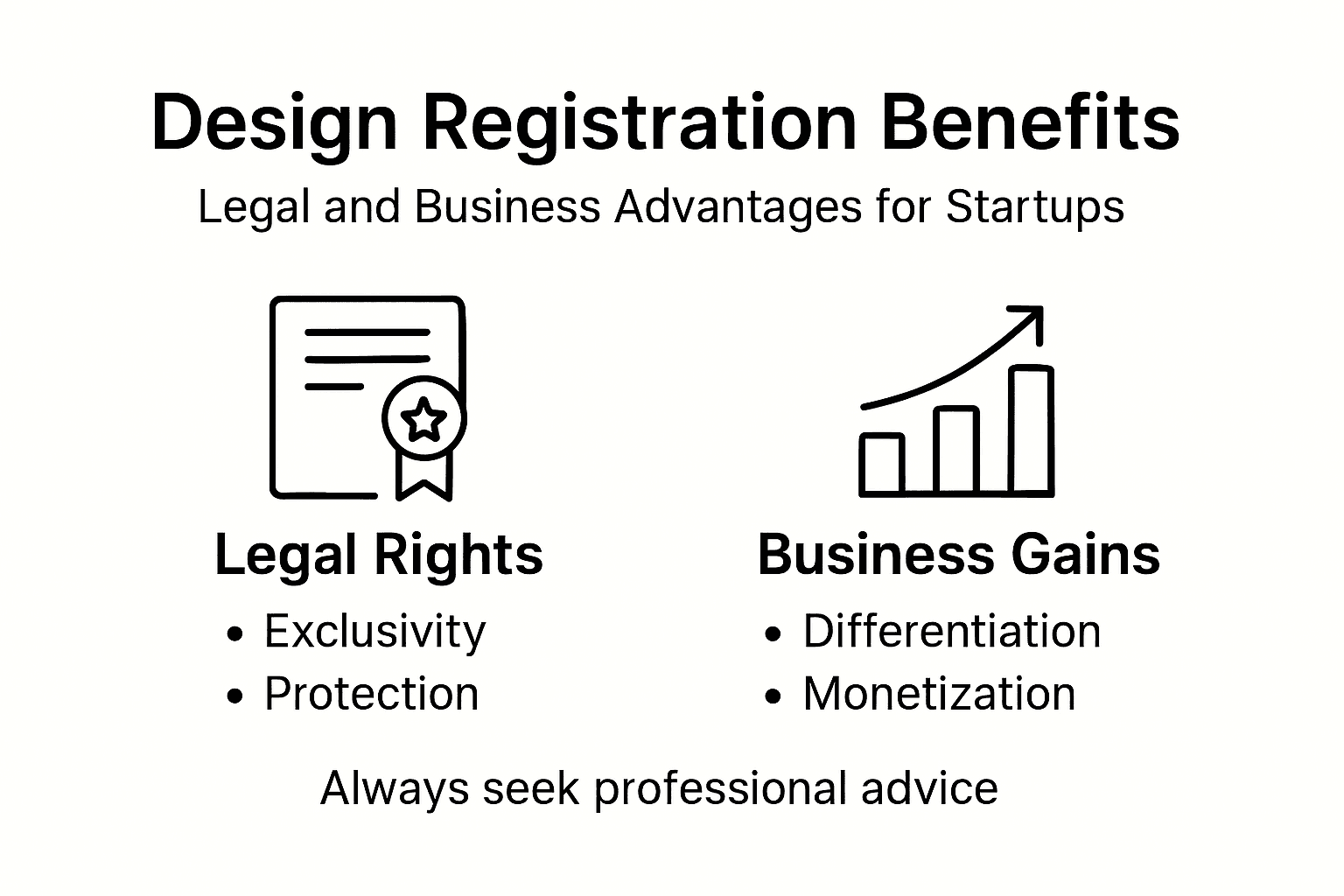
Licensing Revenue lets you monetize your design across industries and geographies. A gaming startup might license its controller design to peripheral manufacturers, generating recurring royalties.
Valuation Enhancement increases your company’s intellectual property portfolio worth. Investors value companies with registered designs—they represent defensible competitive advantages.
Counterfeit Prevention protects your supply chain and brand reputation. Design registration enables customs authorities to seize counterfeit products at borders.
Commercial Advantages for Tech Startups
Registered designs offer specific advantages in competitive tech markets:
Hardware differentiation: Distinctive ergonomic form factors or control layouts prevent direct cloning
UI/UX protection: Visual interface designs receive protection across jurisdictions
Licensing partnerships: Manufacturers pay for design rights, funding your development
M&A value: Acquirers pay premium prices for established design portfolios
International expansion: Protection in target markets enables confidently launching global products
Design registration isn’t just legal protection—it’s a revenue-generating asset that increases company valuation and deters competitors from copying your visual innovations.
Enforcement and Defense
Registration creates presumption of validity in legal proceedings. When you sue an infringer, the burden shifts to them to prove your design is invalid—rather than you proving infringement.
This dramatically reduces litigation costs and increases your probability of winning damages.
Pro tip: Monitor competitor products continuously using design registries and trademark databases; early detection of infringement allows you to send cease-and-desist letters before competitors invest heavily in copycat products, often resolving disputes without costly litigation.
Risks, costs, and common pitfalls to avoid
Design registration demands precision and planning. Small mistakes cost thousands in wasted fees, missed deadlines, or rejected applications. Understanding common pitfalls before filing prevents expensive do-overs and protects your investment.
Financial Costs You’ll Face
Design registration involves multiple expenses across filing, examination, and renewal phases. Budget carefully to avoid surprises.
Filing Fees start your protection. International Hague System filings cost less per country than separate national applications, but costs accumulate with multiple designs and designated territories.
Examination Fees apply in jurisdictions requiring substantive review. U.S. design patents demand detailed examination; European Community Designs do not. Budget accordingly based on your target markets.
Renewal Costs continue throughout protection periods. Costs can accumulate with multiple renewals and international designations, requiring careful budget planning. A design protected 25 years requires 5 renewal cycles in Europe.
Professional Services add significant expense. Design searches, application preparation, prosecution correspondence, and legal advice from intellectual property specialists cost $2,000 to $10,000+ per design across multiple jurisdictions.
Designated Country Fees vary dramatically. Filing in 50 countries costs substantially more than 10. Select markets strategically based on manufacturing locations and customer concentration.
Here’s a quick guide to major design registration costs and what they cover:
Cost Type | What It Covers | Typical Range |
Filing fees | Application submission | $100–$2,000 per design |
Examination fees | Official review in some jurisdictions | $200–$1,000 |
Renewal fees | Continued protection over years | $500–$2,000 per cycle |
Professional services | Attorney/search/management | $2,000–$10,000+ |
Country designation | Expanding protection to new markets | Varies by territory |
Critical Pitfalls That Destroy Protection
Pitfall 1: Skipping Prior Art Searches
Failing to conduct thorough prior art searches before filing wastes fees on applications destined for rejection. Existing designs in databases or marketplace products bar your registration.
Invest $500 to $2,000 in professional searches upfront to avoid $10,000+ in wasted filing fees.
Pitfall 2: Missing Renewal Deadlines
Design protection expires automatically if you miss renewal deadlines. Many startups lose valuable rights because renewal notices go untracked or ignored. Set calendar reminders 12 months before expiration.
Protection lost cannot be recovered—competitors then legally copy your design.
Pitfall 3: Misunderstanding Scope of Protection
Design registration protects ornamental appearance only, not function. Filing on purely functional features results in rejection. Confusing design protection with patents or trademarks leads to registration gaps.
Pitfall 4: Poor Design Documentation
Fuzzy photographs or incomplete views create rejections during examination. Examiners cannot assess novelty with unclear reproductions. Invest in professional photography or high-quality renderings showing all angles.
Pitfall 5: Designating Countries You Don’t Need
Adding unnecessary countries increases costs without benefit. If you don’t manufacture or sell in Argentina, protecting designs there wastes money. Carefully evaluate which designated countries align with your business strategy.
Fraud and Verification Risks
Scammers send fake invoices pretending to represent intellectual property offices. Verify legitimacy directly with official registries before paying unexpected bills.
Redflags include unsolicited invoicing, pressure for immediate payment, and requests for wire transfers rather than official payment channels.
Common scam targets:
Design registration maintenance invoices from fraudulent entities
International renewal notices claiming urgent action required
Domain registration offers disguised as IP services
Invoices for “design monitoring” services you didn’t purchase
Missing a single renewal deadline means losing years of protection—but overpaying for unnecessary designated countries or fraudulent services means losing money upfront.
Why Professional Guidance Matters
Seeking professional advice is recommended to navigate complexities, avoid costly mistakes, and maximize protection while managing costs effectively. Intellectual property specialists help you:
Select optimal jurisdictions based on your business model
Prepare clear design reproductions meeting examination standards
Monitor renewal deadlines systematically
Respond to examination office rejections professionally
Verify correspondence legitimacy
The cost of professional guidance ($3,000 to $15,000 per design portfolio) typically saves 3-5x that amount by avoiding rejected applications, missed renewals, and duplicative filings.
Pro tip: Establish a design management calendar tracking all filing dates, renewal deadlines, and examination milestones at least 12 months in advance; use dedicated IP management software or spreadsheets to prevent costly oversights as your portfolio grows.
Protect Your Visual Innovations with Expert Design Registration Support
Understanding the true scope and importance of design registration is vital to safeguard your product’s unique appearance from costly copycats. This article highlights common pitfalls such as confusing design protection with patents, missing renewal deadlines, or failing to register before public disclosure. If you want to confidently secure your ornamental designs and strengthen your competitive edge, professional guidance is key.
Partner with Studio Legale Coviello, a law firm specializing in intellectual property and international commercial law that combines advanced technology and expert legal advice. Our tailored services ensure your designs meet novelty and ornamental criteria while optimizing cost and filing strategies across markets like Europe, the United States, and worldwide via the Hague System. Don’t let procedural mistakes or missed timelines expose your startup to infringement risks or lost rights. Visit Studio Legale Coviello today to start protecting your valuable design assets and unlock new commercial opportunities.
Frequently Asked Questions
What is design registration?
Design registration is a legal process that protects the visual appearance of a product, including its shape, configuration, and ornamentation. This protection is essential for startups to guard their unique UI and product designs against unauthorized use.
Why is design registration important for startups?
Design registration provides a competitive advantage by deterring competitors from copying your designs. It enhances the value of your intellectual property, allowing you to generate licensing revenue, and increasing your company’s overall worth.
How long does design registration last?
Design registration typically lasts between 15 to 25 years depending on the jurisdiction, with options for renewal. In certain regions, designs must be renewed periodically to maintain protection.
What types of features are protected by design registration?
Design registration protects ornamental features of a product that are primarily aesthetic. It does not cover functional aspects or methods, which are typically protected by utility patents.
Recommended

Comments