


Design Rights Explained: Securing Global Innovation
Updated: 6 days ago

For visionary founders in the European and UAE tech scenes, protecting a product’s visual identity is as critical as guarding core technology. Confusing design rights with patents or copyrights can lead to gaps in protection and missed opportunities for enforcement. This guide highlights how design rights safeguard a product’s unique appearance and addresses common misconceptions, offering clear strategies for aligning legal protection with advanced digital management tools.
Table of Contents
Key Takeaways
Point | Details |
Understanding Design Rights | Design rights protect the unique visual characteristics of products, focusing on appearance rather than functional aspects. |
Registered vs. Unregistered Design Rights | Registered rights offer stronger protection and easier enforcement, while unregistered rights provide limited protection without formal registration. |
Design Protection Strategies | Different jurisdictions provide unique protection mechanisms, including national registrations, regional systems, and international agreements. |
Proactive Monitoring and Management | Businesses should implement comprehensive strategies to monitor potential infringements and manage their design rights effectively in the digital space. |
What Design Rights Protect and Misconceptions
Design rights are specialized legal protections that safeguard the unique visual characteristics of products across various industries. Aesthetic features of design encompass a product’s shape, configuration, pattern, and ornamentation, focusing exclusively on visual identity rather than functional mechanics.
Understanding the precise scope of design rights requires distinguishing them from other intellectual property protections. Unlike patents, which protect technical innovations, or copyrights, which shield creative expressions, design rights concentrate specifically on a product’s external appearance. They enable innovators to prevent unauthorized copying of their unique visual designs in commercial markets.
The key protectable elements of design rights typically include:
Distinctive product shapes
Unique surface patterns
Ornamental configurations
Color schemes integral to the design
Decorative elements that define visual character
There are two primary categories of design rights: registered and unregistered. Registered design rights provide more robust legal protection, allowing designers to take legal action against potential infringers with greater ease. Unregistered design rights offer more limited protection, typically requiring more substantial evidence of deliberate copying.
Here is a side-by-side comparison of registered versus unregistered design rights:
Attribute | Registered Design Rights | Unregistered Design Rights |
Level of Protection | Strong, enforceable in court | Limited, less direct enforcement |
Duration | Up to 25 years, renewable | Approximately 3 years, not renewable |
Proof Required | Design originality and documentation | Evidence of copying, originality |
Legal Action | Easier to initiate proceedings | Requires substantial proof of infringement |
Commercial Confidence | High, supports business growth | Lower, higher risk of disputes |
Design rights foster innovation by granting creators exclusive commercial control over their unique visual innovations.
Pro tip: Consult an intellectual property specialist early in your product development process to determine the most strategic approach for protecting your design’s unique visual characteristics.
Types of Design Protection Worldwide
Design protection strategies vary significantly across different global jurisdictions, offering innovators multiple pathways to secure their visual intellectual property. International design protection mechanisms typically require independent application processes that recognize the unique characteristics of a design while providing legal safeguards against unauthorized reproduction.
The primary types of design protection worldwide can be categorized into three fundamental approaches:
National Registrations: Protection within a specific country’s legal framework
Regional Design Systems: Comprehensive protection across multiple countries (like EU Community Designs)
International Design Registration: Global protection through systems like the Hague Agreement
Each protection mechanism comes with distinct requirements and duration parameters. National design registrations generally demand proof of originality and novelty, with protection typically lasting 10-25 years depending on renewal fees and local regulations. Regional design systems offer more expansive coverage, allowing designers to secure rights across multiple jurisdictions through a single application process.
Design protection is not a one-size-fits-all solution but a strategic approach tailored to specific commercial and creative needs.
The international landscape of design rights includes complex variations in legal frameworks. Some jurisdictions offer automatic unregistered design rights with limited protection, while others require formal registration to establish comprehensive legal defense. Technological innovations and global market dynamics continually reshape these protection mechanisms, making ongoing legal consultation crucial for businesses seeking robust intellectual property strategies.

This table summarizes the main international design protection pathways for innovators:
Protection Type | Coverage Area | Application Process | Typical Duration |
National Registration | Single country | Local agency, country-specific | 10-25 years, varies by country |
Regional System | Multiple countries | Centralized (e.g., EUIPO) | Up to 25 years, renewable |
International System | Global, many countries | Through Hague Agreement | Maximum 15-25 years, depends on jurisdictions |
Pro tip: Conduct a comprehensive jurisdictional analysis before finalizing your design protection strategy to understand the specific requirements and limitations in each target market.
Legal Frameworks Governing Design Rights
Design rights represent a complex legal landscape that varies significantly across different jurisdictions, requiring innovators to navigate intricate regulatory environments. EU design system developments have been particularly instrumental in creating harmonized protections that balance innovation and legal safeguards across member states.
The primary components of global design rights legal frameworks typically include:
Statutory definitions of design protection
Registration processes and requirements
Duration of intellectual property rights
Enforcement mechanisms
International treaty obligations
Technological adaptation clauses
Different regions approach design rights with unique regulatory strategies. National legal systems often have specific nuances that impact how designs are protected, with some jurisdictions offering more robust protection than others. Design right enforcement mechanisms have evolved to address emerging challenges in technological innovation, particularly in digital and rapidly changing industrial sectors.
Legal frameworks for design rights are dynamic systems that continuously adapt to technological and market transformations.
The complexity of international design rights requires businesses to develop sophisticated strategies that account for variations in legal approaches. While some jurisdictions provide automatic protections, others mandate formal registration processes with stringent documentation requirements. Technological advancements and global market dynamics continually challenge existing legal frameworks, necessitating ongoing legislative refinement.
Pro tip: Consult specialized intellectual property attorneys who understand the nuanced differences in design rights across multiple jurisdictions before launching international design strategies.
Requirements for Registration and Duration
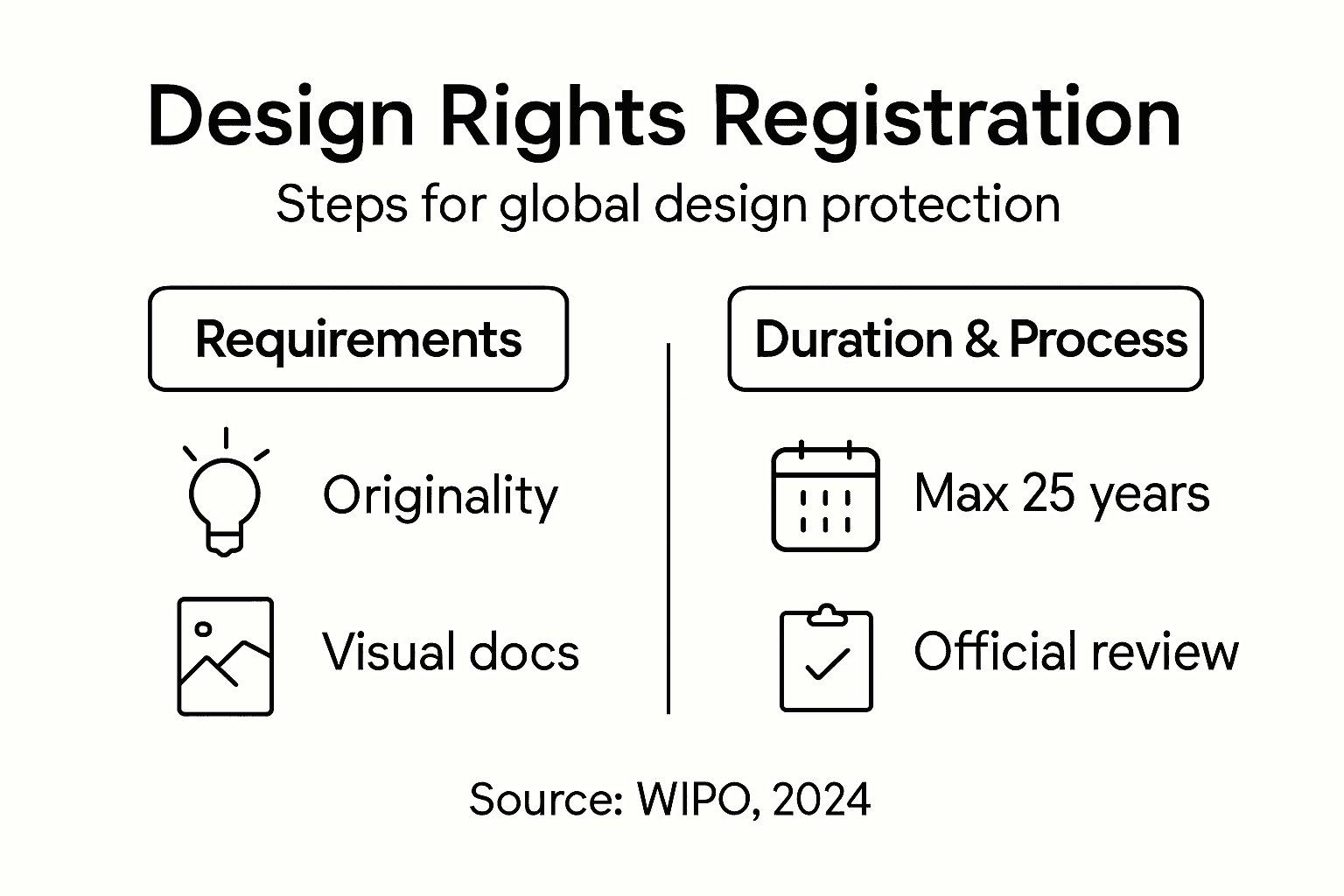
Design rights registration is a complex process that demands meticulous attention to specific legal and procedural requirements. Design registration processes require innovators to navigate intricate documentation and verification steps to secure comprehensive intellectual property protection.
The fundamental requirements for design rights registration typically include:
Proof of design originality
Detailed visual documentation (drawings or photographs)
Comprehensive design description
Payment of registration fees
Demonstration of individual character
Evidence of design’s novelty
Registration duration varies across jurisdictions, but most follow a standard framework. Design protection periods generally start with an initial five-year term, with the option to renew at five-year intervals up to a maximum of 25 years. Unregistered design rights offer more limited protection, typically providing automatic coverage for approximately three years after first public disclosure.
Design rights registration is a strategic investment in protecting innovative visual intellectual property.
The registration process demands careful documentation and strategic planning. Different regions have unique nuances in their requirements, with some jurisdictions offering more flexible approaches while others maintain stringent verification processes. Technological innovations and evolving market dynamics continually reshape design rights registration frameworks, requiring businesses to stay informed about current regulatory landscapes.
Pro tip: Maintain comprehensive documentation of your design’s development process and consult intellectual property specialists to ensure maximum protection across multiple jurisdictions.
Rights Conferred and Risk of Infringement
Design rights provide creators with a powerful legal mechanism to protect their innovative visual intellectual property. Design rights enforcement empowers innovators with exclusive commercial control over their unique design elements, enabling them to prevent unauthorized reproduction or exploitation.
The primary rights conferred by design registration include:
Exclusive commercial use of the design
Right to manufacture products incorporating the design
Authority to sell or distribute design-protected products
Legal standing to pursue infringement claims
Control over licensing and commercial permissions
Ability to prevent unauthorized reproduction
Infringement risks represent a significant concern for design rights holders. Intellectual property enforcement strategies can be complex, involving both direct and indirect violations. Direct infringement occurs through precise copying of design elements, while indirect infringement might involve supplying components or products that enable unauthorized design reproduction.
Design rights protection is not just a legal formality but a strategic business asset that safeguards innovation and competitive advantage.
Legal remedies for design rights infringement are robust and multifaceted. Design rights holders can pursue various actions, including seeking injunctions to halt unauthorized use, demanding financial damages, and requesting the recall or destruction of infringing products. The complexity of enforcement requires sophisticated legal strategies and continuous monitoring of potential violations in increasingly global and digital marketplaces.
Pro tip: Develop a proactive monitoring system to track potential design infringements and maintain comprehensive documentation of your original design process to strengthen potential legal claims.
Common Pitfalls and Digital Management Solutions
Navigating the complex landscape of digital design rights requires sophisticated strategies to address emerging technological challenges. Intellectual property challenges have become increasingly complex in the digital age, demanding innovative approaches to protect design innovations.
Common pitfalls in digital design rights management include:
Unintentional public disclosure
Inadequate documentation of design development
Incomplete understanding of international protection
Lack of proactive monitoring systems
Insufficient digital rights management strategies
Delayed registration of design rights
Digital management solutions have emerged as critical tools for protecting intellectual property. Digital Rights Management technologies provide sophisticated mechanisms to control design distribution, offering creators robust protection in increasingly complex digital ecosystems. These technologies enable precise tracking, limit unauthorized reproduction, and create comprehensive audit trails for design usage.
Effective digital rights management balances robust protection with technological flexibility and user accessibility.
The digital landscape presents unique challenges that require multifaceted protection strategies. Emerging technologies like blockchain, encryption, and advanced tracking systems are revolutionizing how designers secure their intellectual property. Successful digital rights management demands a proactive approach that combines legal frameworks, technological solutions, and continuous monitoring to address potential infringements across global digital platforms.
Pro tip: Implement a comprehensive digital rights management strategy that combines technological tools, legal frameworks, and continuous monitoring to protect your design innovations effectively.
Secure Your Unique Designs with Expert Legal Support
Protecting your innovative visual designs from unauthorized use is more crucial than ever in today’s global market. This article highlights the challenges of navigating complex design rights such as registration nuances, enforcement risks, and the need for tailored international strategies. If you want to confidently safeguard your product’s distinctive appearance and maintain exclusive commercial control, specialized legal guidance can make all the difference.
At Studio Legale Coviello, we combine deep expertise in intellectual property law with cutting-edge technology to ensure your design rights are robustly protected worldwide. Our services include strategic counseling on registered and unregistered design rights, managing complex international registrations, and leveraging digital tools for effective rights enforcement. With proven experience in global jurisdictions and sectors like food tech and IoT, we empower you to transform your design innovations into long-term business assets.
Take control of your design’s future today and navigate the legal landscape with confidence.
Explore how our tailored legal solutions can protect your creative assets and accelerate your business growth. Visit Studio Legale Coviello to start your personalized consultation and secure your intellectual property with expert care.
Frequently Asked Questions
What are design rights and what do they protect?
Design rights protect the unique visual characteristics of products, including their shape, configuration, pattern, and ornamentation. They focus solely on the aesthetic aspects of a design rather than its functional mechanics.
How do registered design rights differ from unregistered design rights?
Registered design rights provide stronger legal protection and can last up to 25 years, with easier enforcement options. In contrast, unregistered design rights offer limited protection for roughly three years and may require substantial evidence of copying for enforcement.
What are the steps involved in registering a design right?
To register a design right, you typically need to provide proof of originality, detailed visual documentation, a comprehensive description of the design, payment of registration fees, and evidence of the design’s novelty and individual character.
What should I do if I believe my design rights have been infringed?
If you suspect that your design rights have been infringed, you can pursue legal action against the infringer, including seeking injunctions to stop unauthorized use, demanding financial damages, or requesting the recall or destruction of infringing products.
Recommended

Comments