


How to Secure Commercial Rights: Avoid 40% SME IP Loss
- Feb 28
- 15 min read

Over 40% of SMEs lose valuable commercial IP rights due to missed registration deadlines or improper filings. For tech startups and SMEs operating in Italy and internationally, this statistic represents millions in lost market value and competitive advantage. This guide provides a clear, stepwise strategy to secure your intellectual property rights, navigate first-to-file registration systems, and protect your commercial assets from common pitfalls that drain business resources.
Table of Contents
Key Takeaways
Point | Details |
Identify and register IP assets early | Recognition and timely filing prevent priority losses under first-to-file systems |
Leverage international treaties for global protection | Madrid Protocol and PCT streamline multi-country registrations for patents and trademarks |
Plan realistic budgets and timelines | Factor legal fees, filing costs, and 6-18 month processing periods into business planning |
Use digital tools and legal counsel | AI-driven management reduces errors by 30% while expert advice prevents costly mistakes |
Monitor and enforce rights actively | Specialized IP courts in Italy offer fast-track procedures for infringement claims |
Introduction: Why Securing Commercial Rights Matters
Commercial rights encompass the legal protections that allow businesses to control and monetize their intellectual property. These include patents for inventions, trademarks for brands, designs for product aesthetics, and copyrights for creative works. For tech startups and SMEs, securing these rights forms the foundation of competitive advantage, investor confidence, and market expansion capability.
In Italy, securing patent, trademark, and design rights operates on a first-to-file system requiring registration before market introduction. This legal framework means whoever files first secures the rights, regardless of who invented or created the asset first. The European Union follows similar principles, making early registration critical for companies planning regional growth.
Businesses that fail to secure commercial rights face severe consequences:
Loss of exclusive market position to competitors who register similar IP first
Inability to prevent copycats from diluting brand value or stealing innovations
Reduced valuation during funding rounds or acquisition discussions
Expensive litigation with uncertain outcomes when defending unregistered rights
Blocked international expansion when foreign entities claim prior registration
“Your intellectual property is often your most valuable business asset. Without formal registration, you’re building a castle on sand.”
The stakes are particularly high for technology companies whose entire business model may depend on proprietary software, unique algorithms, distinctive branding, or innovative product designs. Securing rights isn’t just legal housekeeping; it’s strategic business protection that directly impacts your bottom line and growth trajectory.
Prerequisites: What You Need to Know Before Starting
Before initiating IP registration processes, you need foundational knowledge about the legal environment governing commercial rights in Italy and internationally. Understanding these prerequisites saves time, money, and prevents procedural errors that can invalidate your applications.
First-to-file rules dominate IP protection globally. In Italy and across the EU, the person or entity who files an application first secures the rights, even if others used or invented the IP earlier. This system contrasts with first-to-invent systems and creates urgency around documentation and filing. You must file before any public disclosure, commercial use, or competitor awareness to maintain priority.
The Madrid Protocol and Patent Cooperation Treaty allow international registrations protecting commercial rights in multiple countries including Italy. These treaties streamline the process of securing rights across borders through centralized filing systems. The Madrid Protocol covers trademarks, while the PCT handles patents, enabling businesses to reserve filing dates in numerous jurisdictions with single applications.
Key preparation steps include:
Conducting preliminary searches to verify your IP doesn’t infringe existing rights
Documenting creation dates, development processes, and commercial use evidence
Identifying target markets for protection beyond Italy to plan international filings
Assembling technical specifications, drawings, and descriptions required for applications
Establishing realistic budgets covering filing fees, legal counsel, and translation costs
Professional legal advice proves essential, especially for complex technologies or multi-jurisdictional protection strategies. IP attorneys help navigate procedural requirements, draft stronger applications that withstand challenges, and advise on strategic timing to maximize protection while minimizing costs. They also identify potential obstacles early, such as conflicting prior art or trademark similarities that could derail applications.
Budget planning should account for both immediate filing costs and long-term maintenance fees. Patents and trademarks require periodic renewals, and international registrations multiply these expenses across jurisdictions. Startups should integrate IP costs into financial projections from the outset, treating them as investments in competitive moats rather than optional expenses.
Step 1: Identify Your Intellectual Property Assets
Recognizing which business assets qualify for commercial protection forms the foundation of your IP strategy. Not all innovations or creative works require registration, so prioritizing based on commercial value ensures efficient resource allocation.
Startups should differentiate patents, trademarks, designs, and copyrights for their commercial relevance. Patents protect functional innovations such as new technologies, processes, or product features that solve technical problems. Trademarks safeguard brand identifiers including names, logos, slogans, and even distinctive colors or sounds. Industrial designs cover the aesthetic appearance of products. Copyrights protect original creative expressions like software code, written content, and graphic designs.
Prioritization criteria should focus on:
Revenue impact: Which assets directly drive sales or market differentiation?
Competitive advantage: What prevents competitors from replicating your success?
Investor requirements: Which IP protections increase valuation or satisfy due diligence?
Market expansion plans: What assets need protection in target international markets?
Infringement risk: Which assets are most vulnerable to copying or dilution?
Tech companies often face the patents versus trademarks dilemma. Patents provide strong protection for core technologies but involve lengthy examination processes, high costs, and public disclosure requirements. Trademarks offer quicker registration, lower costs, and indefinite renewal potential for brand elements. Most successful strategies combine both, protecting technical innovations through patents while building brand equity through trademark portfolios.
Document everything before filing. Maintain detailed records showing creation dates, development stages, and commercial deployment timelines. These records establish priority in disputes and support applications with evidence of originality. Use confidentiality agreements with employees, contractors, and partners to preserve trade secret protection for unregistered IP during the development phase.

Create an IP inventory spreadsheet listing all potentially protectable assets, their commercial importance, estimated registration costs, and recommended filing priorities. This systematic approach prevents overlooking valuable assets and helps allocate limited budgets to highest-impact protections first.
Step 2: Register Your IP with Relevant Authorities
Registration transforms ideas and creations into legally enforceable commercial rights. Understanding the specific processes, authorities, and strategic options available in Italy and the EU ensures effective protection aligned with business goals.
Italy uses a first-to-file system requiring prior registration with local or EU offices before market introduction. You have three primary registration paths: national filing with the Italian Patent and Trademark Office (UIBM), EU-wide filing with the European Union Intellectual Property Office (EUIPO), or international filing through WIPO treaties.
National versus EU registration presents important tradeoffs:
Aspect | National (UIBM) | EU-wide (EUIPO) |
Geographic Coverage | Italy only | All 27 EU member states |
Cost | Lower initial fees | Higher but cost-effective for multi-country needs |
Processing Time | 6-12 months | 4-6 months for trademarks |
Enforcement | Italian courts only | Unitary protection across EU |
For trademark registrations, the EUIPO system facilitates easier SME access without mandatory professional representation. The EUIPO simplified process allows direct online applications with user-friendly interfaces and automated preliminary searches. Fees start around €850 for one class of goods or services, with additional classes costing approximately €50 each.
Patent registration requires more complexity. National Italian patents cost roughly €200-600 in official fees but necessitate detailed technical descriptions and claims drafted by specialists. European patents through the EPO provide broader protection with validation in selected countries, though costs escalate with translations and national validation fees potentially reaching €5,000-10,000 for comprehensive coverage.
Design protection offers relatively quick and affordable registration. Registered Community Designs through EUIPO cost approximately €350 for up to 25 years of protection across the EU, making them excellent value for product-based businesses.
Practical registration steps:
Complete preliminary searches through UIBM, EUIPO, or WIPO databases to identify conflicts
Prepare application materials including descriptions, drawings, and classification codes
File online through official portals, ensuring accurate contact and representation details
Respond promptly to office actions or objections within specified deadlines
Pay renewal fees according to jurisdiction-specific schedules to maintain protection
Pro Tip: File trademark applications before patent applications when protecting the same product. Trademarks process faster and establish brand presence while patent examinations proceed, allowing earlier market entry under protected branding even before patent grants issue.
Timelines vary significantly. Trademarks typically register within 4-12 months absent objections. Patents require 18-36 months for examination and grant. Following practical registration procedures with accurate documentation accelerates processing and reduces rejection risks.
Step 3: Understand Costs and Timelines
Realistic financial and temporal expectations prevent budget overruns and planning failures. IP registration involves both immediate filing expenses and long-term maintenance costs that compound across jurisdictions and asset types.
Typical cost ranges for Italian and EU registrations:
IP Type | National Filing | EU Filing | Legal Fees (Est.) |
Trademark | €200-400 | €850-1,500 | €500-1,500 |
Patent | €200-600 | €1,000-2,000 | €3,000-8,000 |
Design | €100-300 | €350-700 | €300-1,000 |
Copyright | Often automatic | N/A | €200-500 for registration |
These figures represent official fees plus conservative legal counsel estimates. Complex technologies, multiple classifications, or opposition proceedings increase costs substantially. International registrations through Madrid Protocol or PCT add per-country designation fees ranging from €100-1,000 per jurisdiction.
Processing timelines from filing to protection:
Trademarks: 4-6 months (EUIPO), 6-12 months (national)
Patents: 18-36 months including examination and potential office action responses
Designs: 1-3 months for registration certificates
International extensions: Add 6-18 months depending on designated countries
Renewal obligations create ongoing costs. Trademarks require renewal every 10 years at fees similar to initial registration. Patents demand annual maintenance fees that escalate over time, potentially reaching several thousand euros by year 20. Designs renew in 5-year increments up to 25 years total protection.
Budgeting strategies for startups and SMEs:
Phase filings by priority, protecting core assets first while deferring secondary IP
Use provisional patent applications to establish priority dates affordably before full specification investment
Limit initial geographic coverage to key markets, expanding as revenue grows
Negotiate fixed-fee arrangements with IP counsel to control legal cost variability
Reserve 20-30% budget buffer for unexpected objections or opposition proceedings
Many jurisdictions offer SME fee reductions. EUIPO provides discounts for small businesses on certain trademark filings. Some national offices reduce patent fees for qualifying small entities. Research available incentives during application planning to maximize budget efficiency.
The total cost of securing comprehensive IP protection for a typical tech startup ranges from €5,000-20,000 in the first year, depending on asset quantity and geographic scope. Annual maintenance costs typically run €1,000-5,000 for established portfolios. Factor these expenses into fundraising targets and cash flow projections to avoid protection lapses that forfeit rights.
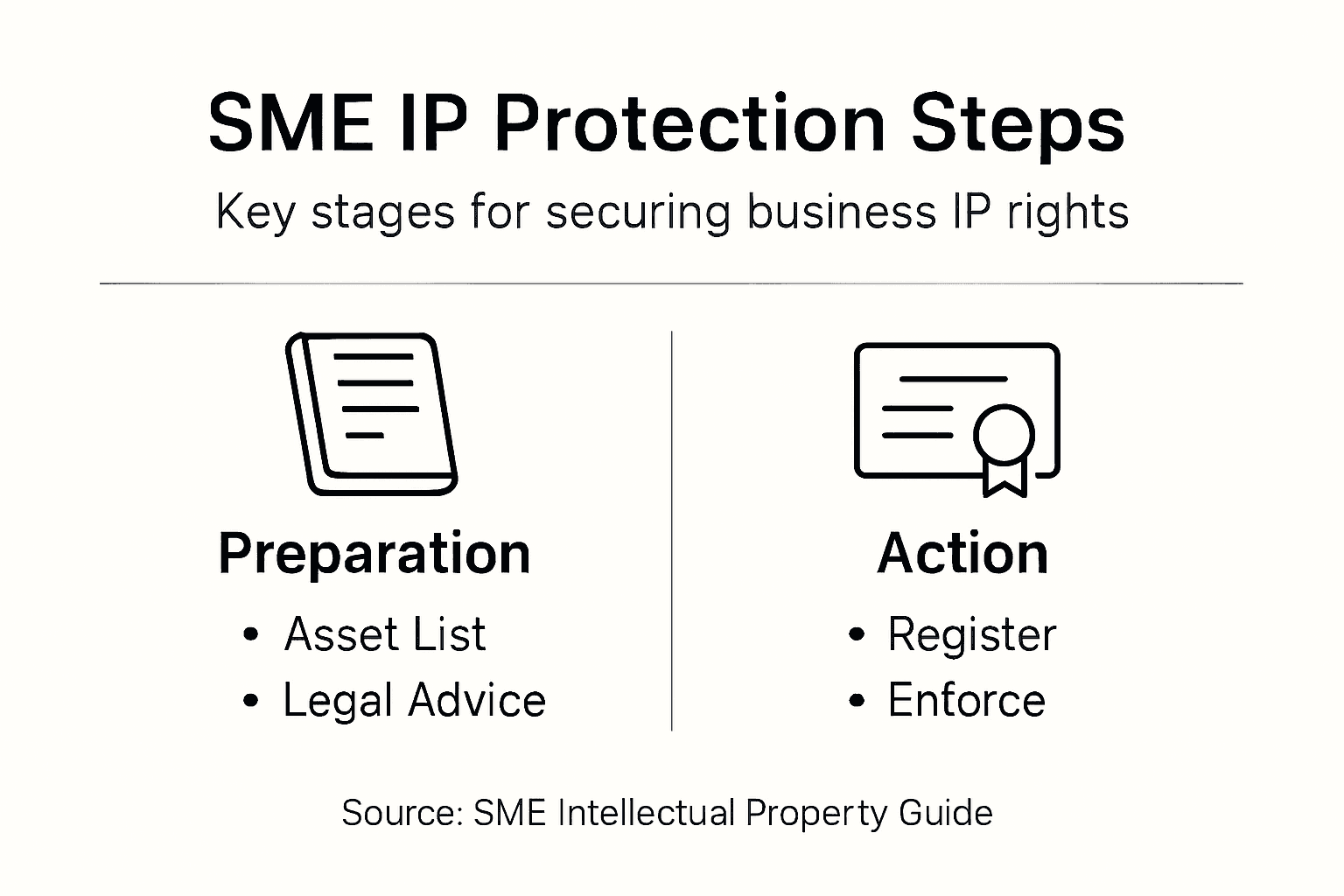
Step 4: Enforce and Protect Your Rights
Securing registration certificates represents only half the battle. Active enforcement against infringement ensures your commercial rights deliver actual competitive protection rather than mere paper documentation.
Italy’s legal system provides robust enforcement mechanisms through specialized IP courts. Business law sections within major courts handle trademark, patent, and design disputes with judges experienced in technical and commercial IP matters. These specialized courts understand complex technologies and market dynamics better than general civil courts, leading to more informed decisions.
Enforcement tools available to rights holders:
Cease and desist letters demanding infringement cessation before litigation
Preliminary injunctions preventing ongoing infringement during court proceedings
Seizure orders removing infringing goods from commerce
Damages claims recovering lost profits and unjust enrichment
Destruction orders eliminating infringing inventory and production materials
Italy’s fast-track procedures allow combining infringement claims with invalidity defenses in single proceedings, accelerating resolution compared to bifurcated systems requiring separate validity and infringement trials. Preliminary injunctions can issue within weeks when infringement evidence is clear and irreparable harm is demonstrated.
Border enforcement through customs authorities provides another powerful tool. Register your IP rights with Italian customs to enable ex officio action against suspected counterfeits. Customs officials can detain suspicious shipments, allowing rights holders to inspect goods and initiate legal action before infringing products enter distribution channels.
Effective enforcement strategy elements:
Implement monitoring systems tracking competitor activities and market entries
Document infringement thoroughly with dated evidence of infringing products or services
Evaluate enforcement economics: litigation costs versus potential recovery and strategic value
Consider alternative dispute resolution to resolve conflicts faster and cheaper when appropriate
Maintain enforcement consistency to preserve rights and avoid abandonment arguments
Pro Tip: Engage enforcement counsel at first infringement suspicion rather than after market damage accumulates. Early legal analysis determines optimal response strategies and prevents tactical errors that weaken later litigation positions. Initial consultations cost far less than recovering from delayed action.
Online infringement presents unique challenges. E-commerce platforms often have notice-and-takedown procedures for IP rights holders. Submit documented claims through platform-specific processes to remove infringing listings quickly. Social media platforms similarly respond to trademark and copyright complaints with content removal mechanisms.
International enforcement requires coordinated action across jurisdictions. Use international treaties and reciprocal enforcement agreements to pursue cross-border infringers. EU regulations allow unitary enforcement actions covering multiple member states, reducing the need for parallel national proceedings.
Step 5: Manage and Optimize Your IP Assets
Ongoing portfolio management transforms static registrations into dynamic business assets that adapt to market evolution and strategic pivots. Systematic monitoring, strategic renewals, and data-driven optimization maximize return on IP investment.
Digital tools revolutionize IP management efficiency. AI-driven IP management systems reduce errors by 30% and improve compliance with renewals and enforcement deadlines. These platforms aggregate portfolio data, automate deadline tracking, and generate renewal reminders months before lapses occur.
Key management activities:
Centralize all IP documentation in searchable databases with status tracking
Monitor renewal deadlines across jurisdictions to prevent inadvertent abandonments
Review portfolio annually to identify underperforming assets for abandonment or sale
Update registrations to reflect business name changes, ownership transfers, or address modifications
Expand protection to new markets as business scales geographically
Specialized AI tools for IP management analyze patent landscapes, identify white space opportunities, and predict litigation risks based on historical data patterns. Machine learning algorithms detect potential infringements by monitoring trademark registrations, patent publications, and market activities faster than manual review allows.
Strategic portfolio optimization involves:
Pruning assets that no longer align with business direction to reduce maintenance costs
Licensing unused IP to generate revenue from non-core assets
Bundling complementary IP into licensing packages that command premium rates
Filing continuation or divisional applications to expand protection around core innovations
Monitoring competitor IP to identify acquisition opportunities or freedom-to-operate risks
Legal counsel provides strategic guidance beyond routine administration. Regular portfolio reviews with IP attorneys identify optimization opportunities, assess litigation risks, and align protection strategies with evolving business goals. Quarterly or semi-annual reviews typically suffice for active portfolios.
Pro Tip: Integrate calendar alerts with management software three months before renewal deadlines. This buffer allows time to evaluate strategic value, secure budget approvals, and process payments without last-minute scrambles that risk missed deadlines and lost rights.
Value extraction from IP portfolios extends beyond direct use. Consider these approaches:
License patents to non-competing industries operating in different markets
Cross-license with partners to access complementary technologies while monetizing your own
Use IP as collateral for financing, particularly valuable patents or established trademarks
Package IP portfolios to increase acquisition valuation during exit negotiations
Donate obsolete IP for tax benefits while maintaining freedom to operate
Maintain confidentiality around strategic IP development. Not all innovations require public registration. Trade secrets offer perpetual protection for non-obvious information kept confidential. Balance registration costs and disclosure requirements against trade secret advantages for process innovations or algorithms difficult to reverse-engineer.
Common Mistakes and How to Avoid Them
Understanding frequent pitfalls allows you to implement preventive measures that protect your investments in commercial rights. These mistakes cost SMEs millions annually in lost protection and enforcement failures.
Delaying registration past critical deadlines represents the most common and costly error. First-to-file systems offer no grace period. Over 40% of SMEs lose IP rights due to poor registration timing or lack of legal advice. Public disclosure before filing destroys novelty for patents and creates prior art that blocks later applications.
“The difference between securing rights and losing them forever often comes down to a single day of delay.”
Skipping professional legal advice to save costs frequently backfires. Improperly drafted applications suffer rejections, require expensive amendments, or grant weak protections easily invalidated by competitors. False economies on legal fees multiply into far larger losses when protection fails. Invest in qualified IP attorneys for complex filings even if budget constraints require phasing registrations.
Ignoring international registrations before market expansion leaves foreign markets unprotected. Competitors can register your brands or technologies in target countries first, blocking your entry or forcing expensive buyouts. File international protection before announcing expansion plans or shipping products abroad.
Failing to track renewal deadlines causes inadvertent abandonments. Most jurisdictions provide limited revival windows with penalty fees, but some allow no restoration of lapsed rights. Missing a renewal transforms valuable assets into public domain instantly. Implement redundant reminder systems with multiple stakeholders receiving alerts.
Practical fixes for common mistakes:
Establish filing protocols requiring IP review before any public product launches or marketing
Budget legal counsel as essential infrastructure, not optional expense
Research and file in key export markets within 6 months of initial filing using priority claims
Deploy automated deadline tracking integrated with accounting systems for renewal payments
Document all creation and development activities contemporaneously to establish priority if disputes arise
Additional pitfalls include inadequate record keeping, poor confidentiality practices before filing, selecting overly narrow protection scopes, and neglecting employee IP assignment agreements. Address these systematically through documented policies and regular compliance audits.
The cost of prevention pales compared to correction expenses. Preventive legal review costs €500-2,000 depending on complexity. Fixing errors or recovering from lost rights can run €10,000-100,000 in legal fees plus permanent market disadvantages. Invest appropriately from the start.
Expected Outcomes: How You Know You’ve Secured Your Commercial Rights
Success in securing commercial rights manifests through tangible milestones and measurable business improvements. These outcomes validate your investment and provide confidence in your competitive positioning.
Receiving official registration certificates represents the primary indicator. Patent grants, trademark registration certificates, and design registration confirmations from UIBM, EUIPO, or other offices provide legal proof of exclusive rights. File these documents securely with backup copies, as they form the foundation for enforcement actions and licensing negotiations.
Observable outcomes of successful rights securing:
Competitors cease infringing activities after receiving cease and desist notices citing your registrations
Investors complete due diligence without IP-related concerns, facilitating funding closures
Licensing opportunities emerge as partners seek legitimate access to your protected technologies or brands
Customs seizures prevent counterfeit products from reaching your markets
Market surveys show improved brand recognition without dilution from confusingly similar marks
Reduction in infringement incidents signals effective protection. When competitors respect your boundaries, enforcement costs decline while market exclusivity strengthens. This quiet success often goes unnoticed but represents the ultimate validation of IP strategy.
Successful resolutions of enforcement actions provide concrete validation. Court judgments in your favor, settlement agreements extracting damages or licensing fees, and injunctions stopping infringement all demonstrate that registered rights carry real market power. Even preliminary injunctions granted quickly show courts recognize your rights’ validity and importance.
Maintaining up-to-date portfolio status without lapses indicates operational excellence. Green status across all assets in management systems, timely renewals without emergency interventions, and zero inadvertent abandonments demonstrate mature IP governance. This operational success protects asset value over decades.
Quantifiable business metrics that reflect IP value include:
Increased company valuation driven by strong IP portfolios during fundraising
Licensing revenue streams generated from monetizing protected assets
Market share defense or growth enabled by competitor exclusion
Reduced piracy or counterfeiting losses measured through sales data
Geographic expansion success without IP blocking issues
Documenting these outcomes supports internal stakeholder communication and external marketing of business strengths. Create dashboards tracking portfolio health metrics, enforcement success rates, and financial returns from IP assets to demonstrate strategic value to boards and investors.
Secure Your Commercial Rights with Expert Legal Support
Navigating IP registration complexities and enforcement challenges requires specialized legal expertise combined with strategic business insight. Studio Legale Coviello delivers comprehensive IP services tailored for tech startups and SMEs pursuing domestic and international growth.

Our IP valuation procedures help you understand which assets deserve protection priority and investment. We develop customized strategies aligned with your market positioning and expansion roadmap. From initial asset identification through registration, enforcement, and portfolio optimization, we provide end-to-end support that transforms IP from legal obligation into competitive advantage.
We guide clients through global IP protection strategies leveraging international treaties and coordinated multi-jurisdictional filings. Our patent registration expertise ensures applications maximize protection scope while navigating examination requirements efficiently. Contact us today to discuss how tailored legal support can secure your commercial rights and accelerate business success.
FAQ
What happens if I miss the registration deadline for my IP?
Missing registration deadlines in first-to-file jurisdictions typically results in permanent loss of priority rights. Competitors who file applications for similar IP before you complete registration will secure protection ahead of you, potentially blocking your own applications. Most systems offer no remedy or grace period once another party establishes prior filing dates. Your only options involve developing alternative IP or negotiating licenses from the prior filer, both expensive and uncertain.
Can I enforce my commercial rights internationally without local registrations?
Enforcement without local registrations in target countries is generally impossible except for copyright and certain well-known trademarks under specific treaty provisions. Most jurisdictions require national registration as a prerequisite for bringing infringement actions in their courts. International treaties like the Madrid Protocol and PCT facilitate obtaining registrations across multiple countries efficiently but do not eliminate the registration requirement itself. File in all markets where you conduct business or face competition to ensure enforceable rights.
Are digital tools necessary for managing IP portfolios?
While not strictly mandatory, digital management tools dramatically reduce oversight risks and improve strategic optimization. Tracking renewal deadlines across multiple jurisdictions and asset types manually creates high error probability. AI-powered platforms identify upcoming deadlines, flag potential infringements, and analyze portfolio performance far more reliably than spreadsheets. For portfolios exceeding 10-15 assets, professional management software becomes cost-effective by preventing even a single missed renewal that would forfeit valuable rights.
How much should startups budget for IP protection in the first year?
Realistic first-year budgets for comprehensive protection typically range €5,000-20,000 depending on asset quantity and geographic scope. Minimum viable protection covering one trademark and one provisional patent application with legal counsel costs approximately €3,000-5,000. Comprehensive coverage including multiple trademarks, full patent applications, design registrations, and EU-wide protection can reach €15,000-30,000. Factor these costs into fundraising targets and treat them as infrastructure investment rather than discretionary expense. Inadequate protection undermines entire business models built on IP assets.
What remedies exist if someone infringes my registered commercial rights?
Registered rights enable multiple remedies including preliminary injunctions stopping ongoing infringement immediately, permanent injunctions preventing future violations, monetary damages compensating lost profits, accounting for infringer’s profits earned through unauthorized use, and destruction of infringing goods. Italy’s specialized IP courts can issue fast-track decisions within weeks for clear cases. Border enforcement through customs adds another layer allowing seizure of counterfeit imports before market entry. Strong registrations also facilitate favorable settlements by demonstrating serious enforcement intent backed by legal authority.
Recommended

Comments