


Copyright Compliance: Why It Matters for Global Startups

Confusion about copyright compliance often surfaces when fast-growing tech startups expand across the European market, especially between countries like Italy and France. Failing to respect exclusive rights granted to creators can expose companies to real financial risk, even when founders believe correct citation offers protection. This article clarifies the core concepts of copyright compliance, debunks common misconceptions, and highlights practical steps to help global leadership teams safeguard their intellectual property through well-informed strategies.
Table of Contents
Key Takeaways
Point | Details |
Understand Copyright Compliance | It involves recognizing creators’ exclusive rights and the nuances of fair use, which are crucial for startups. |
Recognize Different Copyright Rights | Distinguish between economic and moral rights to maintain control over works and build a strong management strategy. |
Mitigate Copyright Risks | Develop comprehensive documentation and contributor agreements to avoid unintended infringements and legal issues. |
Implement Effective Management Strategies | Utilize technology for tracking copyright assets and create ongoing training programs to ensure compliance and innovation. |
Defining Copyright Compliance and Its Misconceptions
Copyright compliance represents a complex legal framework that protects original creative works while establishing boundaries for their use. At its core, copyright compliance involves understanding and respecting the exclusive rights granted to creators, ensuring that intellectual property remains protected across digital and physical domains.
Misconceptions about copyright are widespread, particularly among global startups navigating international regulations. Many entrepreneurs incorrectly assume that proper citation guarantees legal usage, when in reality, attribution does not automatically grant permission to reproduce substantial portions of someone else’s work. Copyright law protects the expression of ideas, not the ideas themselves, making nuanced understanding critical for innovative businesses.
Key aspects of copyright compliance include:
Recognizing automatic protections for original works
Understanding fair use limitations
Obtaining proper permissions before reproduction
Distinguishing between plagiarism and legal copyright infringement
Respecting international intellectual property regulations
Copyright protection extends beyond simple attribution, encompassing complex legal rights surrounding reproduction, distribution, performance, and display of original works. Copyright compliance requires evaluating multiple factors when determining permissible use, including purpose, nature of the work, amount utilized, and potential market impact.
Pro tip: Consult legal professionals specializing in intellectual property to develop a comprehensive copyright compliance strategy tailored to your startup’s specific international operational needs.
Copyright Laws in the EU and Italy
The European Union and Italy have developed robust legal frameworks to protect intellectual property, with copyright laws designed to support creative innovation while safeguarding creators’ rights. Copyright protection in the EU operates on a comprehensive principle that automatically shields original works from the moment of creation, providing significant security for digital and traditional creative endeavors.
In Italy, copyright regulations are primarily governed by Law No. 633 of 1941, which has been continuously updated to align with evolving European directives. These laws extend protection to a wide range of creative works, including:
Literary and artistic compositions
Musical and theatrical productions
Architectural and cinematographic works
Software and digital databases
Multimedia content and digital innovations
Copyright duration in the European context is remarkably consistent, typically lasting the author’s lifetime plus an additional 70 years after their death. This extended protection ensures that creators and their descendants can benefit from their intellectual contributions. Italian copyright laws specifically provide comprehensive coverage for various creative expressions, recognizing both economic and moral rights of authors.
The legal landscape for copyright in Italy and the EU is characterized by its proactive approach to protecting intellectual property. While formal registration is not mandatory, authors can deposit their works with the Italian Society of Authors and Publishers to establish clear evidence of authorship and creation date. This system provides an additional layer of security for creators seeking to protect their original works.
Pro tip: Consult with local intellectual property experts to understand the nuanced copyright protections specific to your industry and creative output in the European market.
Types of Protected Works and Ownership
Copyright protection extends across a diverse range of creative and intellectual outputs, providing comprehensive safeguards for original works. Copyright protection covers multiple work categories, encompassing literary, musical, dramatic, choreographic, pictorial, graphic, and architectural compositions that demonstrate unique creative expression.
The scope of protected works for global startups is remarkably broad, including:
Software and digital applications
Research papers and scholarly articles
Technical diagrams and visual representations
Multimedia content and audiovisual productions
Sound recordings and architectural designs
Database compilations and digital datasets
Ownership dynamics in copyright law are intricate, with initial rights typically residing with the original creator. Research output ownership can become complex, especially when works are produced under institutional funding or employment contracts. Creators must carefully navigate agreements that might transfer or share intellectual property rights, understanding that copyright does not protect ideas themselves, but their specific expression.
The legal framework distinguishes between economic and moral rights, ensuring creators maintain control over how their works are used and attributed. Economic rights allow creators to authorize reproduction, distribution, and public performance, while moral rights protect the integrity of the original work and the creator’s reputation. Startups must develop robust strategies for tracking, managing, and potentially licensing their intellectual assets to maximize their creative investments.
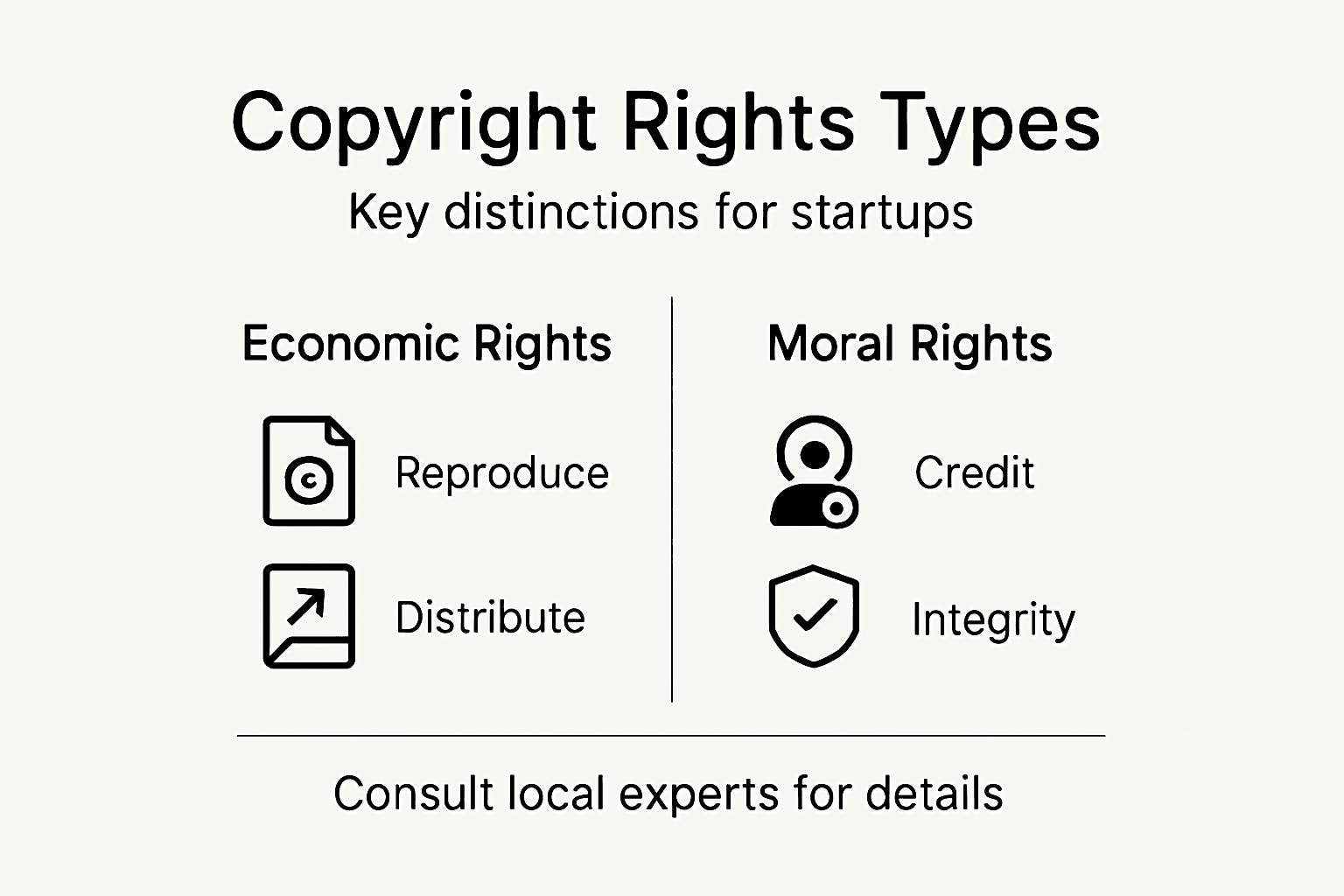
Here’s a comparison of economic and moral rights in copyright law:
Right Type | Core Focus | Examples of Rights | Impact on Creators |
Economic Rights | Control of exploitation | Reproduce, distribute, license | Generate revenue, manage use |
Moral Rights | Protection of reputation | Attribution, work integrity | Maintain recognition, prevent misuse |
Pro tip: Document the creation process and maintain detailed records of intellectual property development to establish clear ownership and protect your startup’s creative assets.
Copyright Compliance for Tech Startups
Tech startups operate in a complex intellectual property landscape where understanding and implementing robust copyright strategies is crucial for long-term success. Strategic copyright protection requires a proactive approach that goes beyond basic legal compliance, integrating comprehensive safeguards into the core business model.
Key copyright compliance strategies for technology companies include:
Developing comprehensive contributor agreements
Implementing rigorous version control systems
Establishing clear intellectual property ownership protocols
Creating internal training programs on copyright basics
Documenting innovation and creative processes
Registering critical intellectual assets
Copyright management demands meticulous attention to detail, particularly for digital innovations where intellectual property boundaries can become blurred. Startups must navigate jurisdictional differences, understanding that fair use doctrines vary significantly across different legal frameworks. This requires maintaining detailed documentation of creative processes, contributor roles, and potential licensing opportunities.

Effective copyright compliance is not merely a legal requirement but a strategic business asset. By establishing clear ownership protocols and protecting innovative technologies, startups can enhance their valuation, attract potential investors, and create a robust foundation for future growth. Developing a comprehensive intellectual property strategy that anticipates potential challenges and proactively addresses them can differentiate a startup in competitive technology markets.
Pro tip: Consult with intellectual property specialists early in your startup’s development to create a tailored copyright protection strategy that aligns with your specific technological innovations.
Risks, Liabilities, and Enforcement Actions
Navigating the complex landscape of copyright risks requires sophisticated understanding of potential legal vulnerabilities that can significantly impact a startup’s operational and financial stability. International copyright enforcement demands strategic awareness of global legal frameworks and proactive protection mechanisms.
Primary copyright risks for global startups include:
Unintentional infringement of existing intellectual property
Inadequate documentation of creative processes
Lack of comprehensive contributor agreements
Insufficient monitoring of potential unauthorized use
Cross-jurisdictional legal complexity
Potential financial penalties for violations
Liability exposure extends beyond simple monetary damages, potentially threatening a startup’s reputation, investor confidence, and future market positioning. International treaties like the Berne Convention and TRIPS Agreement provide foundational protections, but startups must actively develop robust enforcement strategies that anticipate and mitigate potential legal challenges.
Effective risk management requires a multifaceted approach that combines legal preparedness, technological monitoring, and strategic documentation. Startups should implement comprehensive tracking systems, maintain detailed records of creative development, and establish clear protocols for addressing potential infringement. This proactive stance not only minimizes legal risks but also demonstrates organizational maturity to potential investors and partners.
The following table summarizes key copyright compliance risks for startups and recommended preventive actions:
Risk Category | Description | Recommended Preventive Measure |
Unintentional infringement | Accidental use of protected works | Implement strict content vetting |
Poor documentation | Lack of detailed creation records | Maintain meticulous asset logs |
Insufficient agreements | Contributor rights unclear | Execute thorough contributor contracts |
Cross-border complexity | Varying international legal standards | Consult global IP legal specialists |
Pro tip: Develop a comprehensive intellectual property audit process that systematically reviews and documents all creative assets, tracking their origin, development, and potential licensing opportunities.
Strategies for Effective Copyright Management
Successful copyright management requires a comprehensive and strategic approach that goes beyond basic legal compliance. Copyright protection strategies demand proactive planning and systematic implementation across multiple organizational dimensions.
Key strategies for robust copyright management include:
Registering copyrights in relevant jurisdictions
Developing comprehensive contributor agreements
Maintaining detailed documentation of creative processes
Implementing continuous monitoring systems
Establishing clear ownership protocols
Creating internal training and awareness programs
Securing appropriate licensing mechanisms
Technology integration plays a critical role in modern copyright management, enabling startups to track, protect, and leverage their intellectual assets more effectively. Specialized management tools can help organizations navigate the complex landscape of international copyright regulations, providing sophisticated tracking and enforcement capabilities that extend beyond traditional legal frameworks.
Effective copyright management is an ongoing process that requires consistent attention and adaptation. Startups must develop flexible strategies that can evolve with changing technological landscapes and legal environments. This involves not just protecting existing intellectual property but also creating a culture of innovation that understands and respects creative ownership across global markets.
Pro tip: Invest in specialized intellectual property management tools that provide comprehensive tracking, documentation, and monitoring capabilities for your startup’s creative assets.
Secure Your Startup’s Future with Expert Copyright Compliance Support
Navigating copyright compliance is a critical challenge for global startups. Misunderstanding complex international copyright laws or lacking thorough documentation can expose your business to costly risks and legal disputes. Protect your innovations, maintain clear ownership, and confidently operate across borders by partnering with experts who specialize in intellectual property and international commercial law.
Our team at Studio Legale COVIELLO combines deep legal expertise with cutting-edge technology solutions to deliver tailored strategies for safeguarding your copyrights and other intellectual assets. From contributor agreements to ongoing monitoring and compliance management, we help startups build strong foundations that enhance investor confidence and fuel growth.
Take control of your intellectual property today. Discover our services that integrate advanced tools including AI-powered legal approaches and mobile management apps to streamline your copyright protection.
Don’t let copyright uncertainties limit your startup’s potential. Contact Studio Legale COVIELLO now to develop a comprehensive copyright compliance strategy designed specifically for your global ambitions.
Frequently Asked Questions
What is copyright compliance?
Copyright compliance refers to the legal framework that protects original creative works and ensures that creators’ exclusive rights are respected. It involves understanding copyright laws, obtaining necessary permissions, and distinguishing between acceptable use and infringement.
Why is copyright compliance important for global startups?
Copyright compliance is crucial for global startups as it helps protect their intellectual property, minimizes the risk of legal issues, and fosters trust with investors and partners. Ensuring compliance also supports innovation and aligns with international regulations.
What are common misconceptions about copyright?
Common misconceptions about copyright include the belief that proper citation guarantees legal usage and that copyright protects ideas rather than the expression of those ideas. Understanding these aspects is vital for startups to avoid potential legal pitfalls.
How can tech startups develop effective copyright strategies?
Tech startups can develop effective copyright strategies by implementing comprehensive contributor agreements, maintaining detailed documentation of creative processes, and employing monitoring systems to track potential infringement. Consulting with intellectual property specialists is also recommended.
Recommended

Comments