


Intellectual Property in Business: Key to Innovation

Building a technology startup involves more than disruptive ideas and agile teams—it demands a sharp understanding of intellectual property. Overlooking intangible assets like patents, trademarks, copyrights, and trade secrets can leave even the most promising innovations open to exploitation. For global-minded founders and IP managers, mastering these fundamentals helps prevent costly missteps and supports strategic growth beyond borders.
Table of Contents
Key Takeaways
Point | Details |
Understanding IP Types | Entrepreneurs should be aware of different types of intellectual property—patents, trademarks, copyrights, trade secrets, and designs—and their unique protections. |
Proactive IP Management | Implementing a comprehensive IP strategy is crucial, including registrations, audits, and monitoring to safeguard intellectual assets effectively. |
Global Compliance | Businesses need to navigate complex international regulations, developing strategies that account for jurisdiction-specific nuances to protect their IP globally. |
Risk Mitigation | Establishing robust IP risk management practices, including documentation and employee training, can help to minimize legal liabilities and enhance protection. |
Intellectual property fundamentals and misconceptions
Intellectual property (IP) represents a complex legal framework protecting innovative creations across multiple domains. At its core, IP encompasses intangible assets that stem from human creativity and intellectual achievement. Entrepreneurs and innovators must understand these legal protections to safeguard their competitive advantages and prevent unauthorized use of their unique contributions.
The fundamental categories of intellectual property include patents, trademarks, copyrights, and trade secrets. Intellectual property principles recognize that different types of creative works require distinct legal mechanisms for protection. Patents cover novel inventions and technological innovations, trademarks protect brand identities and logos, copyrights defend original artistic and literary works, while trade secrets maintain confidentiality around critical business processes and formulas.
Common misconceptions about intellectual property can significantly undermine an organization’s strategic positioning. Many entrepreneurs mistakenly believe that simply creating something automatically guarantees legal protection. In reality, proactive registration and strategic documentation are essential for establishing and maintaining robust intellectual property rights. Companies must understand that IP protection requires deliberate legal actions, systematic documentation, and ongoing monitoring to prevent potential infringement.
Pro tip: Conduct a comprehensive IP audit annually to identify, categorize, and strategically protect your organization’s intellectual assets before potential competitors can exploit them.
Types of IP: patents, trademarks, copyrights, designs
Intellectual property protection offers sophisticated legal mechanisms designed to safeguard different forms of innovative and creative assets. Fundamental IP protection strategies recognize that each type of intellectual property requires unique approaches to ensure comprehensive legal defense and commercial value.
Patents represent the most technical form of IP protection, covering novel inventions and technological innovations. These legal instruments grant inventors exclusive rights to their unique processes, machines, compositions of matter, and technological solutions for a specified period. Trademarks, by contrast, protect distinctive brand identifiers like logos, names, and symbols that distinguish a company’s goods or services in the marketplace. Copyrights defend original artistic and literary works, including software, music, writings, and creative expressions, providing creators control over reproduction and distribution of their intellectual contributions.

Designs represent a nuanced category of intellectual property that protects the visual aesthetics and ornamental characteristics of products. Industrial design rights safeguard the unique shape, configuration, pattern, or decorative elements that give a product its distinctive appearance. This protection is crucial for industries where visual appeal directly influences consumer purchasing decisions, such as fashion, consumer electronics, and automotive design.
Pro tip: Develop a comprehensive IP strategy that proactively identifies and registers different types of intellectual property across your organization to maximize legal protection and potential commercial value.
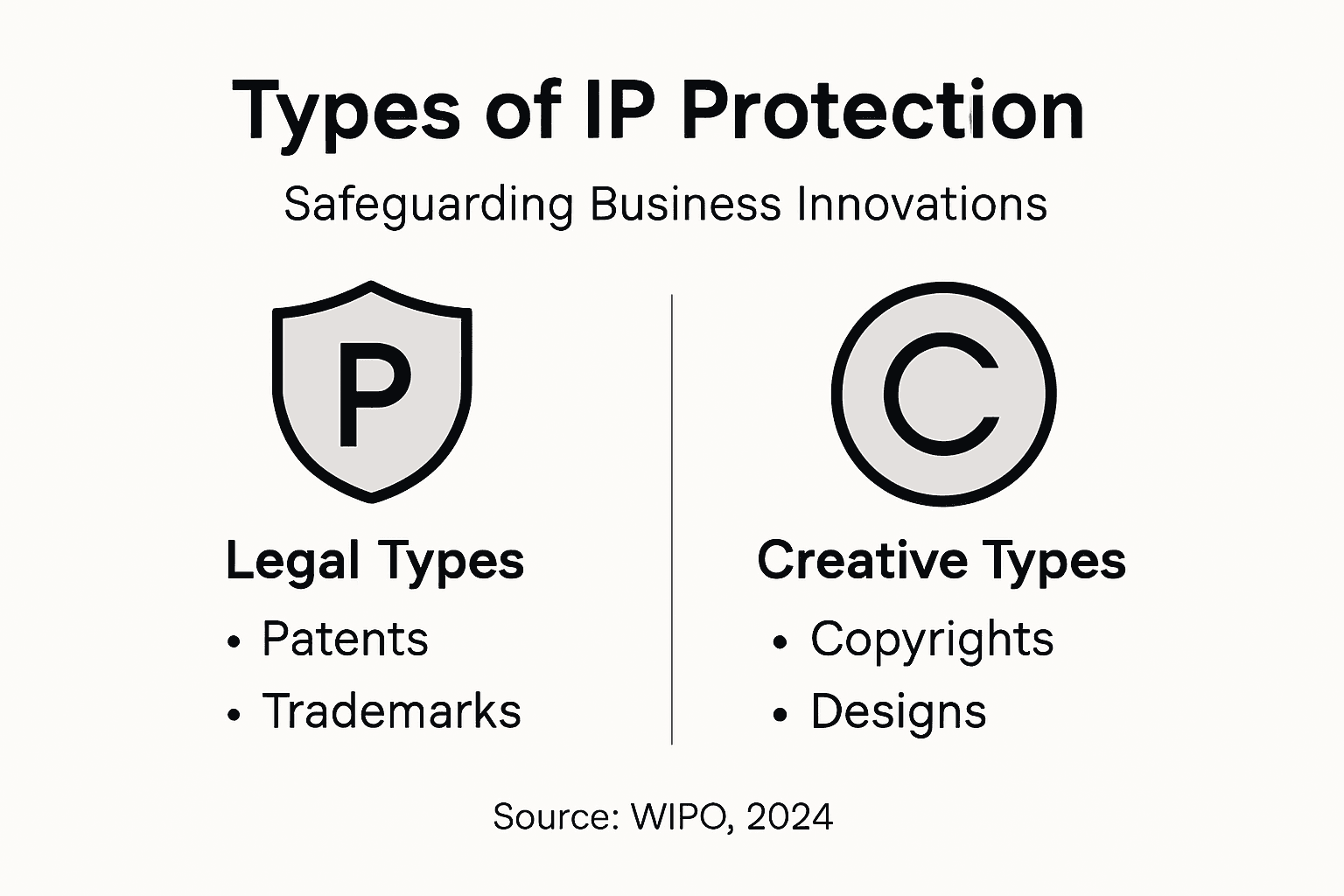
Here’s a comparison of key types of intellectual property and their primary business impacts:
IP Type | What It Protects | Typical Business Benefit |
Patent | Inventions and technical solutions | Market exclusivity, innovation leadership |
Trademark | Brand names, logos, symbols | Brand recognition, customer trust |
Copyright | Artistic and literary works | Control over creative output |
Trade Secret | Confidential business information | Competitive edge, unique processes |
Design | Product appearance and aesthetics | Differentiation by visual appeal |
Global legal frameworks and compliance requirements
Intellectual property protection demands sophisticated navigation of complex international regulations that vary significantly across different jurisdictions. International IP protection standards require businesses to develop comprehensive strategies that address multiple legal frameworks simultaneously, ensuring robust protection of their innovative assets worldwide.
The global intellectual property landscape is primarily governed by key international treaties and organizations that establish standardized protocols for IP registration, enforcement, and cross-border protection. The World Intellectual Property Organization (WIPO) plays a crucial role in harmonizing these frameworks, administering treaties like the Patent Cooperation Treaty (PCT), which simplifies the process of seeking patent protection across multiple countries. Similarly, the Madrid System for international trademark registration and the Berne Convention for copyright protection provide streamlined mechanisms for businesses seeking comprehensive global IP coverage.
Compliance with international IP regulations requires meticulous attention to jurisdiction-specific nuances. Different countries maintain unique requirements for patent novelty, trademark distinctiveness, and copyright originality. Multinational corporations must develop sophisticated legal strategies that account for these variations, often requiring local legal expertise in each target market. This complexity necessitates a proactive approach to IP management, including comprehensive research, strategic filing, and ongoing monitoring of potential infringements across different legal jurisdictions.
Pro tip: Develop a centralized IP management system that tracks registration dates, renewal requirements, and jurisdiction-specific compliance protocols to minimize potential legal vulnerabilities.
Leveraging IP for strategic advantage and revenue
Intellectual property represents far more than a legal protection mechanism—it is a critical strategic asset that can drive significant competitive advantage and revenue generation for innovative organizations. Strategic IP management approaches enable businesses to transform intangible assets into powerful economic instruments that create barriers to entry and unlock multiple revenue streams.
Licensing emerges as one of the most potent strategies for monetizing intellectual property. By strategically licensing patents, trademarks, and copyrights, companies can generate recurring revenue without directly manufacturing products or delivering services themselves. Technology transfer agreements, particularly in sectors like pharmaceuticals, software, and advanced manufacturing, allow organizations to profit from innovations by granting controlled usage rights to other market participants. These licensing models not only generate direct financial returns but also expand the potential market reach of proprietary technologies.
IP portfolios can serve as powerful negotiation tools and competitive defense mechanisms. Businesses with robust intellectual property assets can negotiate stronger partnerships, secure favorable investment terms, and create significant market differentiation. Strategic IP management involves continuously evaluating and refining the portfolio, identifying high-value assets, and developing comprehensive protection strategies that align with broader business objectives. This approach transforms intellectual property from a passive legal defense into an active strategic resource that drives innovation, attracts investors, and creates sustainable competitive advantages.
Pro tip: Conduct a comprehensive annual IP portfolio audit to identify underutilized assets and potential licensing or monetization opportunities.
Risk, liability, and IP management best practices
Intellectual property management requires a sophisticated approach to mitigating potential legal and financial risks that can emerge from inadequate protection strategies. Comprehensive IP risk management demands proactive identification, assessment, and strategic mitigation of potential vulnerabilities across an organization’s intellectual asset portfolio.
Effective IP risk management involves multiple critical components, including rigorous due diligence, continuous monitoring, and robust enforcement mechanisms. Organizations must develop systematic processes to track potential infringements, conduct regular IP audits, and maintain meticulous documentation of their intellectual property assets. This approach requires implementing comprehensive confidentiality protocols, creating clear internal guidelines for IP protection, and establishing robust mechanisms for identifying and responding to potential legal challenges before they escalate into costly disputes.
Liability management in intellectual property necessitates a multi-layered strategy that extends beyond traditional legal defenses. Companies must cultivate a culture of innovation that simultaneously respects intellectual property rights and proactively protects their own creative assets. This involves developing sophisticated contractual frameworks for collaborative projects, implementing strict confidentiality agreements, and creating internal training programs that educate employees about the nuances of IP protection and potential risks associated with inadvertent disclosure or misuse of proprietary information.
Pro tip: Develop a cross-functional IP risk management team that includes legal, technical, and business representatives to create a holistic approach to protecting your organization’s intellectual assets.
Below is a summary of common IP risks and best management practices:
Common IP Risk | Recommended Best Practice | Business Value |
Infringement by competitors | Regular monitoring and enforcement | Protects revenue, brand trust |
Loss of confidentiality | Robust documentation and NDAs | Preserves trade advantage |
Missed renewals or deadlines | Centralized IP management system | Maintains legal protections |
Lack of employee awareness | Employee IP training programs | Reduces accidental disclosure |
Inadequate global compliance | Local legal expertise involvement | Ensures international coverage |
Unlock the Full Potential of Your Intellectual Property
Protecting and strategically managing your intellectual property assets like patents, trademarks, and designs is critical to maintaining a competitive edge and fostering innovation. If you face challenges around global compliance, risk mitigation, or monetizing your IP portfolio, you are not alone. Many businesses struggle with complex legal frameworks and organizing their IP rights effectively, which can put valuable innovations at risk.
At Studio Legale Coviello, we specialize in expert legal and technical consulting tailored for companies and individuals who want to maximize the value of their intellectual property worldwide. Leveraging cutting-edge technologies including artificial intelligence and innovative mobile tools, we help you navigate challenges such as IP registration, enforcement, and strategic licensing with confidence.
Take control of your intellectual assets now and transform them into powerful business advantages.
Licensing opportunities, comprehensive global protection strategies, and robust IP risk management await you at our main site. Discover how our international expertise and award-winning counsel in key sectors like food tech, gaming, and IoT monitoring can elevate your innovation journey.
Experience proactive IP guidance designed specifically for forward-thinking innovators.
Take the next step toward securing your business’s future today.
Start with trusted legal advice from Studio Legale Coviello.

Protect, leverage, and grow your intellectual property assets with expert help you can rely on.
Frequently Asked Questions
What are the different types of intellectual property?
The main types of intellectual property include patents, trademarks, copyrights, trade secrets, and designs. Each type serves to protect different creative assets and innovations in business.
Why is it important for businesses to understand intellectual property?
Understanding intellectual property is crucial for businesses to safeguard their innovations and competitive advantages. It helps prevent unauthorized use of their creations and allows them to leverage IP for strategic gains and revenue generation.
How can a business protect its intellectual property effectively?
A business can protect its intellectual property by conducting regular IP audits, registering relevant IP types, maintaining confidentiality agreements, and implementing ongoing monitoring to prevent infringement.
What role does intellectual property play in innovation?
Intellectual property supports innovation by providing legal protections that encourage creativity and investment in new ideas. This fosters an environment where businesses can develop and monetize their unique products and solutions.
Recommended

Comments