


International Trademark Protection: Strategies for Global Growth

Expanding a technology startup across American, European, and Asian markets often reveals how quickly brand identity becomes a target for imitators in unfamiliar jurisdictions. As your business grows internationally, the risk of trademark infringement rises, and weak local laws intensify the challenge. Understanding international trademark protection means knowing how global treaties like the TRIPS Agreement and Paris Convention can safeguard your brand in new markets, while navigating complex registration and enforcement hurdles that vary by country.
Table of Contents
Key Takeaways
Point | Details |
Understanding International Trademark Protection | Trademark protection is essential in foreign markets and requires navigating various legal systems and treaties to safeguard brand identity. |
Utilizing Multilateral Treaties | Familiarize yourself with key treaties like the TRIPS Agreement and the Madrid Protocol to enhance trademark registration efficiency across multiple jurisdictions. |
Prioritize Target Markets | Focus on registering trademarks in markets with immediate revenue potential to manage costs and validate expansion plans. |
Legal and Enforcement Challenges | Recognize that trademark rights are territorial and enforcement varies significantly by country, necessitating tailored strategies for each market. |
Defining International Trademark Protection
International trademark protection represents the system of legal mechanisms, treaties, and enforcement procedures that safeguard your brand identity across multiple countries and jurisdictions. Unlike domestic trademark registration, which protects your mark only within a single nation’s borders, international trademark protection establishes your rights in foreign markets where your business operates or plans to expand. For technology entrepreneurs and legal professionals managing global growth, understanding this distinction is fundamental. Your tech startup’s innovative brand name, logo, or distinctive visual elements need protection not just in your home market, but everywhere your customers interact with your products or services.
The foundation of international trademark protection rests on a framework of multilateral treaties and agreements that harmonize how member nations treat trademark rights. The TRIPS Agreement and Paris Convention establish the core mechanisms that enable trademark protection to function across borders, creating reciprocal recognition among participating countries. These treaties don’t grant automatic worldwide protection through a single registration. Instead, they create a structured approach where each country maintains its own trademark registry and enforcement system, while simultaneously agreeing to provide certain baseline protections to foreign applicants. For a technology company expanding from the European Union into the United States, Asia-Pacific, and Middle Eastern markets, this means navigating multiple registration systems that operate under shared principles but distinct procedural requirements.
What makes international trademark protection complex is that no single global trademark exists. When you register through mechanisms like the Madrid System, you are actually filing multiple national applications simultaneously, each subject to that country’s specific examination standards, opposition procedures, and enforcement capabilities. A software company protecting its brand in 15 different countries technically holds 15 separate trademarks, each with its own renewal dates, maintenance requirements, and protection scope. The strength of your protection varies based on each jurisdiction’s enforcement infrastructure, local legislation quality, and the resources available to combat counterfeiting. Some markets offer robust enforcement mechanisms with specialized intellectual property courts, while others present significant challenges in defending your rights against infringement.
Effective international trademark protection also means understanding what your trademark actually protects in each market. Trademark rights are not absolute or universal. They apply to specific goods and services within predefined classes under the Nice Classification system. A trademark registered for cloud computing services may not automatically protect you if you later expand into physical hardware manufacturing. Geographic scope matters enormously. A brand protected in Germany does not automatically extend protection to Austria, despite their proximity and cultural similarities. Each jurisdiction maintains separate territorial rights, and your protection strategy must account for the specific markets where customer confusion is most likely to occur and where your brand value generates significant revenue.
Pro tip: When expanding internationally, prioritize trademark registration in markets where you have immediate revenue or concrete expansion plans within 12 months, rather than attempting worldwide coverage immediately. This targeted approach reduces costs while you validate market opportunities, and you can expand protection as your business grows in new regions.
Legal Frameworks and Global Treaties
The international trademark system operates through a complex web of binding treaties that create enforceable standards across member countries. These agreements form the backbone of your protection strategy when expanding into new markets. Without understanding how these frameworks function, you risk gaps in your coverage or discovering too late that your trademark receives weak protection in a critical market. The primary legal instruments that make cross-border trademark protection possible are multilateral agreements that establish minimum standards, reciprocal recognition, and dispute resolution mechanisms. For technology companies operating in multiple jurisdictions, these treaties translate abstract legal concepts into concrete protection for your brand assets.
Two cornerstone agreements define how trademark rights operate internationally. The TRIPS Agreement establishes enforcement standards that all member nations must meet, creating baseline protections that apply regardless of where your business is located. The Paris Convention, established in 1883 and predating modern trademark law by decades, guarantees that foreign trademark applicants receive the same treatment as domestic applicants in each member country. Together, these treaties create a reciprocal system where your trademark rights in one country don’t automatically extend to another, but your ability to register and enforce those rights is protected by international law. This means if you are a software developer registering a trademark in Japan, Japanese law cannot discriminate against you simply because you are a foreign applicant. You gain access to the same registration procedures, the same legal remedies, and the same enforcement mechanisms available to Japanese companies. However, the actual strength of that protection depends entirely on Japan’s domestic trademark laws and enforcement infrastructure.
Beyond these foundational treaties, the Madrid Protocol provides a streamlined registration mechanism that simplifies filing across multiple countries. Instead of submitting separate applications to each country’s trademark office, you file one international application through your home country’s trademark office. The Madrid System then routes your application to designated countries simultaneously. This approach dramatically reduces administrative complexity and filing costs compared to managing dozens of individual national applications. A biotechnology firm seeking protection in the European Union, United States, China, and India can consolidate multiple filings into a single process, though each designated country still examines your application according to its own standards. Some countries approve your trademark quickly, while others take years. Some reject it based on local conflict with existing marks, while others grant approval. The Madrid System creates efficiency in the filing process, not uniformity in the outcomes.
However, treaty membership varies significantly by country, creating blind spots in global protection. Not every country that matters to your business participates in every treaty. China participates in TRIPS and the Paris Convention but only recently joined the Madrid Protocol, creating complications for companies seeking simultaneous registration across Western and Asian markets. Your trademark protection strategy must account for these disparities. Some jurisdictions offer strong enforcement through specialized intellectual property courts with experienced judges and efficient procedures. Others lack adequate enforcement mechanisms, leaving your trademark vulnerable to counterfeiting despite valid registration. The research indicates that disparities in enforcement among countries represent a critical challenge for international trademark holders, particularly in markets where counterfeiting industries thrive or where corruption undermines judicial integrity. This reality means your registration strategy should prioritize strong enforcement jurisdictions first, especially if your brand faces significant counterfeiting risk.
Pro tip: Before registering in a new market, research that country’s intellectual property court system and recent enforcement statistics. Prioritize registration in jurisdictions with specialized IP courts and documented success in trademark infringement cases, as these offer genuine protection value, while relying on standard civil courts in weaker jurisdictions provides mere legal paperwork without practical enforcement capability.
Here’s a quick comparison of major international trademark registration systems:
System/Treaty | Main Purpose | Geographic Scope | Key Benefit |
Paris Convention | Ensures equal treatment for applicants | 179+ countries worldwide | Reciprocal filing rights |
TRIPS Agreement | Sets minimum enforcement standards | All WTO member countries | Baseline global protection |
Madrid Protocol | Streamlines multi-country applications | 110+ member jurisdictions | Reduces filing paperwork |
National Registration | Direct protection in a single country | Any nation with IP office | Local control and procedure |
Registration Processes and Key Requirements
Registering your trademark internationally requires navigating a structured process that varies depending on whether you file through the Madrid System or pursue individual national registrations. The registration journey begins with understanding that your trademark must clear multiple examination hurdles before gaining protection. Each country’s trademark office independently examines your application against its own legal standards, prior registrations, and public policy requirements. This means your brand name that passes examination in Germany might face rejection in Brazil due to conflicting marks already registered there. Getting ahead of these challenges requires understanding the mechanics of how applications move through the system and what documentation you need to prepare upfront.

When filing through the Madrid Protocol, the process unfolds in distinct phases. You submit one application through your home country’s trademark office, establishing what is called the “basic application” or “basic registration.” The Madrid Protocol streamlines filing across multiple jurisdictions by routing your application to each designated country simultaneously, rather than requiring separate submissions to each national office. WIPO conducts a formal examination ensuring your application meets international standards including proper classification of goods and services, accurate representation of your mark, correct payment of fees, and complete documentation. This international phase typically takes two to three months. After WIPO approves your application, it forwards your mark to each country you designated for protection. Here is where the real complexity begins. Each national trademark office conducts its own substantive examination, applying local trademark law to determine whether your mark can be registered.
The examination criteria across countries share common ground but diverge in critical ways. All jurisdictions reject marks that are descriptive (describing the goods or services directly), generic (serving as a common name for the category), or likely to cause confusion with existing registered marks. However, what counts as “confusing” differs dramatically. The European Union applies a broader concept of confusion, considering visual, phonetic, and conceptual similarity, while the United States focuses more narrowly on likelihood of actual marketplace confusion. Some countries reject marks deemed offensive or immoral under local standards. The Middle East has specific requirements regarding marks containing Arabic text or religious elements. Key requirements such as proper classification and documentation standards must be satisfied across all jurisdictions, but the burden of proof and interpretation shifts based on local legal traditions. A technology company’s mark might sail through registration in Singapore but face a six month office action in South Korea requesting additional evidence that the mark is not deceptive or merely descriptive.
Throughout the registration process, you will encounter office actions, oppositions, and refusals that require strategic responses. An office action is a formal communication from a trademark office requesting clarification, additional documentation, or argument regarding why your mark should be registered despite identified concerns. You typically have three to six months to respond. Oppositions occur when third parties with existing trademarks file formal challenges to your application, arguing that your mark infringes their rights. These proceedings can extend registration timelines by months or years. Refusals represent final determinations that your mark cannot be registered in that jurisdiction. Understanding that these obstacles are normal and navigable is essential. Experienced trademark counsel can often overcome office actions through strategic arguments or provide evidence that your mark has acquired distinctiveness through use in the market. The registration process demands patience. While some countries grant approval within six months, others require two to three years from initial filing to final registration.
Pro tip: Before filing internationally, conduct comprehensive trademark searches in your target markets using specialized databases rather than generic internet searches. Identify conflicting marks early, allowing you to adjust your brand strategy or design around issues before investing in formal applications, potentially saving thousands in application fees and years of examination delays.
Trademark Rights and Enforcement Challenges
Owning a registered trademark gives you exclusive rights to use that mark in connection with specified goods or services within a particular jurisdiction. However, these rights exist only on paper unless you actively enforce them. The gap between what your trademark registration promises and what you can actually protect in practice represents one of the most significant challenges international technology entrepreneurs face. Your registration certificate means nothing if counterfeiters flood the market with products bearing your mark and local authorities lack the will or capacity to prosecute infringement. Similarly, if you fail to monitor and challenge infringing uses within statutory timeframes, you risk losing your trademark rights through abandonment or non-enforcement. Understanding what your trademark actually protects and where enforcement becomes practically impossible is essential for realistic global expansion planning.
The territoriality principle forms the foundation of trademark rights, but it also creates a fundamental limitation. Your trademark registration in Germany provides zero protection in France, Spain, or anywhere else outside Germany’s borders. Territoriality challenges limit trademark protection jurisdictionally, meaning you must pursue separate registration and enforcement strategies in each market where your brand operates. This creates a cascading problem for technology companies serving global customers through digital platforms. When your software is available in 85 countries via cloud infrastructure, but your trademark is registered in only 12 of those countries, you have zero legal recourse against counterfeiters operating in the unregistered jurisdictions. A Chinese manufacturer can create knockoff versions of your software and sell them in Brazil, Mexico, and Indonesia without violating your trademark rights because you have no registered marks in those countries. Building a comprehensive trademark portfolio across your actual and potential markets requires significant financial investment and ongoing maintenance.
Enforcement itself presents distinct practical and legal challenges even in jurisdictions where you hold valid registrations. Detecting infringement requires constant market monitoring. Counterfeiters operate increasingly through digital channels, disguising their operations across multiple jurisdictions and platforms. Social media marketplaces host counterfeit goods that vanish and reappear under different seller accounts within hours of removal. Your legal remedies depend entirely on local procedural rules and enforcement infrastructure. Some countries offer streamlined procedures where you can obtain preliminary injunctions within weeks, blocking infringing commerce before trial. Others require exhaustive pre-litigation procedures, formal notices, and administrative determinations that consume six months before you can even file suit. The quality of judicial review matters enormously. Judges specialized in intellectual property matters understand nuanced infringement analysis, while generalist judges may require extensive evidence to appreciate why your technology mark is truly confused with the infringing use. Many jurisdictions simply lack trained judges with intellectual property expertise. Beyond courts, customs authorities can intercept counterfeit goods at borders if you register your mark with customs agencies, but only countries with robust customs enforcement and corruption controls make this mechanism effective.
The concept of transborder reputation offers some protection beyond strict territorial limits for well-known marks. If your software brand achieves such substantial recognition that it is known across multiple countries through advertising, media coverage, and user networks, some jurisdictions extend enhanced protection based on that reputation rather than requiring local registration. However, this protection remains limited, discretionary, and difficult to enforce. Courts applying this doctrine require clear evidence that your mark has acquired notorious or well-known status within that jurisdiction. A technology startup with significant market presence in Western Europe and North America might argue transborder reputation in Middle Eastern or Asian markets where it has substantial web traffic but no formal registration. However, proving this reputation to a skeptical judge involves expensive expert testimony about search volume, brand recognition surveys, and market presence. Many entrepreneurs overestimate the protection that reputation provides and underinvest in actual registrations.
Diverging national trademark laws create additional enforcement friction. What counts as infringement in the European Union differs from United States standards. European courts apply broader infringement tests considering reputation dilution and likelihood of association, while American courts apply narrower standards focused on actual marketplace confusion. A trademark dispute that would result in quick summary judgment in New York might require years of litigation in Berlin with uncertain outcomes. Some countries permit parallel importation, allowing authorized distributors to import your trademarked goods from lower-cost jurisdictions without your permission. Others prohibit this practice entirely. These divergences mean your enforcement strategy cannot rely on uniform approaches across markets.
Pro tip: Focus your enforcement resources on markets where you generate at least 15 percent of revenue and where counterfeit competition directly damages your sales. Fighting trademark infringement in every jurisdiction disperses resources without meaningful return. Concentrate enforcement budgets on your core markets first, establishing successful precedents that deter future infringement, then expand enforcement as your business grows in new regions.
Risks, Costs, and Common Mistakes
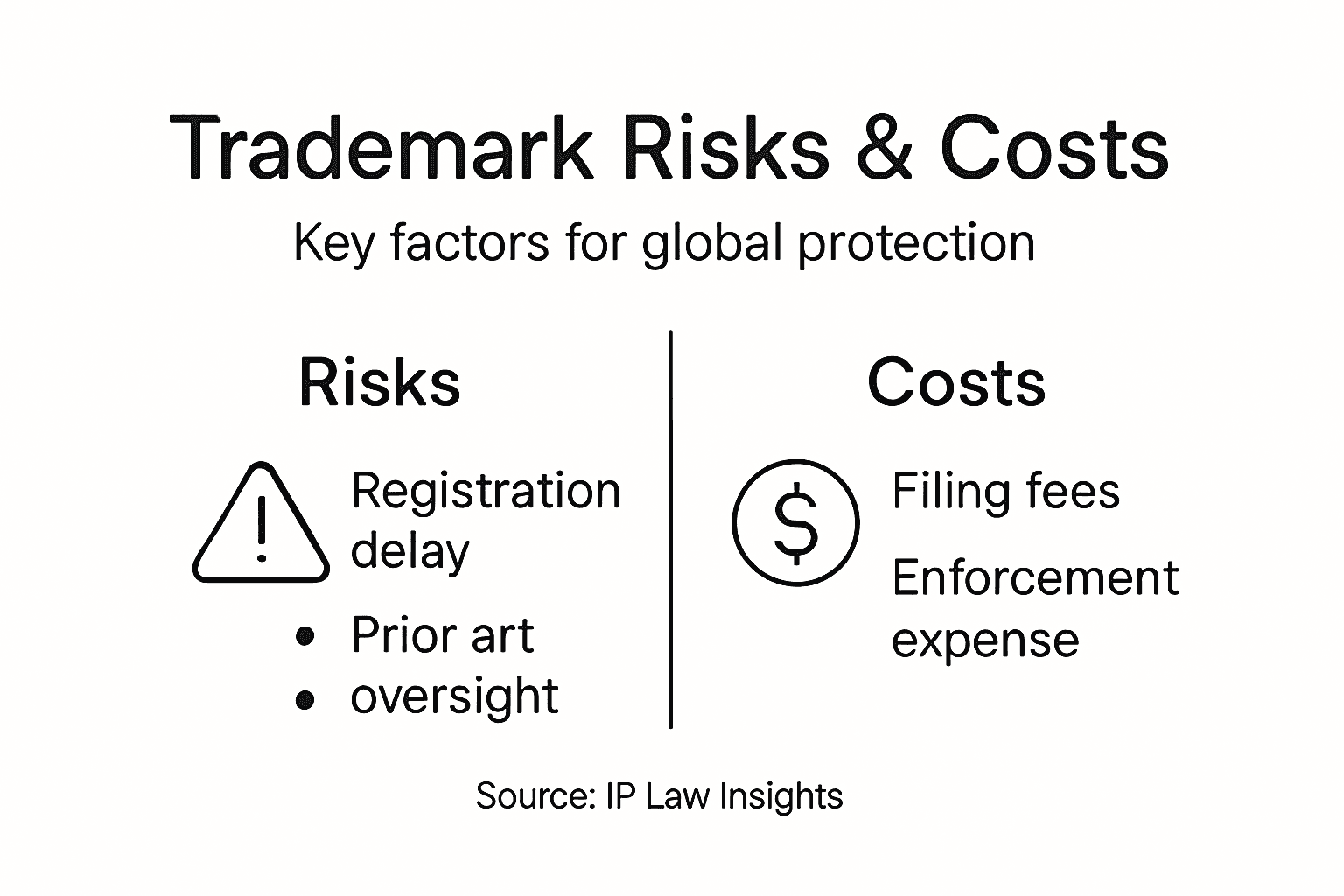
Many entrepreneurs underestimate both the financial commitment and strategic complexity required for effective international trademark protection. The allure of global expansion often blinds business leaders to the substantial costs and ongoing obligations that trademark portfolios demand. A technology startup that invests $50,000 in initial trademark registrations across 15 countries often discovers too late that maintaining these marks requires an additional $5,000 to $10,000 annually in renewal fees, monitoring services, and enforcement actions. These costs escalate dramatically when you must defend your marks against infringement or oppositions. A single trademark dispute in a major market can consume $50,000 to $250,000 in legal fees before reaching trial. Multiply this across multiple jurisdictions where competitors simultaneously challenge your registrations, and the financial burden becomes unsustainable without proper planning.
One of the most damaging mistakes entrepreneurs make is filing for trademark protection without conducting thorough prior art searches. You invest application fees, professional fees, and administrative time only to discover that an identical or confusingly similar mark was registered three years ago in that jurisdiction. Your application gets rejected after six months of examination, and you have lost your filing fees with nothing to show for the effort. Worse, the rejection now creates a documented record that examiners in other countries may reference when examining your applications in their jurisdictions. A second critical mistake involves poor trademark specification. You register your mark for “software and computer services” without clearly defining which specific services your mark actually protects. Later, when competitors operate in adjacent categories you never specified, you discover your trademark provides zero protection. A cloud computing company that registers only for “Software as a Service” may find that trademark useless against competitors offering Infrastructure as a Service or Platform as a Service in the same market.
Maintenance failures represent another common downfall. Trademark registration is not a one-time event. Most jurisdictions require renewal every 10 years, and some demand proof of actual use. You must also monitor your marks for non-use and maintain records documenting genuine commercial exploitation. If you register a trademark in Brazil but never actually market products there, and a competitor files to cancel your registration based on non-use, you face losing your rights in that jurisdiction. This becomes particularly problematic when you register in numerous markets as defensive filing but lack the business capacity to actually use marks everywhere. The intellectual property infrastructure evolves constantly. New technologies, platforms, and market categories emerge faster than trademark classifications can accommodate. Your software trademark may become inadequate as you expand into artificial intelligence applications or blockchain services that existing classifications did not contemplate when you filed. Updating your trademark portfolio to reflect business evolution requires either filing new applications or amending existing registrations through complex procedures that vary by jurisdiction.
Geographic expansion mistakes create cascading problems. Entrepreneurs often expand into new markets without simultaneously establishing trademark protection. You launch a software product in Singapore, Thailand, and Vietnam, building market presence and brand recognition, only to discover that a local operator registered your brand name in those countries months before your market entry. Now you must either negotiate expensive buyouts, rebrand entirely, or litigate in unfamiliar courts with uncertain outcomes. This scenario happens repeatedly because many startups treat trademark registration as a bureaucratic task to address after commercial operations begin. Instead, trademark strategy should precede market entry by 6 to 12 months. Another mistake involves overrelying on international registration mechanisms without understanding their limitations. The Madrid System creates efficiency but not protection. If you file through Madrid and designate 20 countries, each country still independently examines your application. Approval in 15 countries and rejection in 5 creates a fragmented portfolio where your mark lacks protection precisely where competitors operate most aggressively.
The cost structure for international trademark protection breaks down into several distinct components. Initial filing and prosecution costs range from $300 to $1,000 per jurisdiction depending on whether you hire local counsel or use centralized filing services. Classification complexity affects costs significantly. A mark spanning multiple Nice Classes (the international classification system for goods and services) multiplies examination complexity and potential grounds for rejection. Renewal costs, typically $200 to $500 per jurisdiction per renewal cycle, accumulate across your portfolio. Enforcement and monitoring costs represent the largest hidden expense. Comprehensive trademark monitoring across 20 jurisdictions costs $3,000 to $10,000 annually depending on whether you use automated services or employ counsel to manually review markets. Enforcement actions when you detect infringement consume the most substantial budgets. A cease and desist letter costs $500 to $2,000. Litigation over infringement averages $50,000 minimum in developed jurisdictions and escalates dramatically in complex cases. Customs recordation services that intercept counterfeit goods at borders cost additional fees in each jurisdiction.
Technology has introduced new risks that traditional trademark frameworks struggle to address. Domain name squatting remains rampant. Competitors register domains using your trademark and offer counterfeit products or confusingly similar services before you can secure the domain in that country. Social media handle registration operates under completely different rules than trademark law, leaving your brand vulnerable to impersonation accounts that technically violate trademark rights but operate beyond practical enforcement reach. Cryptocurrency and blockchain technologies introduce markets where your trademark has zero protection because these emerging sectors lack established intellectual property frameworks in most jurisdictions. A technology entrepreneur must accept that trademark protection, no matter how comprehensive, always has gaps and limitations.
Below is a summary of common trademark risks and their business impact:
Risk Type | Example Situation | Potential Consequence |
Insufficient Prior Search | Filing where a similar mark already exists | Application rejected, wasted resources |
Maintenance Failure | Not using mark or missing renewal deadlines | Trademark cancellation, loss of rights |
Overextension | Registering in too many markets at once | High costs, unused trademarks |
Weak Enforcement | Registering in country with poor IP laws | Little real-world protection |
Pro tip: Prioritize trademark registration 12 months before market entry in new jurisdictions, not after. Conduct thorough searches in target markets before filing to avoid costly rejections. Budget $1,500 to $3,000 per jurisdiction for first-year filing and prosecution, plus $300 to $800 annually per jurisdiction for maintenance and monitoring for the 10-year renewal cycle. This realistic budgeting prevents painful surprises as your business scales internationally.
Strengthen Your Global Brand with Expert International Trademark Support
Navigating the complex landscape of international trademark protection can be daunting. The challenges of diverse legal frameworks, territorial limitations, and varying enforcement standards require precise strategies and expert guidance. If you face risks like conflicting registrations, costly enforcement proceedings, or inefficient global portfolio management our specialized legal and technical consultancy at Studio Legale Coviello is designed to empower your business advantage. We help technology entrepreneurs and companies secure robust trademark protection in key jurisdictions using innovative solutions including AI-driven tools and a dedicated mobile app for intellectual property management.

Do not let uncertainties or delayed registrations put your brand at risk. Act now to develop a tailored international trademark protection plan that prioritizes markets with strong enforcement and aligns with your growth objectives. Visit Studio Legale Coviello to access global intellectual property expertise and cutting-edge digital innovation ensuring your trademarks, patents, and designs are reliably safeguarded worldwide. Explore how our comprehensive services can reduce your risk and accelerate your global expansion today.
Frequently Asked Questions
What is international trademark protection?
International trademark protection refers to legal mechanisms and treaties that safeguard your brand identity across multiple countries, setting up rights in foreign markets where your business operates or plans to expand.
How does the Madrid Protocol simplify the trademark registration process?
The Madrid Protocol allows you to file one international application through your home country’s trademark office, which is then routed to designated countries, thus reducing administrative complexity and filing costs compared to managing separate applications for each country.
What are the main challenges in enforcing trademark rights internationally?
Challenges include the need for separate registration in each jurisdiction, variations in enforcement mechanisms, and the difficulties in monitoring and addressing counterfeiting in markets where you lack local trademark protection.
Why is conducting a prior art search important before filing a trademark application?
Conducting a prior art search helps identify existing similar marks, preventing wasted resources on applications that may be rejected due to conflicts, and avoiding a situation where your trademark rights could be undermined by prior registrations.
Recommended

Comments