


Patent Licensing Explained: Key Strategies for Startups

Bringing a new invention to market can raise tough questions for any Italian or international tech startup, especially when it comes to protecting unique ideas and securing fair returns. Patent licensing offers a structured way to control who can make, use, or sell your innovation while turning intellectual efforts into financial value. Understanding the core principles of patent licensing equips founders to avoid costly legal missteps and unlock commercial opportunities around the world.
Table of Contents
Key Takeaways
Point | Details |
Understanding Patent Licensing | Patent licensing is a strategic way for inventors to monetize inventions while protecting their intellectual property. |
Types of Licensing Agreements | Different licensing types, such as exclusive and non-exclusive licenses, offer varying rights and competitive impacts. |
Legal Considerations | Comprehensive legal compliance is crucial for startups to navigate patent rights and licensing agreements successfully. |
Maximizing Patent Value | Effective licensing strategies can transform patents into significant revenue generators through innovative arrangements and market positioning. |
What Is Patent Licensing and Its Core Principles
Patent licensing represents a strategic legal mechanism that enables inventors and companies to monetize their technological innovations while protecting their intellectual property rights. At its core, patent licensing allows a patent owner to grant specific permissions to another party, authorizing them to use, manufacture, or sell an invention within defined parameters and for predetermined compensation.
The fundamental principles of patent licensing revolve around several critical components:
Exclusive Rights Transfer: The patent owner retains fundamental ownership while granting specific usage rights
Financial Compensation: Typically structured through royalty payments or upfront licensing fees
Defined Usage Boundaries: Clear specifications about how, where, and when the patented technology can be utilized
Legal Protection: Ensures the original inventor maintains control over their intellectual creation
Understanding the patent process overview is crucial for startups considering licensing strategies. Patent licensing isn’t merely a transactional process but a sophisticated intellectual property management approach that balances innovation protection with commercial opportunity.
Successful patent licensing requires careful negotiation and a comprehensive understanding of the technological landscape. Startup founders must conduct thorough due diligence, assess the market potential of their invention, and craft licensing agreements that protect their interests while creating mutually beneficial partnerships.
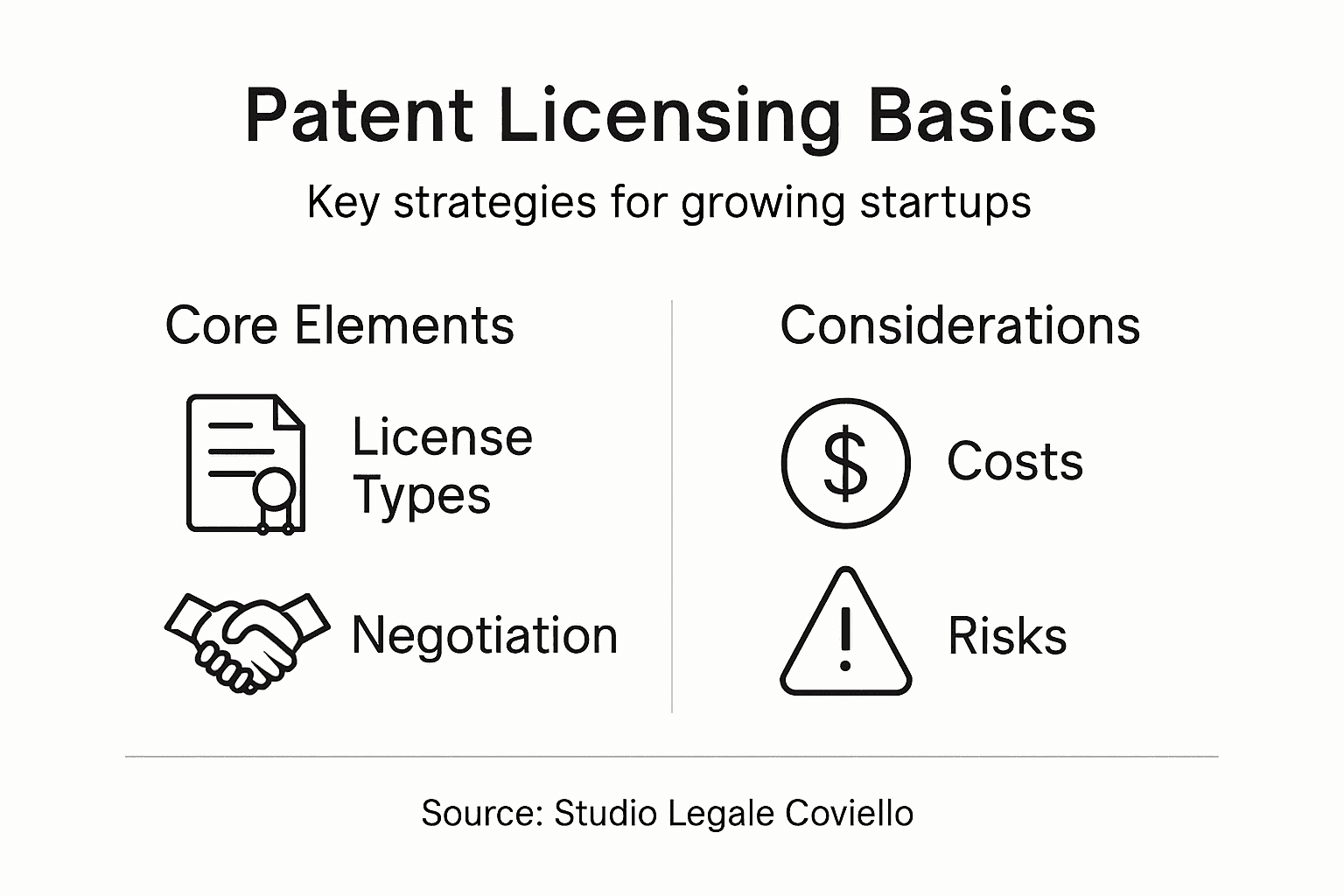
Pro tip: Always consult an intellectual property attorney before finalizing any patent licensing agreement to ensure comprehensive legal protection and optimal negotiation terms.
Types of Patent Licensing Agreements Explained
Patent licensing agreements represent sophisticated legal instruments that enable technology transfer and commercialization through carefully structured arrangements. Licensing agreements vary significantly in their scope, rights granted, and strategic objectives, making them critical tools for startups and established companies alike.

The primary types of patent licensing agreements include:
Here’s how the main types of patent licensing agreements differ:
Licensing Type | Rights Granted | Typical Use Case | Level of Competition Impact |
Exclusive License | One licensee only | Sole market entry for licensee | High, limits competitors |
Non-Exclusive License | Multiple licensees allowed | Broad market adoption | Low, open to many parties |
Sole License | Licensee & owner both use | Owner retention of some rights | Moderate, flexible roles |
Cross-Licensing | Mutual exchange of patents | Collaboration between companies | Variable, fosters alliances |
Exclusive Licenses: Grant rights to a single entity in a specific field or territory
Non-Exclusive Licenses: Allow multiple parties to use the same patent simultaneously
Sole Licenses: Permit only the licensee and patent owner to use the technology
Cross-Licensing Agreements: Enable mutual technology sharing between companies
Territorial and Field of Use Considerations play a crucial role in defining licensing parameters. License grant and scope determine the precise boundaries of how, where, and under what conditions a patent can be utilized. These constraints help protect the original inventor’s interests while creating clear commercial opportunities for licensees.
Successful licensing strategies require careful negotiation and a deep understanding of both technological and legal landscapes. Startup founders must meticulously evaluate potential licensing agreements, considering factors like royalty structures, performance benchmarks, and long-term strategic alignment with their business objectives.
Patent licensing is not just a legal transaction, but a strategic partnership that can define a company’s technological trajectory.
Pro tip: Consult an intellectual property attorney who specializes in technology transfer to help navigate the complex nuances of patent licensing agreements and protect your startup’s innovative potential.
How Patent Licensing Works in Practice
Patent licensing transforms innovative technologies from conceptual ideas into commercially viable assets through a structured, strategic process. Patent licensing processes involve multiple intricate stages that require careful navigation by inventors, researchers, and startup founders seeking to monetize their intellectual property effectively.
The practical workflow of patent licensing typically encompasses several critical stages:
Invention Disclosure: Inventors document and submit detailed technical information about their innovation
Market Assessment: Licensing offices evaluate technological feasibility and commercial potential
Patentability Review: Determining whether the invention meets legal and technical criteria for protection
Licensing Strategy Development: Crafting approaches for technology transfer and commercialization
Negotiation and Agreement: Defining precise terms of technology usage and financial arrangements
Startups must understand that technology commercialization involves more than simply signing a licensing agreement. The process requires ongoing performance monitoring, periodic reporting, and strategic alignment between licensors and licensees to ensure mutual success.
Successful patent licensing demands a comprehensive understanding of both technological innovation and legal frameworks. Startup founders must carefully evaluate potential licensing opportunities, considering factors such as market demand, competitive landscape, potential revenue streams, and long-term strategic implications of their intellectual property assets.
Patent licensing transforms intellectual concepts into tangible economic value, bridging the gap between innovation and marketplace implementation.
Pro tip: Develop a comprehensive documentation trail for your invention, including detailed technical specifications, prototypes, and potential commercial applications to strengthen your patent licensing negotiations.
Key Legal Considerations and Compliance Steps
Navigating the complex landscape of patent licensing requires startups to understand critical patent legal considerations that can make or break their intellectual property strategy. The legal framework surrounding patent licensing is intricate, demanding meticulous attention to multiple regulatory and contractual dimensions.
Key legal compliance steps for startups include:
Prior Art Search: Comprehensive investigation of existing technologies
Patent Application Integrity: Ensuring precise documentation and filing
Rights Definition: Clearly delineating ownership and usage permissions
Territorial Restrictions: Establishing precise geographic licensing boundaries
Royalty Structure: Defining financial terms and payment mechanisms
The legal nature of patent licensing involves complex interactions between contract and property law. Intellectual property licensing requires startups to develop robust agreements that protect their innovations while creating pathways for commercialization.
Startup founders must recognize that successful patent licensing extends beyond mere legal documentation. It demands a strategic approach that balances technical innovation, legal protection, and commercial viability. This requires ongoing legal monitoring, periodic agreement reviews, and adaptive strategies that respond to technological and market changes.
Legal precision in patent licensing is not about restricting innovation, but about creating sustainable frameworks for technological advancement.
Pro tip: Consult an intellectual property attorney specializing in technology transfer to develop comprehensive licensing agreements that anticipate potential future scenarios and protect your startup’s long-term interests.
Risks, Costs, and Common Licensing Pitfalls
Patent licensing presents a complex landscape of potential risks and financial challenges that startups must carefully navigate. Patent licensing risks can dramatically impact a company’s innovation strategy, requiring sophisticated understanding and proactive management of intellectual property dynamics.
Key risks and potential pitfalls for startups include:
Patent Thicket Complexity: Navigating overlapping patent rights
Holdup Risks: Potential legal challenges from patent holders
Transaction Costs: Expenses related to licensing negotiations
Performance Benchmark Failures: Non-compliance with agreement terms
Royalty Payment Challenges: Managing ongoing financial obligations
Startups must develop strategic approaches to mitigate potential licensing complications. Licensing performance monitoring becomes critical in managing potential breaches and maintaining compliance with complex intellectual property agreements. This involves creating robust tracking mechanisms, establishing clear performance metrics, and maintaining rigorous documentation of all licensing activities.
Financial implications extend beyond simple transaction costs. Companies must budget for potentially significant expenses, including application fees, ongoing royalty payments, legal counsel, and potential enforcement actions. The total cost of a licensing strategy can quickly escalate, making careful financial planning and risk assessment essential for startup survival.
These are the primary cost factors and risk considerations in patent licensing:
Risk/Cost | Description | Startup Impact |
Transaction Costs | Fees, negotiation, legal expenses | High initial outlay |
Royalty Obligations | Ongoing payments based on revenue or units | Affects profitability |
Compliance Failure | Not meeting license terms | Potential legal disputes |
Patent Thickets | Overlapping patent coverage | Increases complexity |
Successful patent licensing is about balancing innovation potential with calculated risk management.
Pro tip: Create a comprehensive risk assessment matrix that anticipates potential licensing challenges and develops contingency strategies before finalizing any patent licensing agreement.
Maximizing Patent Value Through Licensing Strategies
Successful patent monetization requires startups to develop sophisticated licensing value strategies that transform intellectual property from potential assets into strategic revenue generators. The most innovative companies understand that patent licensing is not merely a transactional process but a comprehensive approach to technological commercialization.
Key strategies for maximizing patent value include:
Cross-Licensing Arrangements: Mutual technology sharing to expand market reach
Patent Portfolio Packaging: Bundling complementary patents for increased attractiveness
Performance-Based Licensing: Tying royalties to specific market achievements
Tiered Licensing Models: Creating flexible access levels for different market segments
Global Market Positioning: Strategically selecting territories for maximum impact
Startups must carefully select appropriate licensing approaches that align with their specific technological and commercial objectives. This involves understanding market dynamics, potential licensee capabilities, and creating flexible agreements that can adapt to evolving technological landscapes.
Effective patent value maximization goes beyond simple monetary considerations. It requires a holistic approach that balances immediate financial returns with long-term innovation potential, strategic market positioning, and potential future technological developments. Successful startups view their patents as dynamic assets that can be strategically leveraged across multiple commercial dimensions.
Patent value is not determined by the technology alone, but by the strategic vision of its creators.
Pro tip: Develop a comprehensive patent portfolio strategy that considers potential future market transformations and creates licensing models flexible enough to capture emerging opportunities.
Unlock the Full Potential of Your Patent Licensing Strategy
Navigating the complex world of patent licensing demands meticulous legal expertise and strategic insight. This article highlights the challenges startups face, such as negotiating exclusive rights, managing royalty obligations, and crafting agreements that protect intellectual property while maximizing commercial opportunities. Protecting your innovation with precision and foresight can make the difference between thriving in a competitive market and losing valuable assets.

Empower your startup with tailored legal and technical assistance from Studio Legale Coviello. Our firm specializes in intellectual property and international commercial law, leveraging cutting-edge technologies including artificial intelligence to streamline your patent licensing and intellectual asset management. Explore how we can help you develop robust licensing agreements, optimize patent portfolios, and mitigate risks to secure sustainable growth. Act now to ensure your innovations receive the legal protection and strategic support they deserve. Visit Studio Legale Coviello and discover expert guidance on patent licensing today.
Frequently Asked Questions
What is patent licensing and how does it work?
Patent licensing is a legal mechanism that allows a patent owner to grant permission to another party to use, manufacture, or sell their invention. This process involves a licensing agreement that outlines the rights granted, financial compensation, and specific terms of use.
What are the different types of patent licensing agreements?
The main types of patent licensing agreements include exclusive licenses, which grant rights to a single licensee; non-exclusive licenses, allowing multiple users; sole licenses, where the patent owner retains some rights; and cross-licensing agreements, which enable mutual technology sharing between companies.
What legal considerations should startups keep in mind when licensing patents?
Startups should conduct a prior art search, ensure the patent application is properly documented, clearly define ownership and usage rights, establish territorial restrictions, and define the royalty structure to avoid potential legal disputes and maintain compliance.
How can startups maximize the value of their patents through licensing strategies?
Startups can maximize patent value by employing strategies such as cross-licensing arrangements, packaging complementary patents, using performance-based licensing tied to market achievements, and creating tiered licensing models for flexible access to different market segments.
Recommended

Comments