


Role of Technology in IP Law for Modern Businesses

Protecting intellectual property has become a strategic priority for tech entrepreneurs and startup founders in high-velocity sectors like Food Tech and Gaming. Rapid digital transformation pressures businesses to defend their innovations with smarter tools as traditional legal frameworks evolve. By harnessing emerging legal technology such as Artificial Intelligence, Blockchain, and Digital Rights Management, innovators can secure their creations while managing complex challenges in global markets.
Table of Contents
Key Takeaways
Point | Details |
Evolving IP Strategies | Businesses must reimagine traditional intellectual property protection methods to align with digital transformation. |
Technological Integration | Incorporating advanced technologies such as AI and Blockchain is essential for effective IP management and competitive advantage. |
Legal Framework Adaptation | There is an urgent need for flexible legal frameworks that evolve with technological advancements to adequately protect intellectual property. |
Proactive Legal Strategies | Organizations should develop comprehensive legal strategies that anticipate and adapt to rapid technological changes in the IP landscape. |
Technology’s Evolving Impact on Intellectual Property
The digital landscape has fundamentally transformed intellectual property (IP) law, introducing unprecedented technological challenges and opportunities. Digital transformation reshapes innovation frameworks, compelling businesses and legal professionals to reimagine traditional IP protection strategies.
The emerging technological ecosystem presents several critical developments in intellectual property management:
Artificial Intelligence driving automated patent searches and infringement detection
Blockchain enabling transparent ownership verification and rights tracking
Digital Rights Management (DRM) systems providing granular control over digital assets
Smart Contracts automating licensing and royalty distribution processes
These technological innovations are radically reconstructing how intellectual property is created, protected, and monetized. Emerging technologies offer more sophisticated tracking mechanisms, allowing businesses to monitor and defend their innovations with unprecedented precision. Machine learning algorithms can now rapidly scan global databases, identifying potential IP conflicts in minutes rather than months.
Here’s how emerging technologies differ in their impact on intellectual property management:
Technology | Primary Function | Business Benefit | Typical Use Cases |
Artificial Intelligence | Automated patent analysis | Faster conflict detection | Patent scanning, infringement alerts |
Blockchain | Ownership verification | Enhanced transparency | Tracking rights, proof of ownership |
DRM Systems | Content protection | Granular usage control | Digital media, software licensing |
Smart Contracts | Licensing automation | Streamlined royalty payments | Digital publishing, licensing deals |
Modern organizations must adopt agile technological approaches to remain competitive in the intellectual property landscape. Proactive digital strategies are no longer optional but essential for maintaining a robust IP portfolio. Businesses that integrate advanced technological tools into their IP management will gain significant competitive advantages.
Pro tip: Regularly audit your technological IP protection infrastructure to ensure alignment with emerging digital rights management standards.
Types of Legal Tech Transforming IP Protection
Legal technology has revolutionized intellectual property protection by introducing sophisticated digital tools that fundamentally reshape traditional IP management approaches. Legal tech platforms are streamlining complex IP workflows across multiple domains, enabling more efficient and precise rights management.
The most transformative legal technologies in IP protection include:
Artificial Intelligence (AI) for automated patent analysis and infringement detection
Blockchain systems providing immutable ownership verification
Digital Rights Management (DRM) platforms for granular content protection
Cloud-Based Tracking solutions enabling real-time IP monitoring
Machine Learning algorithms for predictive conflict identification
These technologies address critical challenges in modern IP management by introducing unprecedented levels of transparency and efficiency. Advanced legal tech tools are challenging existing regulatory frameworks, compelling legal professionals to adapt rapidly to technological innovations. The integration of these sophisticated digital solutions allows businesses to track, protect, and monetize their intellectual assets with remarkable precision.
Regional variations in technological adoption significantly impact IP protection strategies. While some jurisdictions like the United States and European Union have embraced these technological advancements, others remain more cautious about their implementation. Strategic technological integration has become a critical competitive advantage for organizations seeking robust intellectual property management.
Regional differences shape IP technology adoption strategies:
Region | Adoption Level | Regulatory Support | Notable Approach |
United States | High | Strong, evolving regulatory | Aggressive tech integration |
European Union | High | Harmonized frameworks | Balance innovation, protection |
Asia-Pacific | Emerging | Rapid development, varied | Growing adoption, innovation |
Rest of World | Moderate to low | Limited or cautious | Gradual implementation |
Pro tip: Conduct regular technology audits to ensure your IP protection infrastructure remains aligned with the latest digital rights management standards.
How AI and Automation Enhance IP Enforcement
Artificial Intelligence has dramatically transformed intellectual property enforcement, providing unprecedented capabilities for detecting and preventing potential infringements. AI enables sophisticated pattern recognition that dramatically improves the accuracy and speed of identifying unauthorized intellectual property usage.
Key technological advancements in AI-driven IP enforcement include:
Automated Monitoring of digital platforms for potential copyright violations
Machine Learning Algorithms that detect subtle pattern similarities
Predictive Analytics for identifying potential future infringement risks
Real-Time Scanning of global databases and online marketplaces
Natural Language Processing to analyze complex legal documents
These sophisticated technologies enable businesses to proactively protect their intellectual property with unprecedented precision. By leveraging advanced machine learning techniques, organizations can now detect potential infringements faster and more accurately than traditional manual review processes. The ability to process massive datasets and recognize complex patterns allows AI systems to identify potential IP violations that might escape human detection.

The integration of AI into IP enforcement represents a fundamental shift in intellectual property management strategies. Modern businesses can now implement dynamic protection mechanisms that continuously monitor and adapt to emerging threats, transforming intellectual property from a passive asset to an actively managed strategic resource.
Pro tip: Implement automated AI-driven monitoring systems that provide comprehensive, real-time tracking of your intellectual property across multiple digital platforms.
Legal Frameworks for Digital IP Protection
The digital age has dramatically transformed intellectual property protection, challenging existing legal frameworks to adapt to rapidly evolving technological landscapes. AI challenges traditional intellectual property regulations, necessitating innovative approaches to protect digital innovations and AI-generated works.
Key considerations in developing modern digital IP legal frameworks include:
Global Policy Harmonization across international jurisdictions
Adaptive Regulatory Mechanisms for emerging technologies
Clear Authorship Guidelines for AI-generated content
Comprehensive Digital Rights Management
Ethical Considerations in technological innovation
The complexity of digital intellectual property protection requires a multifaceted approach that balances technological innovation with legal safeguards. Emerging legal frameworks must address unique challenges surrounding AI-generated works, including questions of ownership, inventorship, and appropriate attribution. This involves creating nuanced legal definitions that can accommodate the dynamic nature of digital and AI-driven innovations.
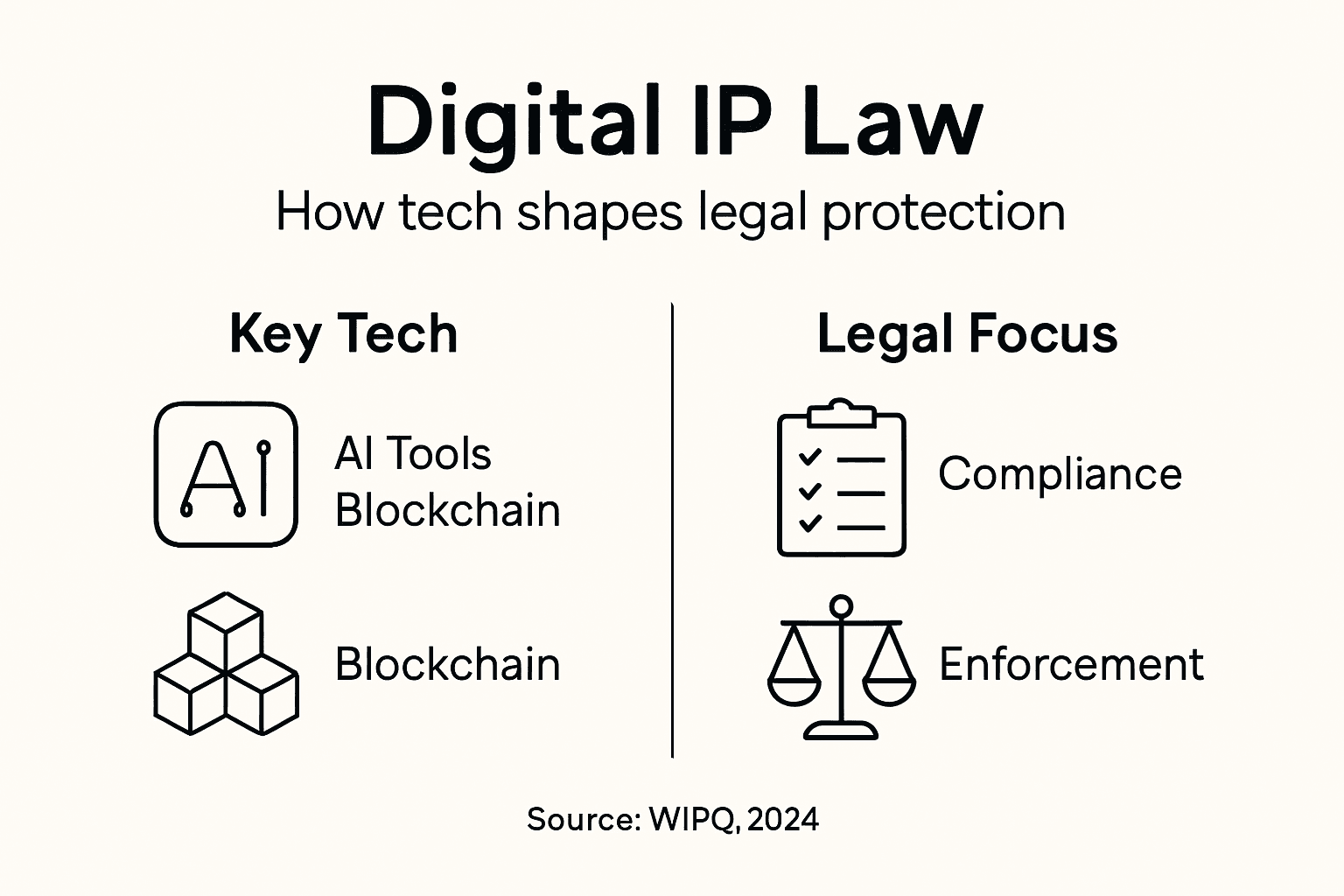
Governments and legal institutions worldwide are increasingly recognizing the need for flexible regulatory environments that can quickly respond to technological advancements. The goal is to create legal frameworks that protect intellectual property rights while simultaneously fostering innovation and technological progress.
Pro tip: Regularly consult international IP legal experts to stay updated on emerging digital protection standards and regulatory changes.
Challenges and Risks in Tech-Driven IP Law
The digital landscape has dramatically transformed intellectual property protection, introducing unprecedented legal complexities and technological challenges. Digital rights face significant enforcement risks, compelling businesses and legal professionals to develop innovative strategies for protecting intellectual assets.
Key challenges in tech-driven intellectual property law include:
Online Piracy and unauthorized digital content distribution
Jurisdictional Ambiguities across international boundaries
Enforcement Difficulties in digital platforms
Fair Use Conflicts in emerging technological contexts
Rapid Technological Evolution outpacing legal frameworks
These challenges are compounded by the complex interactions between emerging technologies and existing legal structures. Tech-driven IP law confronts significant regulatory uncertainties, particularly surrounding artificial intelligence, blockchain, and digital rights management systems. The dynamic nature of technological innovation requires legal frameworks that can adaptively respond to new forms of intellectual property creation and protection.
Modern organizations must develop proactive legal strategies that anticipate technological disruptions. This involves creating flexible legal frameworks that balance innovation protection with the need for technological advancement, ensuring intellectual property rights remain robust and enforceable in an increasingly digital world.
Pro tip: Develop comprehensive, technology-agnostic IP protection strategies that can rapidly adapt to emerging digital innovations.
Stay Ahead in Intellectual Property with Cutting-Edge Legal Technology
Modern businesses face complex challenges in protecting and enforcing intellectual property rights in a fast-evolving digital world. With issues like AI-driven infringement detection and blockchain-based ownership verification changing the IP landscape, relying on traditional legal methods is no longer enough. The need for agile, tech-savvy legal support that understands emerging technologies such as Artificial Intelligence, Digital Rights Management, and smart contract automation has never been greater.

Unlock the full potential of your intellectual assets by partnering with Studio Legale Coviello, a law firm specializing in intellectual property and international commercial law that integrates advanced technology for superior IP management. Benefit from tailored legal and technical consulting designed to safeguard your trademarks, patents, designs, and copyrights with precision and innovation. Don’t let technological disruption put your IP at risk—explore our expert services and equip your business with proven solutions for digital rights protection today.
Frequently Asked Questions
What impact does artificial intelligence have on intellectual property management?
Artificial intelligence automates patent analysis and infringement detection, enabling faster identification of potential conflicts and enhancing the overall efficiency of IP management.
How does blockchain technology support intellectual property protection?
Blockchain technology provides immutable ownership verification and transparent rights tracking, allowing businesses to manage and protect their intellectual assets more effectively.
What role do digital rights management (DRM) systems play in protecting digital content?
DRM systems enable granular control over digital assets by managing how content can be accessed, used, and distributed, thus preventing unauthorized usage and piracy.
Why is it crucial for modern businesses to adopt tech-driven IP strategies?
Adopting tech-driven IP strategies is essential for maintaining a competitive edge, as these approaches allow for proactive and agile management of intellectual property, ensuring robust protection in the digital landscape.
Recommended

Comments