


What Is Licensing Agreement? 5 Key Facts for Companies 2026

Many Italian companies and international startups believe that licensing agreements transfer ownership of intellectual property. This is false. Licensing grants conditional usage rights while ownership remains firmly with the licensor. Understanding this distinction is critical for protecting your IP assets and building revenue streams. This guide explains the legal nature of licensing agreements, Italian regulatory requirements, and strategic insights for companies commercializing patents, trademarks, and know-how in 2026.
Table of Contents
Key Takeaways
Point | Details |
Licensing grants usage rights without ownership transfer | |
Italian law governs trademark licensing with quality controls | Formal writing is not mandatory, but quality safeguards protect brand integrity and consumer trust. |
Exclusive vs. non-exclusive licenses carry different risks | Exclusive licenses grant sole rights with higher fees; non-exclusive licenses risk trademark confusion. |
Know-how licensing depends on confidentiality clauses | Without secrecy provisions, valuable trade secrets lose legal protection. |
Cross-border licensing requires arbitration clauses | Clear dispute resolution mechanisms reduce legal costs and uncertainty in international deals. |
Definition and Purpose of Licensing Agreements
A licensing agreement is a contract where the IP owner (licensor) permits another party (licensee) to use specific intellectual property under defined conditions. A licensing agreement is a legally binding contract granting usage rights without transferring ownership, defining scope, duration, territory, and compensation. The licensor retains all ownership rights. The licensee gains access to use the IP for business purposes.
Core contract elements include:
Scope: which IP assets are covered and permitted uses
Duration: time period for license validity
Territory: geographic regions where usage is allowed
Compensation: royalties, fees, or other payment structures
Companies use licensing to expand market reach without manufacturing or distribution investments. You leverage existing IP assets to generate revenue streams while maintaining control. This model works especially well for patents, trademarks, and copyrights where direct commercialization requires significant capital.
Licensing balances two strategic goals. First, it protects your IP by controlling how others use it through contract terms. Second, it commercializes IP by granting calculated access to partners who can bring your innovations to market faster. This dual function makes licensing essential for startups and established firms seeking growth without diluting ownership.
Italian Legal Framework for Licensing
The Italian Intellectual Property Code establishes rules governing trademark licensing in Italy. Unlike some jurisdictions, Italian law does not mandate written contracts for valid licenses. Oral agreements can be legally binding, though written documentation is strongly recommended for evidence and clarity.
Licensors must ensure quality control over how licensees use trademarks. If a licensee produces inferior goods or services under your brand, consumers may be misled. Italian law protects public interests by requiring licensors to monitor and maintain brand standards. This safeguard prevents trademark deception and preserves brand integrity.
Key Italian legal considerations:
Italian licensing contracts should clearly define quality standards and monitoring rights
Protection of Made in Italy trademarks requires explicit geographic origin controls
Non-exclusive trademark licenses risk cancellation if they confuse consumers about product sources
Registration of exclusive licenses with the Italian Patent and Trademark Office provides third-party notice
For companies operating in Italy, understanding these regulatory safeguards is critical. You must draft contracts that comply with Italian public policy while protecting your commercial interests. Failure to maintain quality controls can result in trademark disputes or loss of rights.
Key Contractual Elements and Types of Licensing Agreements
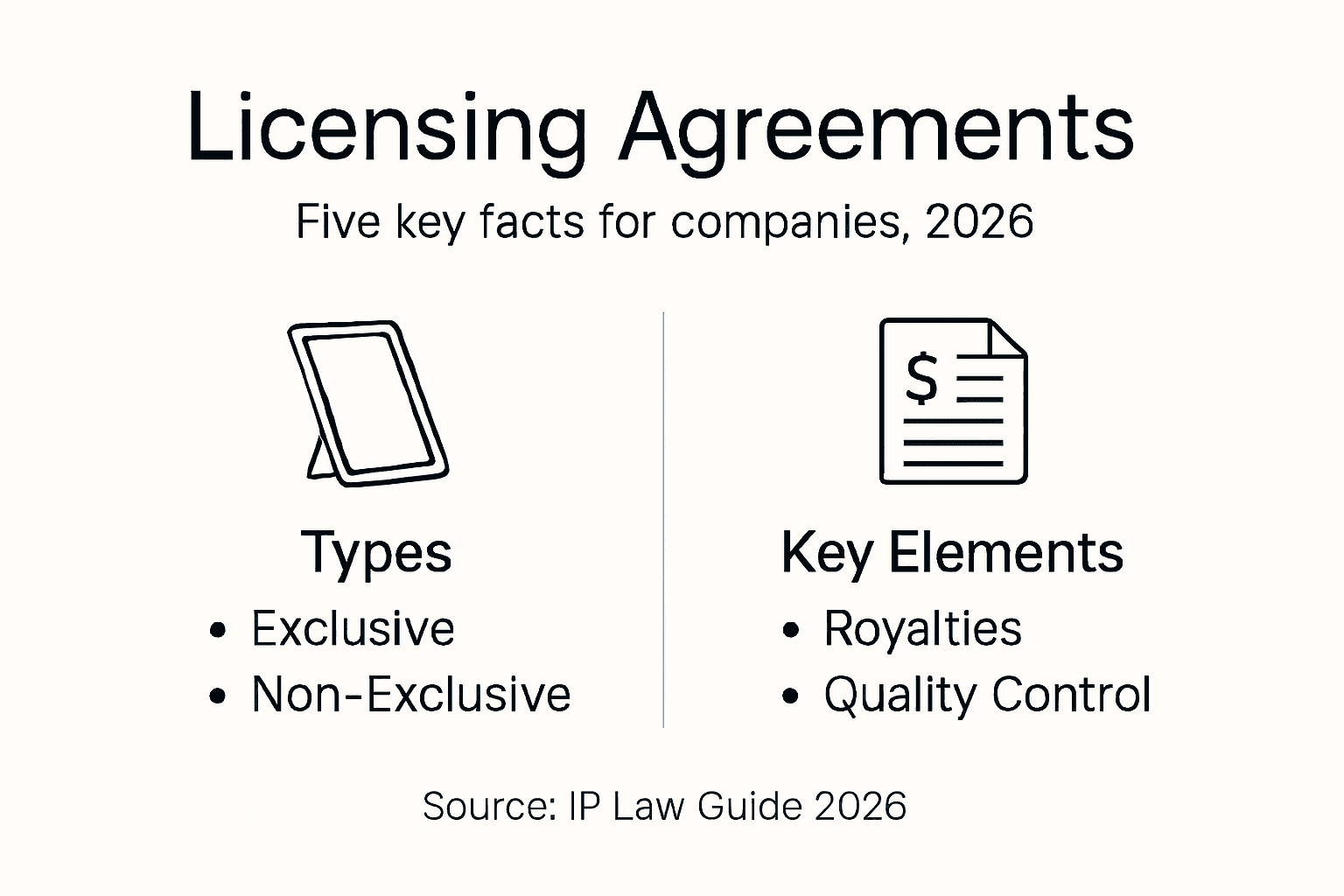
Licensing agreements can be tailored with exclusivity, territorial scope, royalty structures, and performance obligations aligned to business goals. Two main types dominate: exclusive and non-exclusive licenses. Each carries distinct business implications.
Exclusive licenses grant sole usage rights to one licensee within a defined territory or field. You cannot license the same IP to competitors in that space. This arrangement typically commands higher fees and stricter performance obligations. Licensees gain market protection, motivating larger investments in commercialization.

Non-exclusive licenses allow multiple licensees to use the same IP simultaneously. Fees are usually lower because licensees face competition from other authorized users. However, non-exclusive trademark licenses pose higher risk of consumer confusion under Italian law, potentially leading to trademark cancellation.
License Type | Rights Granted | Typical Fees | Main Risk |
Exclusive | Sole usage rights in territory/field | Higher royalties, milestone payments | Licensee failure impacts all revenue |
Non-Exclusive | Multiple users allowed simultaneously | Lower per-license fees | Trademark confusion, market dilution |
Key license contract clauses include:
Royalty rates: percentage of sales or fixed fees per unit
Milestone payments: lump sums tied to development or sales targets
Equity stakes: ownership shares in licensee company for startups
Quality control: inspection rights, approval processes, brand standards
Territorial limits: specific countries or regions for IP use
Field-of-use restrictions: limited to certain industries or applications
Quality control clauses safeguard brand integrity by giving you oversight of how licensees represent your IP. For trademarks especially, maintaining consistent quality across all licensed uses is legally required and commercially essential.
Pro Tip: Choose exclusive licenses when entering new markets where partner commitment is critical. Use non-exclusive licenses for established products where multiple distributors accelerate market penetration without confusion risk.
Licensing Different Types of Intellectual Property
Each IP category requires tailored licensing approaches. Patents and trademarks enjoy statutory legal protections, making their licensing relatively straightforward. Know-how and trade secrets depend entirely on contractual confidentiality.
Patent licenses grant rights to make, use, or sell patented inventions. You define technical scope, geographic territory, and royalty structures. Patent protection gives you legal recourse against unauthorized use, strengthening your negotiating position.
Trademark licenses allow use of brand names, logos, or slogans. Quality control provisions are legally required in Italy to prevent consumer deception. You must monitor licensee practices to maintain trademark validity.
Know-how licensing requires contractual definitions for secrecy and exclusive use due to reliance on confidentiality for protection. Unlike patents, know-how has no government registration. Once disclosed without confidentiality safeguards, it loses all legal protection. Your contract must explicitly define confidential information, restrict disclosure, and impose penalties for breaches.
Copyright licenses cover creative works like software, content, or designs. You grant specific usage rights such as reproduction, distribution, or adaptation. Territorial and time limitations are common. Digital content licensing often includes technological protection measures.
Tailor licensing terms to IP type:
Patents: focus on technical scope and improvement rights
Trademarks: emphasize quality standards and brand guidelines
Know-how: prioritize confidentiality clauses and non-disclosure agreements
Copyrights: specify usage rights, derivative works, and sublicensing permissions
For startups with mixed IP portfolios, bundling multiple asset types into single licensing agreements can streamline deals. However, ensure each IP category receives appropriate contractual protections matching its legal nature.
Common Misconceptions About Licensing Agreements
Misunderstanding licensing fundamentals leads to costly legal mistakes. Three misconceptions dominate among Italian companies and international startups.
Misconception one: licensing transfers IP ownership. False. Licensing only grants usage rights temporarily; ownership remains with the licensor. You retain full title to patents, trademarks, or copyrights. The licensee gains conditional access for business purposes. When the license expires or terminates, all rights revert to you.
“A license is permission to do something that would otherwise be unlawful, granted by the party with authority to give such permission.”
Misconception two: non-exclusive licenses are always safe. False for trademarks under Italian law. Multiple licensees using the same trademark can confuse consumers about product origin. If confusion becomes widespread, Italian authorities may cancel your trademark registration. Non-exclusive licenses work better for patents or copyrights where consumer confusion is not a legal concern.
Misconception three: all licensing agreements are standard contracts. False. Every deal requires customization based on:
IP type and competitive value
Industry standards and market conditions
Licensee capabilities and financial strength
Geographic scope and regulatory environment
Strategic goals for market entry or revenue generation
Misconception four: know-how automatically stays protected. False. Trade secrets and know-how lose legal protection upon unauthorized disclosure. Without robust confidentiality clauses, non-disclosure agreements, and access restrictions, your valuable know-how becomes public information. Once disclosed, you cannot reclaim secrecy protections.
Understanding these realities helps you draft stronger contracts, negotiate better terms, and avoid legal disputes that drain resources.
Benefits and Risks for Startups Engaging in Licensing
Startups licensing technology face trade-offs between access to technologies and market opportunities versus risks like resource constraints and high failure rates. Licensing offers strategic advantages but requires careful risk management.
Benefits for startups:
Technology access: license proven innovations instead of developing from scratch
Faster market entry: leverage established IP to accelerate product launches
Revenue generation: out-license your own IP to create cash flow without manufacturing
Reduced capital requirements: avoid production facility investments through licensing partnerships
Market validation: successful licenses demonstrate commercial viability to investors
Risks for startups:
Financial constraints: royalty obligations strain limited cash flow
Dependency: reliance on licensee performance for revenue generation
Loss of control: licensees may underperform or damage brand reputation
Contract complexity: poorly drafted terms create disputes or unfavorable obligations
Competitive exposure: disclosing IP during negotiations risks unauthorized use
To maximize licensing advantages for startups, follow this structured approach:
Identify valuable IP assets in your portfolio worth licensing
Select license type (exclusive/non-exclusive) matching market strategy
Draft detailed terms covering royalties, milestones, quality controls, and termination rights
Negotiate with prospective licensees focusing on aligned incentives
Finalize agreements with experienced IP legal counsel review
Monitor licensee compliance through regular audits and quality inspections
Update contracts as business conditions or regulations evolve
Pro Tip: Structure milestone payments tied to specific performance metrics rather than pure royalties. This ensures licensees remain motivated while protecting your interests if commercialization falters.
For startups, licensing can transform IP assets into revenue generators and strategic partnerships. However, success demands rigorous contract design, partner selection, and ongoing relationship management.
Cross-Border Licensing and Arbitration Clauses
International licensing introduces jurisdictional complexity. When licensor and licensee operate in different countries, disputes become expensive and time-consuming in traditional courts. Well-drafted arbitration clauses in international licensing agreements effectively resolve cross-border disputes, reducing uncertainty and costs.
Arbitration offers several advantages:
Neutral forum: neither party has home-court advantage
Specialized expertise: arbitrators understand IP and international commerce
Faster resolution: arbitration typically concludes in months versus years for litigation
Lower costs: streamlined procedures reduce legal fees and business disruption
Confidentiality: proceedings remain private, protecting trade secrets and business strategies
Enforceable awards: international treaties facilitate cross-border enforcement
Your licensing contract should explicitly include arbitration provisions:
Specify arbitration institution (ICC, WIPO, or regional bodies)
Define seat of arbitration (neutral jurisdiction)
Choose governing law (contract interpretation rules)
Limit discovery to reduce costs
Set language for proceedings
Establish fee allocation rules
For Italian companies licensing internationally, arbitration clauses provide legal certainty when dealing with partners in jurisdictions with unfamiliar court systems. Startups and SMEs especially benefit from cost-effective dispute resolution that preserves business relationships.
Without clear dispute resolution mechanisms, cross-border licensing disputes can become prohibitively expensive. Courts in different countries may reach conflicting decisions about contract interpretation or IP validity. Arbitration avoids these problems through binding decisions enforceable worldwide under the New York Convention.
Conclusion and Practical Guidance for Companies
Licensing agreements are powerful tools for protecting and commercializing intellectual property when structured correctly. They grant conditional usage rights while preserving ownership, enabling you to expand market reach and generate revenue without significant capital investments.
Actionable guidance for Italian companies and startups:
Tailor contractual terms precisely to your IP type, business goals, and risk tolerance
Engage specialized IP legal counsel to ensure enforceability under Italian and international law
Use exclusive licenses for strategic partnerships requiring deep commitment
Implement non-exclusive licenses carefully, especially for trademarks where confusion risks exist
Prioritize confidentiality provisions in know-how and trade secret licenses
Include arbitration clauses in all cross-border agreements to manage dispute risks
Monitor licensee compliance through quality audits and performance reviews
Strategically, view licensing as both protection mechanism and growth accelerator. Well-drafted agreements prevent unauthorized IP use while creating commercial opportunities. Poorly drafted contracts expose you to legal disputes, revenue loss, and brand damage.
For detailed licensing contract advice, consult IP specialists who understand both Italian regulatory requirements and international best practices. Your licensing strategy should evolve as your business grows, markets shift, and regulations change.
Pro Tip: Schedule annual reviews of all active licensing agreements. Market conditions, competitive landscapes, and regulatory environments change rapidly. Updating contract terms proactively prevents disputes and captures new opportunities as they emerge.
Explore Expert Legal Support to Maximize Your Licensing Strategy
Navigating licensing agreements requires specialized legal expertise in intellectual property law, contract drafting, and international commerce. Studio Legale Coviello provides comprehensive licensing contracts legal services tailored to tech companies and startups operating in Italy and globally.
Our firm assists with drafting, reviewing, and negotiating licensing agreements that protect your IP while maximizing commercial value. We combine traditional legal excellence with innovative technology tools to deliver efficient, cost-effective counsel. Whether you need strategic IP management for brand portfolios or patent commercialization guidance for technical innovations, we provide practical solutions aligned with your business objectives. Contact us for a consultation to evaluate your licensing opportunities and develop agreements that support sustainable growth.
Frequently Asked Questions About Licensing Agreements
What risks are unique to startups licensing IP?
Startups face resource constraints that make royalty obligations difficult to manage during early revenue stages. Dependency on licensee performance creates vulnerability if partners underperform or abandon commercialization efforts. Additionally, startups often lack bargaining power when negotiating with established companies, potentially accepting unfavorable terms that limit future growth.
How does exclusive licensing benefit Italian companies?
Exclusive licenses attract serious partners willing to invest heavily in commercialization because they gain market protection from competitors. Higher royalty rates and milestone payments increase revenue potential. For Italian manufacturers especially, exclusive territorial licenses help penetrate foreign markets through committed local partners who understand regional regulations and customer preferences.
Can oral licensing agreements be enforced under Italian law?
Yes, Italian law recognizes oral licenses as valid contracts though proving their terms becomes challenging without written documentation. Courts will enforce oral agreements if parties can demonstrate mutual consent on essential terms like scope, duration, and compensation. However, written contracts are strongly recommended to avoid disputes and provide clear evidence of agreed obligations.
What key clauses protect know-how in licensing contracts?
Confidentiality provisions must define what constitutes confidential information, restrict disclosure to authorized personnel only, and impose penalties for breaches. Non-disclosure agreements should bind all parties and employees with access. Technical specifications require limited distribution on a need-to-know basis. Include provisions for returning or destroying confidential materials upon contract termination to prevent ongoing misuse.
Why include arbitration clauses in cross-border licenses?
Arbitration provides neutral forums that prevent home-court advantage for either party, reducing bias concerns. Specialized arbitrators understand complex IP and international commerce issues better than general courts. Faster resolution timelines and lower costs make arbitration especially valuable for startups and SMEs with limited legal budgets. International treaties ensure arbitration awards are enforceable across borders, unlike court judgments which face recognition challenges.
How often should companies review existing licensing agreements?
Annual reviews are recommended to assess whether contract terms still align with current business strategies, market conditions, and regulatory environments. Technology sectors require more frequent reviews due to rapid innovation cycles. Trigger immediate reviews when licensees change ownership, markets shift dramatically, or new competitors emerge. Proactive updates prevent disputes and capture evolving opportunities before competitors do.
Recommended

Comments