


Patentability Explained: What Startups Must Know

Securing your competitive edge in the dynamic worlds of Food Tech and IoT often hinges on more than just innovation—it requires a clear grasp of what truly makes an invention patentable. Many Italian and international startup founders stumble when navigating the strict rules and territorial limits of patent protection, misreading provisional filings as enforceable rights or overestimating what counts as inventiveness. This guide cuts through common misconceptions and highlights the core legal benchmarks, helping you develop a smart, defensible patent strategy for your venture’s unique technology.
Table of Contents
Key Takeaways
Point | Details |
Understanding Patentability Requirements | Ensure your invention meets the criteria of novelty, inventiveness, and industrial applicability to qualify for patent protection. |
Territorial Nature of Patents | Remember that patents are territorial; a US patent is only valid in the United States, necessitating separate filings for international protection. |
The Importance of Timing | File your patent application before any public disclosure to protect your invention and establish patent rights. |
Document Everything | Maintain thorough documentation of your invention process to support claims of novelty and defend against potential challenges. |
Patentability Defined and Common Misconceptions
Patentability is the legal determination that an invention meets specific criteria set by patent offices, allowing it to receive protection as intellectual property. Not every innovation qualifies for patent protection—the rules are strict, and misunderstanding them costs startups valuable time and resources.
A patent grant represents a state-backed monopoly right that prevents others from using, making, or selling your invention without permission. You disclose your invention to the patent office, and in exchange, you receive exclusive rights for a defined period (typically 20 years from filing date).
Three core requirements determine patentability:
Novelty: Your invention must be genuinely new—not publicly disclosed, sold, or described anywhere before you apply.
Inventiveness: The invention must show a non-obvious leap beyond what already exists in your field.
Industrial applicability: Your invention must be capable of being made or used in some industry or practical context.
Certain inventions are excluded from patentability regardless of how novel they are. Scientific theories, abstract methods, purely aesthetic creations, and medical treatment methods face significant hurdles in many jurisdictions. This matters greatly for food tech and IoT founders—processing methods in food tech may qualify, but the biological principle underlying fermentation does not.
Patent protection is territorial, meaning a US patent protects only in the United States. Your Italian startup needs separate filings in each market where you want protection.
Misconceptions plague early-stage founders. The most damaging mistake is treating a filed application as equivalent to a granted patent. Filing and protection are vastly different—filing gives you a priority date, but grants no enforcement rights until examination succeeds. Many startups publicly announce patent-pending status prematurely, only to face rejection months later.
Another widespread misconception involves thinking a general guide to patents and patentability creates absolute, permanent protection. Patent law changes, prior art emerges, and competitors challenge validity regularly. Your protection requires active monitoring and renewal.
Tech founders often believe that adding one novel feature to existing technology guarantees patentability. It doesn’t. The inventiveness bar asks whether someone skilled in your field would find the addition obvious given what’s publicly known.
Many startup founders assume they can patent their business model or software algorithm as-is. Pure software without hardware application faces severe patentability restrictions in multiple jurisdictions. Food tech entrepreneurs sometimes try patenting flavor combinations or nutritional ratios, which typically fail novelty or obviousness tests.
Pro tip: Document your invention’s novelty before any public disclosure—publish or present nothing until you’ve filed your patent application or secured a non-disclosure agreement, as most patent systems reject applications after public disclosure.
Essential Patentability Criteria and Types of Inventions
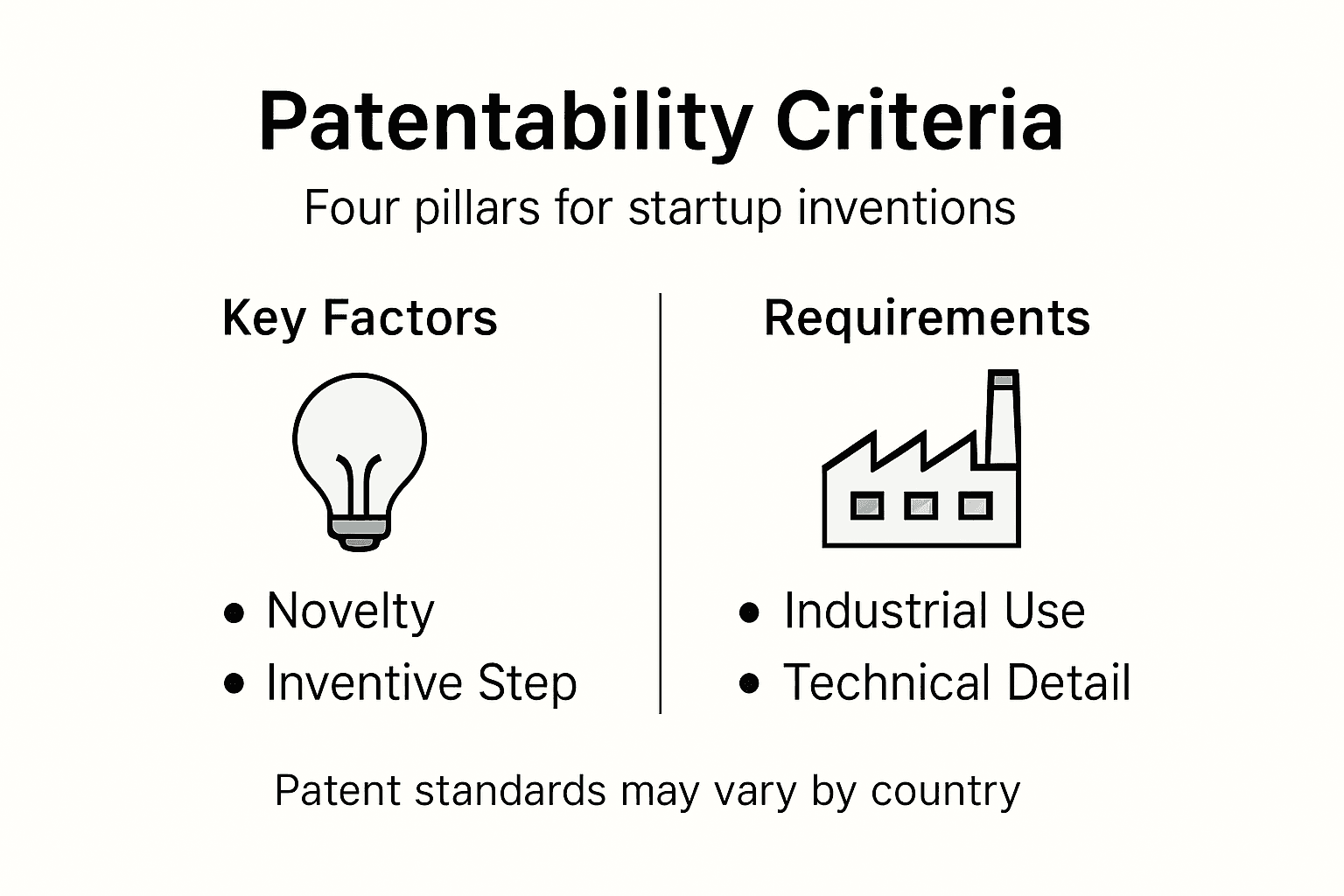
Patentability rests on four foundational pillars that patent offices worldwide evaluate during examination. Understanding these criteria determines whether your startup’s innovation receives protection or faces rejection.
The invention must possess technical character—it solves a real technical problem, not merely an abstract concept. This distinction matters enormously for software and food tech founders. A pure algorithm without hardware application struggles for patentability, but software controlling IoT sensors or automating food production processes qualifies. The four basic requirements for patentability demand that your invention be susceptible to industrial application, meaning it must be practically producible or usable in a commercial context.

Novelty requires that no single prior publication, product, or disclosure contains every element of your invention. Your competition’s existing solution doesn’t need to be identical—if one component already exists publicly, novelty fails. This applies even if that prior disclosure happened in another country or language.
An inventive step (also called non-obviousness) means the invention isn’t an obvious combination of what’s already known. Ask: Would someone skilled in your field consider this innovation a logical next step? For IoT startups, combining existing sensors with standard firmware might be obvious. But a novel algorithm that reduces power consumption by 67 percent through an unexpected parameter adjustment likely clears this bar.
Industrial applicability means your invention must be producible or usable in any commercial field. This includes:
Products (physical items, devices, apparatus)
Processes (methods, systems, technical procedures)
Compositions (mixtures, compounds, formulations)
Improvements (enhancements to existing inventions)
Patent offices exclude abstract ideas, natural phenomena, scientific theories, and certain business methods—regardless of how innovative they seem to you.
Food tech founders frequently encounter exclusions around natural processes. Fermenting vegetables using naturally occurring bacteria isn’t patentable as a biological principle, but a specific apparatus controlling temperature, humidity, and microbial strain to achieve consistent results in half the traditional time could be.
Sufficient disclosure matters equally. Your patent application must explain your invention with enough detail that someone skilled in your field could replicate it. Vague claims about “proprietary algorithms” won’t survive examination. You must describe the technical solution clearly, even while protecting specific trade secrets through careful claim drafting.
Following the essential steps in patent registration checklist, document exactly how your invention addresses technical problems and achieves results competitors cannot easily replicate.
Pro tip: File your patent application before publicly demonstrating or disclosing your invention, as most jurisdictions have strict novelty requirements that consider public disclosure as prior art.
Here is a side-by-side comparison of patentability requirements for Food Tech and IoT startups:
Patentability Factor | Food Tech Example | IoT Example |
Technical Character | Apparatus for fermentation control | Sensor system for real-time monitoring |
Novelty Challenge | Biological principles often excluded | Pure software rarely patentable |
Inventive Step | New process sequence or apparatus | Algorithm reducing energy use |
Key Application Focus | Processes and physical devices | Integration of hardware and software |
Major Exclusion Risk | Natural phenomena, simple blends | Software-only, business methods |
Legal Standards and International Patentability Rules
Patent law operates on a social contract between inventors and society. You disclose your innovation publicly through the patent application, and in return, governments grant you exclusive rights for a limited term—typically 20 years from your filing date.
This bargain incentivizes innovation worldwide while ensuring knowledge disseminates across industries and competitors. Your patent document becomes public, allowing engineers and entrepreneurs to study your solution and build upon it after protection expires.
Every jurisdiction applies three core legal standards:
Novelty: Your invention cannot have been publicly disclosed anywhere before filing
Inventive step (non-obviousness): The invention must show innovation beyond what skilled professionals would consider obvious
Industrial applicability: Your invention must be producible or usable in commercial contexts
Patent laws provide exclusive rights to inventors for a limited term, creating legal certainty for startups protecting digital innovations. However, patentability is territorial—your Italian patent protects only in Italy, your US patent only in America.
This reality reshapes your international strategy. Filing in every market isn’t economically viable for early-stage startups. Instead, the Patent Cooperation Treaty (PCT) allows you to file one international application covering 192 member countries, then decide later which markets deserve national protection.
Public disclosure before filing is fatal to patentability in most jurisdictions. A single presentation at a conference, social media post, or customer demo can destroy worldwide patent rights.
Subject matter eligibility varies by jurisdiction. European and American offices reject abstract ideas, pure software algorithms, and business methods. But the same algorithm controlling IoT sensors in food production facilities or automating temperature regulation qualifies because it solves technical problems.
Claims must satisfy sufficiency of disclosure. Your application must enable someone skilled in your field to replicate your invention without undue experimentation. Vague language about “proprietary methods” fails this test.
International patent offices harmonize standards through treaties, but procedural differences persist. The USPTO emphasizes utility and non-obviousness, while European offices focus heavily on inventive step and technical character. Understanding these variations matters when filing abroad.
Your startup should document everything before public disclosure—prior art searches, technical notebooks, prototype iterations. This evidence protects your filing date and demonstrates invention conception dates during disputes.
Pro tip: Before any public announcement or customer demo, file a provisional patent application to secure your priority date, then refine claims during the 12-month period before filing your full international application.
Real-World Startup Use Cases and Unique Challenges
Your startup’s patent strategy must align directly with your business model and competitive threats. One size doesn’t fit all—a food tech startup protecting fermentation algorithms faces entirely different patentability challenges than an IoT company controlling smart sensors across connected networks.
Food tech startups typically pursue utility patents protecting specific processing methods or apparatus configurations. A startup optimizing fermentation duration through novel temperature sequencing and microbial strain selection has patentable subject matter. However, claiming the nutritional outcome alone—“a yogurt with 40 percent more probiotics”—fails because results from biological processes lack patentability in most jurisdictions.
IoT startups encounter different obstacles. Your distributed sensor network managing real-time data collection across facilities may combine existing hardware with novel software algorithms. Utility patents can prevent competitors from using novel features, but pure software controlling standard IoT devices struggles for patentability without demonstrating technical transformation or unexpected results.
Cost remains the harshest reality. Patent prosecution expenses run $8,000 to $15,000 per jurisdiction for utility patents, with international coverage easily reaching $50,000 to $100,000. Early-stage startups with limited runway must prioritize strategically.
Consider these practical challenges:
Rapidly changing markets: Your novel feature becomes obvious after competitors publish similar solutions six months later
Demonstrating novelty: Prior art searches uncover forgotten patents or academic papers predating your invention
Claim scope versus enforceability: Broad claims face rejection; narrow claims provide weak protection against workarounds
Patent portfolio management: Maintaining multiple filings across territories costs money annually through renewal fees
Smart patent strategy means filing in markets where you’ll actually operate and generate revenue—not pursuing global coverage that drains resources without commercial benefit.
Italian food tech startups often benefit from filing first in Europe and the United States, then deciding on Asian markets based on competitive threats and customer presence. This staged approach conserves cash while maintaining global rights through PCT filing.
Real-world startups balance three competing priorities: securing competitive advantage through early patents, managing prosecution costs within limited budgets, and maintaining agility as markets pivot. Your patent claims must reflect actual business objectives—if your revenue comes from licensing, claims need broader scope; if you’re defending against competitors, narrow claims targeting your specific implementation may suffice.
Conflicts arise when patent costs consume resources needed for product development or market expansion. Many successful startups file provisional applications initially, then convert to full applications only after validating product-market fit and securing funding.
Pro tip: Before investing heavily in patent prosecution, conduct freedom-to-operate searches ensuring your innovation doesn’t infringe existing patents, and align your filing strategy with your actual revenue geography and funding timeline.
Risks, Costs, and How to Avoid Patent Pitfalls
Patent protection carries hidden costs and unexpected risks that blindside unprepared startups. Understanding these pitfalls separates founders who build sustainable IP strategies from those who waste resources on worthless filings.
The most damaging risk is over-relying on patent protection. Your granted patent doesn’t automatically stop competitors. Enforcement requires litigation costing $500,000 to $5 million depending on complexity and jurisdiction. Many startup patents sit in drawers, never enforced, providing zero competitive advantage.
Another critical risk involves prior art challenges. Competitors or patent examiners uncover forgotten patents, academic papers, or product demonstrations predating your application. A single prior disclosure destroys novelty claims years after your filing. This risk intensifies in rapidly evolving fields like food tech and IoT where innovation cycles compress.
Patent rights include exceptions and limitations to balance interests, meaning your exclusive rights face jurisdictional boundaries. Researchers can use your invention for experimental purposes in many countries. Competitors can design around your claims through minor modifications. Licensing competitors costs money and creates market sharing obligations.
Costs accumulate across multiple dimensions:
To clarify budgeting and planning, here’s a summary of typical patent costs at different stages:
Patent Activity | Cost Range (USD) | Purpose | Startup Consideration |
Filing Fees | $500 – $2,500 | Initial official submission | Usually required in each region |
Prosecution Expenses | $8,000 – $15,000 | Lawyer and examiner interaction | Can escalate if challenged |
International Coverage | $50,000 – $150,000 | PCT national filings and translations | Often prohibitive for startups |
Maintenance Fees | $400 – $2,000/year | Keeping patent active | Grows with portfolio size |
Litigation Defense | $500,000 – $5 million | Enforcing or defending patent rights | Rare but high risk |
Filing fees: $500 to $2,500 per jurisdiction for initial application
Prosecution costs: $8,000 to $15,000 per jurisdiction through grant
Maintenance fees: $400 to $2,000 annually per patent per territory
International expansion: $50,000 to $150,000 for genuine global coverage
Litigation defense: $500,000 to $5 million if competitors challenge validity
Many startups file broad patent applications, then abandon them after rejections pile up—wasting resources without gaining protection.
A common pitfall involves filing too many patents too early. Startups flush with funding file protection for every feature variation, then face $30,000 annual maintenance bills they can’t justify. Strategic filing means targeting patents aligned with core competitive advantages and revenue geography.
Another trap is insufficient documentation during invention. Lab notebooks, prototype iterations, and development records establish conception dates and reduce obviousness challenges. Without documentation, examiners assume your invention builds obviously on known solutions.
Startups also misjudge claim scope versus enforceability. Overly broad claims invite rejections; excessively narrow claims create workarounds competitors exploit. Balancing this requires technical expertise and patent prosecution experience.
Failing to conduct freedom-to-operate searches creates infringement liability. Your patent-pending innovation might infringe existing patents you never discovered. Operating in that space triggers cease-and-desist letters and potential licensing demands.
Pro tip: Before filing internationally, conduct thorough prior art searches and freedom-to-operate analyses, then file only in markets matching your business revenue geography and customer presence—not globally just because you can.
Secure Your Startup’s Innovation with Expert Patent Guidance
Navigating patentability challenges like novelty, inventive step, and industrial applicability can overwhelm startup founders, especially in fast-paced fields like Food Tech and IoT. Misunderstandings about filing timing, territorial protection, and claim scope often lead to costly mistakes or lost rights. Address these critical issues confidently with specialized legal and technical support tailored to your industry needs.

Take control of your intellectual property strategy today by partnering with Studio Legale Coviello. We combine cutting-edge technology and deep expertise to help you protect your inventions effectively while managing costs and risks. Visit our main site for comprehensive insights and start building a robust patent portfolio that aligns with your business goals. Don’t wait until public disclosure erodes your rights—act now to secure your filings and safeguard your innovations.
Frequently Asked Questions
What are the core requirements for an invention to be patentable?
An invention must meet three core requirements: novelty, inventiveness, and industrial applicability. Novelty means it must be genuinely new and not publicly disclosed before applying. Inventiveness indicates that the invention must show a non-obvious advancement beyond existing knowledge. Industrial applicability means it must be capable of being made or used in some industry or practical context.
What is the difference between a filed patent application and a granted patent?
A filed patent application provides a priority date but does not confer enforcement rights until the patent is granted after examination. Startups often mistakenly think that filing an application instantly offers protection, while a granted patent is the legal recognition that prevents others from using, making, or selling the invention without permission.
Can software be patented?
Pure software without a hardware application faces significant restrictions in patentability across many jurisdictions. However, software that provides a specific technical solution, such as integrating with hardware (like IoT devices) or automating a process, may qualify for patent protection.
What are the risks and costs associated with patenting?
Patent protection involves hidden costs and risks such as litigation expenses, prior art challenges from competitors, and the high cost of filing and maintaining patents. Filing fees can range from $500 to $2,500, while prosecution costs can escalate to $15,000 or more per jurisdiction. Startups must strategically manage their filing to align with their budget and business goals.
Recommended

Comments