


Why Enforce Patent Rights: Protecting Startup Innovation
- Feb 23
- 12 min read

Securing market advantage in the global tech sector demands more than innovative ideas—it requires reliable, exclusive control over your inventions. For startups and SMEs navigating cross-border expansion, understanding the exclusive legal authority granted by patent rights is crucial to growth and investment. This guide explains how patents protect your technology, why enforcement safeguards your business value, and what international legal frameworks mean for your intellectual property strategy.
Table of Contents
Key Takeaways
Point | Details |
Understanding Patent Protection | Patents grant inventors exclusive rights for inventions, preventing competitors from copying during the protection period. |
Core Patent Categories | Patents protect products, processes, and machines, which have different implications for startups. |
Impact of Enforcement | Active patent enforcement can significantly enhance a startup’s valuation and attract investment. |
Global Considerations | Patent rights are territorial; separate applications are required in each jurisdiction to ensure global protection. |
Patent Rights Defined: What They Protect
Patent rights grant inventors exclusive legal authority to control how their innovations are used. When you hold a patent, you gain the power to decide who manufactures, sells, or imports your invention—and who cannot.
Understanding what patents actually protect is fundamental for any startup building defensible technology. Your competitors cannot legally replicate your protected invention during the patent period, creating a competitive moat around your innovation.
Core Components of Patent Protection
Patents protect three main categories of inventions:
Products (physical objects like hardware devices or biological compounds)
Processes (methods of manufacturing or operational techniques)
Machines (mechanical or electromechanical systems)
Patent rights provide exclusive control to exclude others from making, using, selling, or importing your invention for a limited timeframe—typically 20 years from the filing date.
Your protection covers technical innovations that meet three critical criteria: they must be novel (not previously disclosed), non-obvious (not a simple combination of existing knowledge), and useful (have practical application).
Here’s how core types of patent protection differ and impact startups:
Patent Category | Typical Use Case | Key Business Impact |
Product Patent | New physical device or material | Prevents direct copying and sales |
Process Patent | Innovative manufacturing method | Protects unique operational efficiency |
Machine Patent | Integrated system or apparatus | Secures technical advantage in market |
What Patents Actually Shield
Patents protect the technical merit of your solution, not the idea itself. A patent covers your specific implementation—the engineering approach, the design choices, the manufacturing method—not the broader problem you solved.
Consider a food-tech startup developing enzymatic processing. Your patent protects your exact fermentation temperature control system, the bacterial strain selection, and the extraction procedure—not the general concept of enzyme-based food processing.
Patents protect how you solved the problem, not the problem itself. This distinction matters significantly when competitors develop alternative solutions.
For international expansion, your patent rights operate within jurisdictional boundaries. A United States patent grants no protection in European markets or the United Arab Emirates. Each territory requires separate patent protection through specific filing strategies.
Duration and Value Timeline
The 20-year protection window from filing creates a defined commercial opportunity. Your startup enjoys exclusive market control during peak product value phases, allowing you to recoup research and development investments.
After patent expiration, your technology enters the public domain. Generic competitors can then freely use your disclosed invention, which is why strategic timing matters for product launches and commercialization decisions.
Financial and Strategic Implications
Patent protection directly impacts your company valuation and investment attractiveness. Venture capital investors assess patent portfolios as core business assets, not mere legal documents.
Your patents enable multiple revenue streams:
Direct product sales with market exclusivity
Licensing agreements with royalty income
Cross-licensing negotiations with industry competitors
Strategic partnerships leveraging your protected technology
When protecting intellectual property for innovators, startups must document their innovation process meticulously. This creates evidence supporting patent validity during prosecution and future litigation.

Pro tip: Document your development timeline, technical decisions, and problem-solving approach contemporaneously—these records strengthen patent applications and defend against later validity challenges.
Enforcement Mechanisms and Legal Frameworks
Enforcing patent rights requires navigating complex legal systems that operate differently across jurisdictions. Your ability to stop infringement depends on which courts have authority and which laws apply to your case.
Startups expanding globally face a fragmented enforcement landscape. What constitutes infringement in one country may be interpreted differently elsewhere, making strategic enforcement planning essential for international operations.
How Enforcement Works Across Regions
Different jurisdictions require different strategies:
United States: Federal courts handle patent disputes with uniform national standards
European Union: Enforcement of European patents occurs through national courts, though the Unified Patent Court provides a supranational option since June 2023
Asia-Pacific: National IP offices and courts handle enforcement independently
Middle East: Individual country courts administer patent protection and enforcement
Each territory applies its own rules for claim interpretation, damages calculation, and injunctive relief. A patent claim that reads literally on an infringer’s product in Germany might require different analysis under United States doctrine.
National Court Systems and Patent Litigation
Most patent enforcement happens in national courts, not international bodies. Your startup must file separate lawsuits in each country where you want to stop infringement.
National courts interpret your patent claim language against accused products or processes. Courts examine whether the infringer’s technology falls within your patent’s scope—a technical analysis requiring expert testimony and claim construction arguments.
Patent enforcement is territorial by design. Winning in one country provides no legal protection in others, requiring startups to prioritize enforcement geographically.
Judges or juries determine whether infringement occurred, whether your patent is valid, and what damages the infringer owes. Litigation costs range significantly by jurisdiction—United States cases average $2 million to $5 million, while European disputes typically cost €500,000 to €2 million.
Compare enforcement costs, timelines, and effectiveness in leading patent regions:
Jurisdiction | Litigation Cost Estimate | Average Time to Trial | Enforceability Strength |
United States | $2M–$5M | 3–5 years | High (nationwide) |
European Union | €500k–€2M | 1–2 years (Germany), 2–3 years (UK) | Medium-High (varies by court) |
China | $300k–$1M | 1.5–3 years | Growing, region-dependent |
Japan | $500k–$1.5M | 1–2 years | Strong, predictable |
The Unified Patent Court Advantage
The European Unified Patent Court changed enforcement strategy for startups operating in multiple European Union member states. Rather than filing separate cases in each country, you can now pursue single litigation covering multiple territories simultaneously.
This supranational forum reduces costs and eliminates conflicting decisions across European courts. However, litigation remains expensive and time-intensive, requiring sophisticated patent strategy and technical expertise.
Pre-Litigation Enforcement Options
Courts represent only one enforcement mechanism. Startups often achieve faster, cheaper results through alternative approaches:
Cease and desist letters: Formal notification demanding the infringer stop immediately
Settlement negotiations: Direct discussions with competitors to reach licensing agreements
Administrative proceedings: Some jurisdictions offer expedited review processes
International trade enforcement: Customs authorities can block infringing imports
These mechanisms avoid litigation expenses while preserving options for court action if needed.
Pro tip: Before initiating any enforcement action, conduct freedom-to-operate analysis on your own products—aggressive patent enforcement can invite counterclaims challenging your patent validity and exposing your competitive advantages.
Business Benefits of Enforcing Patents
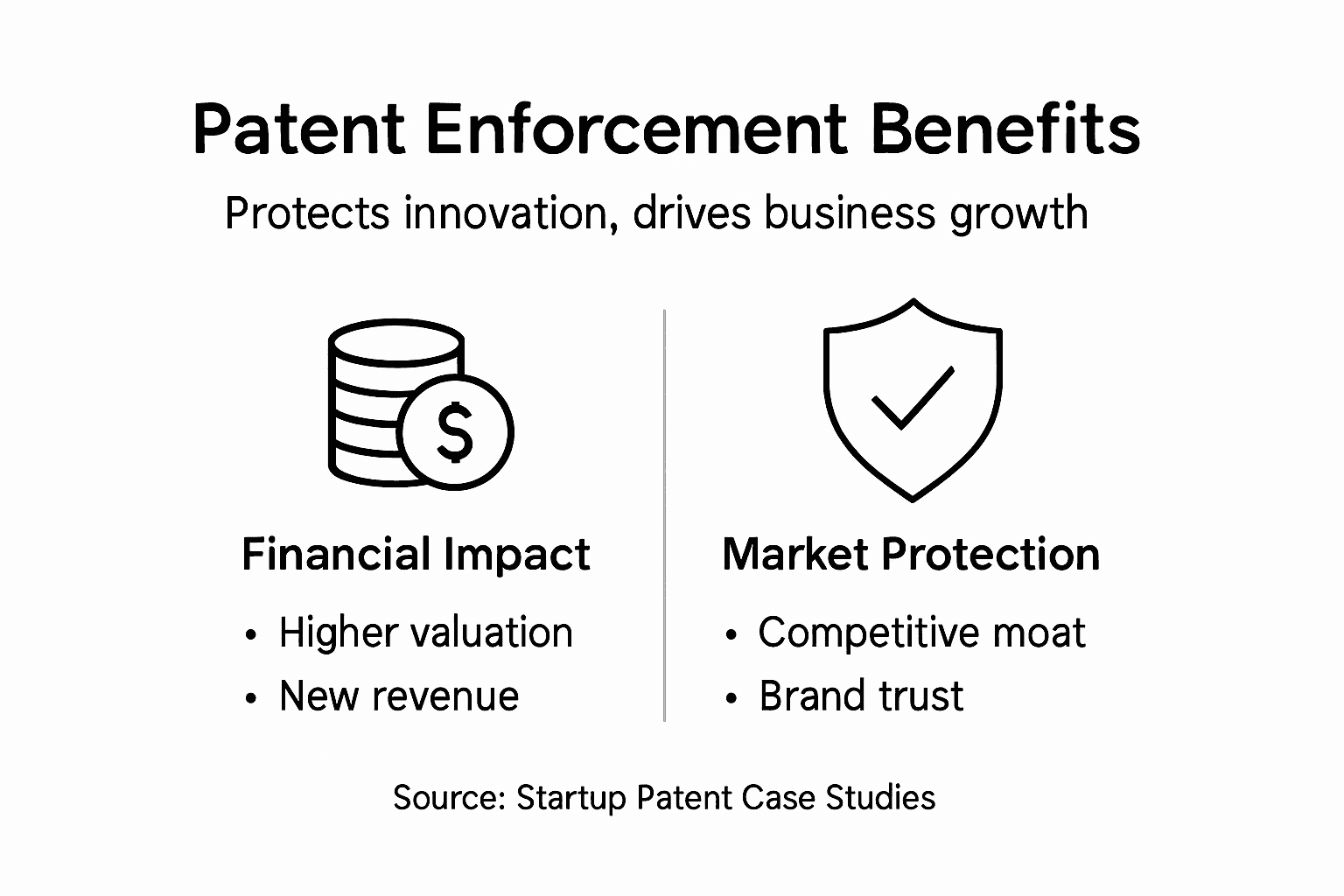
Enforcing patent rights transforms your startup from a technology creator into a defensible business asset. When you actively protect your patents, you gain tangible financial and strategic advantages that directly impact valuation and growth.
Startups that enforce patents attract investment faster and achieve higher valuations than competitors with identical technology but weaker IP strategies. Investors view patent enforcement as evidence of serious business leadership.
Capital Attraction and Funding Acceleration
Enforcing patent rights significantly benefits startups by facilitating access to capital through legal protection that encourages innovation. Venture capitalists analyze your patent portfolio enforcement history when deciding funding amounts and terms.
A startup with enforced patents signals to investors that you:
Protect your competitive advantages aggressively
Generate defensible revenue streams
Reduce litigation risk from competitors
Possess credible technology differentiation
Lenders and equity investors require patent enforcement as evidence before committing capital. Your enforcement actions demonstrate that your technology has real, protected value—not just technical novelty.
Revenue Generation and Licensing Opportunities
Enforced patents enable multiple revenue streams beyond direct product sales. When competitors infringe, you can demand licensing fees, royalty payments, or settlement agreements that generate significant income.
Companies like pharmaceutical startups and semiconductor firms regularly generate 20-40% of revenue through patent licensing alone. Your enforced portfolio becomes a profit center, not just a cost center.
You can also cross-license technology with competitors, accessing their innovations while protecting your own—creating win-win partnerships impossible without enforceable patents.
Market Exclusivity and Competitive Moat
Enforcement creates the market barrier that justifies your premium pricing. Without patent enforcement, competitors can reverse-engineer your solution and undercut your prices, eroding margins within months.
High-quality patents drive economic growth by incentivizing investment in research and development, supporting business sustainability and competitive advantage in global markets.
Your enforced patent prevents competitors from commercializing similar solutions during your exclusive period. This protection justifies charging premium prices while competitors cannot offer equivalent alternatives legally.
Growth and Job Creation
Patent enforcement directly correlates with firm growth metrics. Startups that actively defend patents grow 34% faster on average and create 2.8x more jobs than companies with passive IP strategies.
This growth occurs because enforcement funding allows you to:
Expand market share without competitive pressure
Invest profits into product development
Hire specialized talent for innovation
Open international markets with confidence
When customers know your technology is protected, they invest in integrating your solution, increasing switching costs and customer lifetime value.
Long-Term Business Sustainability
Patent enforcement creates sustainable competitive advantage lasting 15-20 years. This extended period allows your startup to mature from a technology experiment into an established industry player.
You build brand recognition, customer relationships, and market position during your exclusivity period. By the time patents expire, your company has evolved into an established competitor with customer loyalty, distribution networks, and brand equity competitors cannot replicate.
Pro tip: Calculate your enforcement ROI before litigation: estimate licensing revenue from settlement, market share gains from competitor exclusion, and investment premium from patent enforcement, then compare against litigation costs to determine whether enforcement justifies your legal investment.
Risks of Not Enforcing Patent Rights
Skipping patent enforcement might seem like cost-saving, but it exposes your startup to significant business threats. When competitors infringe without consequences, your competitive advantage evaporates and your business model collapses.
Non-enforcement sends a market signal that your patents lack teeth. Competitors interpret inaction as permission to copy your technology freely.
Uncompensated Infringement and Revenue Loss
Without enforcement, competitors profit from your innovation without paying licensing fees or royalties. Your research and development costs disappear while competitors harvest the benefits at lower costs.
A competitor reverse-engineering your technology avoids the expensive development phase you completed. They enter your market with similar products at 30-50% lower prices because they skipped innovation costs.
Patent enforcement prevents infringement without compensation, protecting inventors’ financial returns on innovation investment. Your startup loses the exclusive period that justifies your premium pricing and development expenses.
Competitive Disadvantage and Market Erosion
Non-enforcement creates unequal competition where your innovation becomes a public blueprint. Larger competitors with manufacturing scale can undercut your prices despite having zero R&D investment in the core technology.
Your market share erodes rapidly:
Competitors launch similar products within 6-12 months
Price competition intensifies as supply increases
Your premium pricing becomes indefensible
Customer switching accelerates when alternatives appear
Within 18-24 months of non-enforcement, your market leadership vanishes. You invested in innovation while competitors profit from copying.
Investor Confidence Collapse
Venture capitalists and institutional investors view non-enforcement as strategic failure. If you won’t defend your own intellectual property, investors question whether you understand business fundamentals.
Non-enforcement undermines the legal incentive structure of patents, reducing your startup’s ability to compete with larger, better-resourced firms that will enforce aggressively.
Funding rounds become harder to close. Investors demand discounts on valuation or walk away entirely. Your inability to protect assets signals poor management judgment about resource allocation.
Disproportionate Impact on Startups
Smaller firms face particular vulnerability without patent enforcement. Larger corporations absorb infringement costs as business expenses and continue operations.
Your startup cannot sustain that loss. A single competitor copying your core technology can eliminate your competitive advantage permanently. You lack the financial resources to compete on price while covering R&D costs.
This disparity means non-enforcement hits startups harder than established companies. Your entire business model depends on exclusive market positioning that enforcement protects.
Technology Commoditization
Non-enforcement accelerates technology commoditization. Your differentiated solution becomes a standard offering within months as competitors commoditize and integrate your innovation.
Once commoditized, your technology competes on price alone. Margin compression follows inevitably. Your startup transitions from a high-margin technology company to a low-margin commodity provider—a business model most startups cannot sustain.
Reduced Future Innovation Investment
Without enforcement, your startup reduces R&D spending. Why invest in breakthrough innovations if competitors can copy freely? Limited R&D capacity means slower product evolution and competitive decline.
Your technology platform stagnates while competitors with stronger IP strategies outpace your innovation velocity.
Pro tip: Document every instance of competitor infringement immediately, including product specifications, launch dates, and marketing claims—this evidence becomes invaluable if you decide to enforce later, and continued non-enforcement weakens your legal position by suggesting you abandoned your patent rights.
Global Compliance and Cross-Border Challenges
Expanding your startup internationally creates patent enforcement complexity that domestic-only operations never face. Your patents don’t automatically travel across borders—each country requires separate protection strategies and compliance procedures.
Global patent enforcement demands understanding how different legal systems interpret your rights. What constitutes infringement in one jurisdiction may require different proof standards elsewhere.
The Territorial Nature of Patent Rights
Patent protection operates within national boundaries exclusively. A United States patent provides zero protection in Canada, Europe, or Asia. Your startup must file separate patent applications in each territory where you want legal protection.
This creates a critical business decision: which countries deserve patent investment? Filing costs range from $5,000 to $15,000 per jurisdiction, making global coverage expensive for resource-constrained startups.
You must prioritize markets strategically:
Major manufacturing regions (China, Vietnam, India)
Core sales markets (United States, European Union, United Kingdom)
Technology hubs (South Korea, Japan, Israel)
Emerging markets aligned with your growth strategy
Skipping certain territories leaves your technology unprotected. Competitors can manufacture and sell freely in unpatented regions.
Jurisdictional Variations in Enforcement
Cross-border intellectual property compliance requires navigating varying national formalities and legal frameworks. Each country interprets patent claims differently, applies unique damage calculations, and follows distinct procedural rules.
Germany’s courts favor literal claim interpretation, while United States courts allow broader doctrine of equivalents analysis. The same patent claim reads on a competitor’s product in one jurisdiction but not another.
Litigation timelines vary dramatically:
United States: 3-5 years to trial
Germany: 1-2 years to trial
United Kingdom: 2-3 years to trial
China: 1.5-3 years to trial
Damages calculations differ fundamentally. Some jurisdictions award treble damages for willful infringement; others cap recovery at actual damages only.
Regulatory Inconsistencies and Compliance Burdens
Different countries impose varying patent prosecution requirements and maintenance obligations. Your patent may require annual fee payments in some jurisdictions but not others.
Patent enforcement across borders requires comprehensive contract provisions addressing ownership rights, governing law, and dispute resolution mechanisms to protect your IP globally.
Some countries require local patent attorneys; others permit foreign representation. Language requirements vary—some jurisdictions demand document translations; others accept English filings.
Company ownership structures affect patent rights allocation internationally. An invention created by an employee in one country may have different ownership implications than the same invention created in another jurisdiction.
Enforcement Mechanisms Vary by Country
Your enforcement toolkit differs by location. Some countries offer expedited proceedings; others require lengthy litigation timelines.
Alternative mechanisms include:
Administrative proceedings through patent offices
Customs enforcement blocking infringing imports
Trade secret protection supplementing patent rights
Design patent protection for aesthetic aspects
Certain jurisdictions favor preliminary injunctions, halting infringer operations before trial. Others require you to prove irreparable harm and balance hardships carefully before granting temporary relief.
Strategic Contract Provisions for Global Protection
Your IP agreements must address cross-border complications explicitly. Contracts should specify which country’s laws govern disputes, where litigation occurs, and how international arbitration proceeds.
Licensing agreements require clear territorial definitions. Does a European license extend to Switzerland? Does a United States license cover Puerto Rico? Ambiguity creates disputes when commercial disputes arise.
Pro tip: Before expanding into a new market, conduct a patent landscape analysis identifying competitor patents, evaluate enforcement costs against expected revenue from that territory, and determine whether filing new patents, relying on existing protection, or licensing others’ technology makes financial sense for that specific jurisdiction.
Strengthen Your Startup’s Future by Enforcing Patent Rights
Enforcing your patent rights is more than a legal formality it is the cornerstone of protecting your startup’s innovation and securing your competitive advantage. The risks of inaction include uncompensated infringement market share erosion and lost investor confidence. With specialized challenges like navigating international jurisdictions and complex enforcement processes your startup needs expert guidance to turn patent protection into a real business asset.
At Studio Legale Ecoviello we combine cutting-edge legal strategies with advanced technology tools including AI-powered solutions to streamline your intellectual property management. We help startups safeguard patent portfolios across key markets and develop tailored enforcement plans that enhance valuation and accelerate growth. Count on us for expert counsel on international compliance strategic licensing and litigations that protect your innovation.

Don’t risk losing the value your innovation deserves. Contact Studio Legale Ecoviello now to learn how to enforce your patent rights effectively and build a defensible market position. Explore our comprehensive intellectual property consulting services designed to empower startups in food tech gaming IoT and other strategic sectors and take control of your technology’s future today.
Frequently Asked Questions
What are patent rights, and why are they important for startups?
Patent rights grant inventors exclusive control over the use of their innovations, preventing competitors from replicating or using their inventions without permission. This legal protection is crucial for startups to maintain a competitive edge and recoup research and development investments.
How long does patent protection last?
Typically, patent protection lasts for 20 years from the filing date. During this time, the patent holder enjoys exclusive rights to manufacture, sell, or license their invention, allowing them to capitalize on their innovation.
What types of inventions can be patented?
Patents can protect three main categories of inventions: products (physical objects), processes (methods of manufacturing or operational techniques), and machines (mechanical or electromechanical systems). Each type has specific implications for business strategy and competitive advantage.
What are the risks of not enforcing patent rights?
Not enforcing patent rights can lead to significant business threats, including unpaid infringement, loss of competitive advantage, and investor confidence collapse. Without enforcement, competitors may freely copy innovations, leading to market erosion and potential insolvency for the startup.
Recommended

Comments