


Why Register a Copyright: Protecting Tech Innovations

Launching a technology startup often means investing years in crafting software, digital design, and new algorithms that set your business apart. Protecting this creative work from copycats and misunderstanding is critical for Italian and international entrepreneurs aiming to compete globally. Copyright law does not just shield your original ideas but gives you powerful rights automatically upon creation, according to European Union and United States regulations. This guide highlights how robust copyright protection strengthens your position and clarifies common misconceptions that can put your intellectual assets at risk.
Table of Contents
Key Takeaways
Point | Details |
Understanding Copyright | Copyright protects original works, providing automatic rights upon creation, making registration beneficial but not mandatory. |
Broader Scope of Protection | Copyright extends to digital assets such as software and multimedia, not just traditional artworks. |
Exclusive Rights & Business Value | Registration offers exclusive rights that enhance legal control and monetization opportunities for entrepreneurs. |
Risks of Non-Registration | Failing to register exposes creators to legal challenges, financial losses, and competitive disadvantages. |
Defining Copyright and Key Misconceptions
Copyright represents a critical legal mechanism for protecting original creative works, particularly in the rapidly evolving technology sector. At its core, copyright law safeguards the unique expression of ideas, providing creators exclusive rights to their intellectual property. Understanding copyright fundamentals is essential for tech entrepreneurs seeking to protect their digital innovations.
The fundamental purpose of copyright extends beyond mere legal protection - it represents a framework that encourages creativity by ensuring creators can benefit from their original works. Copyright covers a diverse range of intellectual assets including:
Software code and applications
Digital design elements
Technical documentation
Multimedia presentations
Unique algorithmic solutions
Contrary to popular misconception, copyright protection is not a complex bureaucratic process. Intellectual property rights are automatically established upon the creation of an original work, though formal registration can provide additional legal advantages. The key distinction lies in protecting the specific expression of an idea, not the idea itself.
Most technology entrepreneurs misunderstand several critical aspects of copyright. The most prevalent misconceptions include believing that:
Here’s a comparison of common copyright misconceptions with the actual legal realities faced by tech entrepreneurs:
Misconception | Legal Reality | Business Impact |
Registration is required | Protection is automatic upon creation | May overlook automatic rights |
Ideas can be copyrighted | Only expressions are protected | Risks exposing concepts |
Limited to traditional works | Covers digital, software, and multimedia | Missed protection for innovations |
Laws are globally uniform | Jurisdictions vary widely | Complex global strategies needed |
Copyright requires formal registration to be valid
Ideas themselves can be copyrighted
Copyright protection is limited to traditional creative works
International copyright laws are uniform across jurisdictions
Pro tip: Always document the creation process and maintain clear records of your original work to strengthen potential copyright claims.
Types of Works Eligible for Copyright
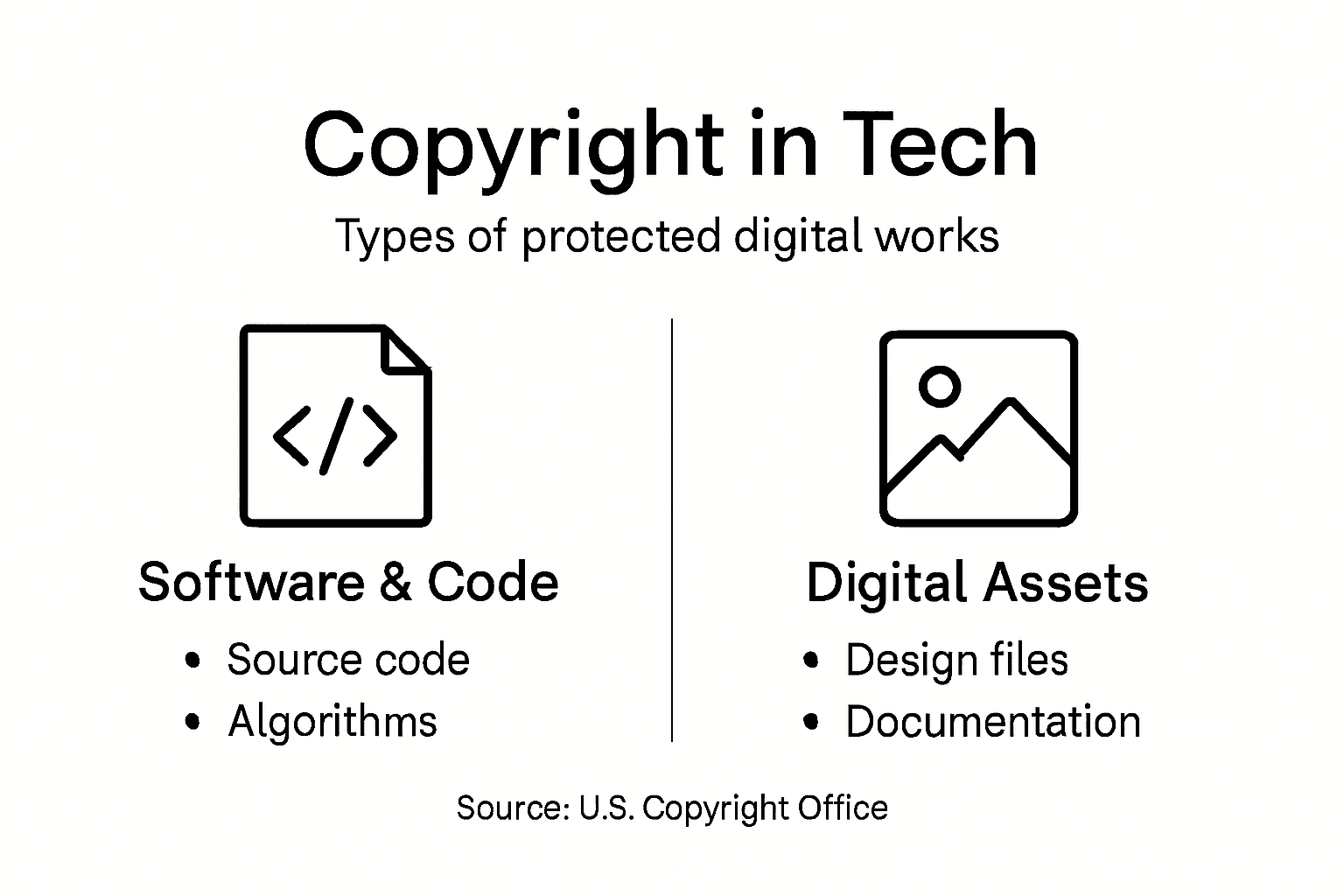
In the digital age, copyright protection extends far beyond traditional creative works, encompassing a wide range of intellectual assets critical for technology entrepreneurs. Copyright registration categories provide a comprehensive framework for protecting various forms of creative expression in the technological landscape.
The U.S. Copyright Office recognizes several broad categories of works eligible for copyright protection, each tailored to capture the unique nuances of creative and technological output:
Literary Works
Computer software and programming code
Technical documentation
Databases and digital compilations
Technical manuals and specifications
Visual Arts
Digital graphics and design elements
User interface designs
Technical illustrations
Architectural drawings
Multimedia visual content
Performing Arts
Interactive digital performances
Choreographed software interactions
User experience design sequences
Audiovisual Works
Software demonstration videos
Digital animation
Instructional and training multimedia
Screen recordings and software walkthroughs
Technology startups often misunderstand the breadth of works that can receive copyright protection. Intellectual property is not limited to traditional artistic creations but encompasses innovative digital assets that represent original creative expression. The key requirement is that the work must be an original creation fixed in a tangible medium, which in modern contexts includes digital formats.
Copyright protection covers the specific expression of an idea, not the underlying concept itself. This critical distinction allows innovators to protect their unique implementation while keeping fundamental ideas accessible.
Understanding these categories is crucial for tech entrepreneurs seeking to safeguard their intellectual assets. While some works might overlap multiple categories, each represents a distinct avenue for legal protection of creative digital innovations.
Pro tip: Document the creation process of your digital works comprehensively, including dates, versions, and development stages to strengthen potential copyright claims.
Legal Framework Governing Copyright Registration
Navigating the complex landscape of copyright protection requires a nuanced understanding of the legal frameworks that govern intellectual property rights. Copyright legislation mechanisms provide a comprehensive structure designed to protect creators’ rights while fostering technological innovation.
The legal framework for copyright registration encompasses multiple critical components that technology entrepreneurs must understand:
International Agreements
Berne Convention
WIPO Copyright Treaty
TRIPS Agreement
National Legislation
United States Copyright Act
European Union Copyright Directives
Country-specific intellectual property laws
Registration Procedures
Documentation requirements
Proof of original creation
Filing processes and timelines
Associated legal protections
Intellectual property law establishes a complex ecosystem of rights that extend beyond simple ownership. These legal frameworks are designed to balance the interests of creators with broader societal needs for innovation and knowledge sharing. Technology startups must recognize that copyright protection is not just a legal formality but a strategic asset that can provide significant competitive advantages.
Copyright laws are dynamic, constantly evolving to address emerging technological challenges and protect innovative digital creations across global jurisdictions.
Different jurisdictions maintain unique approaches to copyright registration, with variations in protection duration, scope, and enforcement mechanisms. Multinational technology companies must navigate these nuanced legal landscapes carefully, understanding that copyright protection is not uniform across borders.
Pro tip: Consult with intellectual property specialists who understand international copyright regulations to develop a comprehensive protection strategy for your digital innovations.
Exclusive Rights Provided by Registration
Copyright registration transforms intellectual property from a conceptual asset into a legally defensible resource, providing technology entrepreneurs with a powerful toolkit of exclusive rights. Copyright protection mechanisms offer creators comprehensive legal safeguards that extend far beyond basic ownership.

The exclusive rights granted through copyright registration encompass several critical dimensions:
The following table summarizes the exclusive business rights gained through copyright registration:
Exclusive Right | Description | Startup Benefit |
Reproduction | Control over copying and duplication | Prevents unauthorized distribution |
Distribution | Authority to share/sell works | Enables revenue collection |
Derivative Creation | Rights to adaptations or updates | Supports innovation and expansion |
Performance/Display | Rights for public and digital use | Enables marketing and outreach |
Reproduction Rights
Exact digital replication
Partial or complete copying
Reproduction across different platforms
Distribution Rights
Physical distribution
Digital transmission
Commercial and non-commercial sharing
Derivative Work Rights
Creating adaptations
Transforming original content
Developing new iterations
Performance and Display Rights
Public demonstrations
Digital presentations
Commercial and educational exhibitions
Intellectual property law empowers creators with the ability to control how their work is used, shared, and monetized. These exclusive rights provide a legal shield that prevents unauthorized exploitation and enables strategic licensing opportunities for technology innovators.
Copyright registration transforms intellectual property from a vulnerable concept into a legally enforceable asset, giving creators unprecedented control over their digital innovations.
Technology startups should recognize that copyright registration is not merely a bureaucratic process, but a strategic mechanism for protecting and potentially monetizing their creative output. The legal presumptions established through registration can significantly enhance a company’s ability to defend its intellectual assets in potential litigation scenarios.
Pro tip: Maintain comprehensive documentation of your work’s creation process, including drafts, versions, and development timelines to strengthen your copyright registration claims.
Business and Financial Advantages for Entrepreneurs
For technology entrepreneurs, copyright registration represents far more than a legal formality - it’s a strategic business asset that unlocks significant financial opportunities. Copyright registration benefits provide a robust framework for protecting and monetizing intellectual innovations.
The financial advantages of copyright registration span multiple critical dimensions:
Revenue Generation
Licensing income streams
Royalty agreements
Potential sale of intellectual property rights
Investment Attractiveness
Demonstrates legal sophistication
Increases company valuation
Signals professional intellectual asset management
Competitive Positioning
Legal credibility
Enhanced market differentiation
Protection against unauthorized use
Financial Risk Mitigation
Legal recourse for infringement
Potential statutory damage claims
Preventative legal protection
Intellectual property management transforms creative works into quantifiable financial assets. By establishing clear ownership and usage rights, entrepreneurs can strategically leverage their innovations as tradable commodities in the global marketplace.
Copyright registration converts intellectual creativity into a measurable economic instrument, enabling entrepreneurs to monetize their digital innovations with legal precision.
Beyond immediate financial benefits, copyright registration provides technology startups with a competitive edge. It signals to potential investors, partners, and customers that the organization takes its intellectual assets seriously and has implemented robust protection mechanisms.
Pro tip: Develop a comprehensive intellectual property strategy that views copyright registration as an ongoing investment in your company’s long-term financial potential.
Risks of Non-Registration and Common Pitfalls
Navigating the complex landscape of intellectual property protection demands a proactive approach, as failing to register copyrights can expose technology entrepreneurs to significant vulnerabilities. Research documentation risks highlight the critical importance of maintaining comprehensive legal safeguards for creative works.
Technology startups frequently encounter several high-stakes risks associated with copyright non-registration:
Legal Vulnerabilities
Limited infringement lawsuit options
Reduced legal credibility
Difficulty proving ownership
Financial Exposure
Inability to claim statutory damages
Restricted licensing potential
Diminished asset valuation
Competitive Disadvantages
Easier intellectual property theft
Reduced market positioning
Limited negotiation leverage
Reputational Consequences
Perceived lack of professionalism
Reduced investor confidence
Potential stakeholder distrust
Intellectual property management requires deliberate, strategic documentation to protect innovative digital assets. Entrepreneurs who neglect proper registration create significant vulnerabilities that can undermine their long-term business objectives.
Non-registration transforms valuable intellectual assets into vulnerable, unprotected concepts that can be easily appropriated by competitors.
Many technology entrepreneurs mistakenly believe that copyright protection is automatic and does not require formal registration. This misconception can lead to catastrophic legal and financial consequences, potentially destroying years of innovative work and significant financial investments.
Pro tip: Treat copyright registration as a critical business process, not an optional administrative task, and consistently document your creative development journey.
Secure Your Tech Innovations with Expert Copyright Protection
The challenge of safeguarding original digital creations is vital for technology entrepreneurs who want to avoid legal risks and maximize financial opportunities. Copyright registration grants exclusive rights that protect software, designs, documentation, and multimedia content from unauthorized use. This article highlights common pitfalls and critical legal realities that innovators must understand to defend their intellectual property effectively.
Don’t leave your innovations exposed to infringement or lost revenue. At Studio Legale Coviello, we specialize in intellectual property law and provide tailored legal and technical consulting to help you enforce your copyright protections worldwide. Through advanced strategies and cutting-edge digital tools, including AI-powered services, we empower startups to document, register, and monetize creative assets confidently.
Leverage our expertise in intellectual property management to transform your creations into valuable business assets.

Take control of your technology innovations today. Visit Studio Legale Coviello to explore how our solutions can streamline your copyright registration process, strengthen your legal position, and boost your competitive edge in global markets.
Frequently Asked Questions
What is copyright, and why is it important for tech innovations?
Copyright is a legal mechanism that protects original creative works, including software, digital designs, and algorithms. It ensures that creators maintain exclusive rights to their intellectual property, encouraging innovation and creativity in technology.
Do I need to formally register my copyright to be protected?
No, copyright protection is automatic upon the creation of an original work. However, formal registration can provide additional legal advantages, such as easier enforcement of rights in case of infringement.
What types of works are eligible for copyright protection in the tech industry?
Eligible works include literary works like software code and technical documentation, visual arts such as digital designs, audiovisual works like software demonstration videos, and other digital multimedia content.
What are the risks of not registering a copyright for my tech innovations?
Failing to register a copyright can lead to significant legal vulnerabilities, including limited options for suing for infringement, difficulty proving ownership, and diminished financial value of your intellectual assets.
Recommended

Comments