


Why Register a Design: Protecting Market Value

Building a tech startup in Italy or the United States introduces fierce competition over product aesthetics. Protecting visual innovation through design registration gives you exclusive rights, helping guard your creative work from unauthorized use. Founders who grasp the difference between patents, trademarks, and registered designs stay ahead by preserving their brand’s distinctiveness and securing legal tools for rapid growth. This guide clarifies key concepts so your design strategy creates business value and strengthens protection in global markets.
Table of Contents
Key Takeaways
Point | Details |
Understand Design Registration | It protects the visual elements of a product, providing exclusive rights against unauthorized use. |
Prioritize Novelty and Originality | Ensure designs are both new and independently created to qualify for registration. |
Leverage Legal Protections | Utilize enforcement tools like cease and desist letters to safeguard your registered designs against infringement. |
Assess Financial Commitment | Evaluate registration costs and ongoing maintenance before proceeding to ensure it aligns with business strategy. |
Defining Design Registration and Key Concepts
Design registration protects the visual appearance of a product or object. It grants exclusive legal rights to prevent others from using your registered design without permission, making it a cornerstone of intellectual property strategy for tech startups.
A design refers to the ornamental or aesthetic features of an object. This includes:
Shape and form of a product
Color schemes and patterns
Surface textures and finishes
Packaging design elements
Combination of visual characteristics
Design registration differs fundamentally from patents and trademarks. While patents protect functionality, design registration protects visual design elements that are new and original. This distinction matters when developing innovative tech products where aesthetics drive market differentiation.
Design registration creates exclusive rights based on visual novelty alone, not technical innovation or brand identity.
For startup founders, understanding key concepts is essential before filing:
Novelty means your design hasn’t been publicly disclosed before filing. Registration in major markets requires this basic standard.
Originality requires that the design results from independent creative effort. Copying existing designs invalidates protection, even if you modify them slightly.
Visual distinctiveness separates your design from commonplace products. Generic shapes typically fail registration; unique design choices succeed.
Protection scope varies globally. The European Union offers strong design protection through unified registration, while securing design rights for global markets requires understanding jurisdiction-specific requirements. United States, Japanese, and Chinese design systems each contain unique criteria and filing procedures.
Tech founders often overlook design registration because it feels secondary to patent protection. This mistake costs millions. A distinctive design creates instant market recognition—think smartphone silhouettes or gaming device aesthetics—that consumers protect through loyalty.
Design registration applies to physical products and their digital representations. If your startup develops hardware with distinctive visual characteristics, protection becomes urgent before competitors reverse engineer your aesthetic innovations.
The registration timeline varies by jurisdiction, typically ranging from three months to two years for approval. Filing before product launch ensures protection from day one, preventing competitors from copying your design during critical market entry phases.
Pro tip: File design registrations in your primary target markets before announcing product launches; competitors monitor patent and design filings closely, and early registration prevents them from filing similar designs and creating legal complications.
Types of Designs Eligible for Registration
Not every visual element qualifies for design registration. Understanding which designs meet eligibility criteria prevents wasted filing efforts and protects your budget for registrations that actually work.
Designs must meet specific requirements to gain protection:
New and original — The design cannot exist in identical form in public records before filing
Distinctive visual character — It must differ meaningfully from existing designs in your industry
Ornamental or aesthetic focus — Purely functional designs typically fail registration
Capable of industrial application — The design must be reproducible on actual products
Two-dimensional designs qualify for registration. Logos, patterns, graphic layouts, and surface decorations all receive protection. Your app interface design, if sufficiently distinctive, can qualify. The key is visual originality that distinguishes your product from competitors.
Three-dimensional designs are equally eligible. Product shapes, packaging forms, and structural configurations protect through design registration. Tech hardware—smartphone casings, smartwatch forms, gaming controller curves—all represent three-dimensional designs that deserve protection.
Combinations of two-dimensional and three-dimensional elements create the strongest registrations, as they offer broader protection than single-category designs.
Color designs deserve attention from startups. A specific color scheme applied to product packaging or device exteriors can register as a standalone design. Apple’s approach to product color distinctiveness demonstrates this strategy’s market value.
There are important exclusions from design registration:
Purely functional designs (function alone cannot drive protection)
Designs that violate public policy or morality standards
Designs consisting only of technical features without ornamental value
Works primarily protected by copyright (though some jurisdictions permit parallel protection)
Registering industrial designs for global protection requires understanding these distinctions across different markets. The European Union, United States, and other major jurisdictions define eligibility slightly differently. A design acceptable in one market might face rejection in another.
Multiple filings often make sense. Your gaming console design might register internationally, while your software interface design requires separate jurisdiction-specific evaluation. Strategic filing protects your most distinctive visual assets.
Timing matters significantly. File before public disclosure of your design through product launches, trade shows, or online announcements. Once disclosed, most jurisdictions give you limited grace periods—typically 6 to 12 months—before public disclosure invalidates novelty requirements.
Pro tip: Conduct design searches in your target markets before filing to identify conflicting designs; this prevents costly rejections and reveals design strategy opportunities your competitors may have overlooked.
Legal Protections and Enforcement Mechanisms
Design registration creates enforceable legal rights. Without understanding the enforcement tools available, your registration becomes merely symbolic—protecting nothing against determined competitors.
Once registered, you hold exclusive rights that prevent others from copying your design. These rights are not suggestions; they carry legal weight backed by court systems across jurisdictions.

In the United States, design patents grant exclusive rights to prevent others from making, using, offering for sale, or selling the design without permission. This framework applies equally to European Community designs, WIPO designs, and national registrations in other countries.
Your enforcement toolkit includes:
Cease and desist letters — Formal legal notices demanding competitors stop infringing
Administrative opposition — Challenging competitor filings before they register
Litigation and injunctions — Court orders forcing infringers to halt production
Damages recovery — Financial compensation for lost market share and profits
Border enforcement — Customs agencies seizing counterfeit products at ports
Enforcement begins with monitoring. Watch competitor product launches, trade show announcements, and online marketplaces. Early detection of infringement gives you negotiating leverage before costs escalate.
Most infringement disputes settle before reaching trial; early cease and desist letters often resolve violations cost-effectively.
Injunctions represent your most powerful enforcement tool. Courts can order immediate cessation of infringing activities, preventing competitors from profiting during lengthy litigation. This remedy protects your first-mover advantage in critical market windows.
Damages vary by jurisdiction and circumstance. Some regions award compensatory damages (actual losses), while others permit enhanced damages for willful infringement. Italian and European courts typically assess damages based on reasonable licensing fees or lost profits.
Administrative procedures offer faster alternatives to litigation. Opposition proceedings at the European Union Intellectual Property Office or national design offices resolve conflicts months faster than courts, reducing legal costs by 60 to 70 percent.
International enforcement requires strategic filing. A design registered only in Italy faces challenges enforcing against German manufacturers. Register in markets where you sell products or where competitors operate.
Digital enforcement has grown critical. Marketplace monitoring, social media tracking, and e-commerce platform reporting mechanisms identify counterfeiters rapidly. Professional IP management tools accelerate detection of unauthorized copies.
Pro tip: Document every infringement instance with screenshots, purchase records, and market data before contacting legal counsel; this evidence strengthens settlement negotiations and reduces litigation costs substantially.
Business Advantages of Registered Designs
Registered designs transform your intellectual property into competitive weapons. They move beyond legal protection into territory that directly impacts revenue, market position, and company valuation.
Your first advantage is market exclusivity. Competitors cannot legally copy your design for years—typically 15 to 25 years depending on jurisdiction. This exclusivity window gives you time to establish brand recognition, build customer loyalty, and capture market share before knockoffs appear.
Design registration provides legal protection maintaining brand identity and market position. This prevents competitors from copying or imitating your designs, which safeguards your investment and enhances consumer trust in your brand.
Registered designs create measurable business benefits:
Increased licensing revenue — License your designs to manufacturers in new markets or industries
Higher company valuation — Design portfolios add significant intangible asset value during investment rounds or acquisitions
Barrier to entry — Your registrations prevent competitors from entering markets you’ve established
Marketing strength — “Patented design” and “registered design” labels boost consumer perception of quality
Negotiating leverage — Design registrations strengthen your position in partnership and licensing discussions
Consider how registration affects investor perception. Venture capitalists and acquirers evaluate design portfolios as assets. A startup with 15 registered designs in key markets appears far more valuable than an identical competitor with zero registrations.
Registered designs can increase a design’s commercial value and provide licensing opportunities that directly support business growth.
Brand confidence grows with registration. Customers perceive registered designs as protected innovations worthy of premium pricing. Your marketing team can highlight design registrations in campaigns, positioning your products as legally protected originals.
Employee confidence also strengthens. Your team works harder when they know their design innovations receive legal protection. Retention improves when designers see their work registered globally.
Operational advantages emerge quickly. Nationwide legal protection and exclusive rights reduce the risk of others using similar designs in commerce, which protects brand value and prevents consumer confusion.
Licensing becomes profitable. Rather than manufacturing products globally yourself, license your registered designs to regional manufacturers. This generates passive income with minimal operational overhead. Gaming companies and fashion brands successfully use this model, earning 5 to 15 percent of licensee revenues.
Competitor litigation costs shrink. When you hold registered designs, cease and desist letters often resolve disputes without courtroom battles. Competitors recognize the strength of your registration and settle quickly.
Below is a summary of business benefits gained from registering your design:
Benefit | How It Impacts Business | Who Gains |
Market Exclusivity | Competitors blocked for years | Founders, investors |
Licensing Revenue | Enables new income streams | IP holders |
Brand Protection | Safeguards identity, loyalty | Marketing team |
Higher Valuation | Adds asset value for deals | Owners, acquirers |
Negotiation Leverage | Improves partnerships, deals | Legal, business teams |
Resale value increases substantially. If you eventually sell your company, registered design portfolios command premium valuations—sometimes adding 20 to 40 percent to acquisition prices.
Pro tip: Build a design registration strategy before launching products; register in markets where you currently sell or plan to enter within two years, prioritizing markets with the highest competitive intensity and largest customer bases.
Risks, Costs, and Alternatives Compared
Design registration demands careful financial and strategic evaluation. The benefits are real, but costs and risks require honest assessment before committing resources.
Registration costs vary significantly by jurisdiction and complexity. Expect to spend between 500 and 3,000 euros per design for professional filing, including attorney fees and application costs. Multiple jurisdictions multiply these expenses rapidly—registering one design in five markets costs 2,500 to 15,000 euros.
Maintenance obligations create ongoing expenses. European Community designs require renewal fees every five years to maintain protection. United States design patents require periodic maintenance fees. These recurring costs accumulate over the protection period.
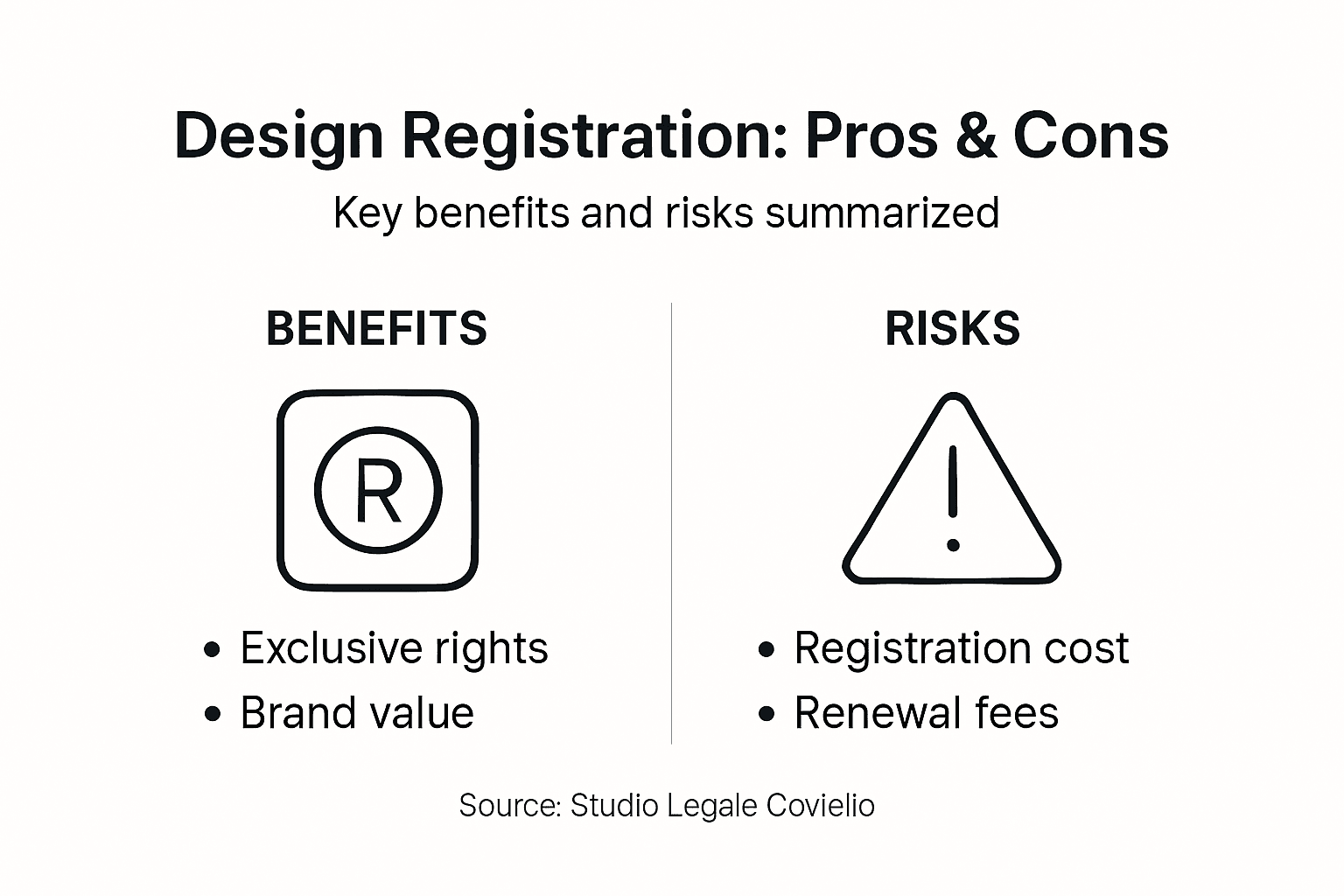
Design patent protection involves application fees and attorney costs, plus potential litigation expenses if enforcement becomes necessary. Defending a design infringement case costs 50,000 to 300,000 euros depending on complexity and jurisdiction. Not all startups can absorb these legal bills.
Key financial risks include:
Here’s a quick comparison of protected and unprotected design rights for startups:
Aspect | Registered Design | Unregistered Right | Trade Secret | Copyright |
Legal Scope | Strong, enforceable in court | Limited, tougher to enforce | Only protects kept secrets | Covers artistic design representation |
Cost | Registration fees, renewals | No filing cost | No official cost | No filing cost |
Duration | 15-25 years | 3-10 years (varies) | Indefinite while secret | Life of creator + decades |
Application | Physical and digital products | Often physical, digital varies | Manufacturing processes | Graphic, artistic work |
Risk | Rejection, enforcement cost | Easy expiration, weak in disputes | Lost if disclosed | Limited product protection |
Application rejection — Designs failing novelty or distinctiveness standards waste filing fees entirely
Narrow protection scope — Only ornamental aspects receive protection, not functional features
Limited duration — Protection expires (typically 15 to 25 years), allowing competitors to copy freely
Enforcement costs — Litigation expenses often exceed the design’s commercial value
Invalidity challenges — Competitors can attack registrations through opposition proceedings
Protection limitations matter significantly. Design registration protects visual appearance only, not the underlying concept or function. A competitor can create a functionally superior design that looks different and avoid infringement entirely.
Limited protection duration means your exclusive advantage eventually disappears; plan accordingly by building brand loyalty before expiration.
Alternatives exist and sometimes make financial sense. Unregistered design rights provide automatic protection in many jurisdictions without filing costs—ideal for designs you plan to keep confidential.
Trade secrets offer indefinite protection if you prevent disclosure. Keep proprietary design documentation confidential, restrict employee access, and use confidentiality agreements. This costs nothing but fails if competitors reverse engineer your design.
Copyright protection covers design drawings and digital representations automatically. This costs zero but protects the creative expression, not the product itself. Copyright fails when competitors create original designs inspired by your work.
Trademarks protect brand recognition associated with specific designs. A distinctive logo or color scheme qualifies for trademark protection, offering longer duration than design registration. However, trademark protection narrows to brand elements specifically.
First-to-market advantage provides protection without legal registration. Launch quickly, establish brand loyalty, build distribution networks, and create barriers through supply chain relationships. Competitors face time and resource disadvantages even without design registrations.
Comparison of approaches:
Design registration: Moderate cost, 15-25 year protection, requires enforcement
Unregistered rights: Zero cost, automatic protection, weaker in disputes
Trade secrets: Zero cost, indefinite duration, lost if disclosed
Copyright: Zero cost, limited scope, automatic protection
First-to-market: Variable cost, unlimited duration, relies on market dominance
Smartup founders often combine approaches. Register your most distinctive, commercially valuable designs in key markets. Use trade secrets for proprietary manufacturing processes. Leverage trademark protection for brand elements. Build first-mover advantages through rapid innovation cycles.
Pro tip: Calculate the lifetime enforcement cost before filing; if defending a design infringement exceeds 10 times your annual design revenue, consider unregistered protection or trade secrets instead of formal registration.
Secure Your Design to Protect Market Value and Strengthen Your Brand
Registering a design is more than securing exclusive rights to your product’s unique appearance. It is about preserving your market advantage and preventing costly infringement that can damage your brand identity and revenue. The challenge many startups face is navigating the complex legal landscape of design registration across different jurisdictions while managing expenses and enforcement risks. Understanding concepts like novelty, visual distinctiveness, and enforcement mechanisms is critical to transforming your designs into valuable business assets.
Take control of your intellectual property with expert guidance from Studio Legale Coviello. Our team specializes in international intellectual property law, blending legal expertise with cutting-edge technologies such as AI-driven tools and mobile app solutions for IP management. Whether you need strategic advice on filing design registrations or robust enforcement support tailored to your market, we offer personalized solutions that protect your designs globally. Start securing your competitive edge today by visiting Studio Legale Coviello and discover how our services can safeguard and maximize your intellectual assets.
Frequently Asked Questions
What is design registration?
Design registration protects the visual appearance of a product, granting legal rights to prevent others from using your registered design without permission.
Why is it important for startups to register their designs?
Registering designs provides market exclusivity, protects brand identity, and enhances valuation, helping startups establish a competitive advantage and build customer loyalty.
What are the key requirements for a design to be eligible for registration?
A design must be new, original, visually distinctive, ornamental or aesthetic in focus, and capable of industrial application to qualify for registration.
How long does design registration protection last?
Design registration typically provides protection for 15 to 25 years, depending on the jurisdiction, allowing creators to maintain exclusive rights during that period.
Recommended

Comments